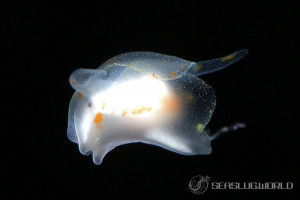
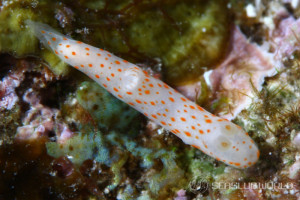
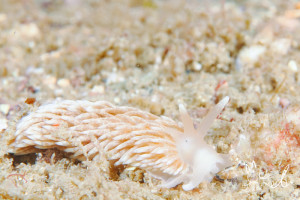
Gastropteron multo Ong & Gosliner, 2017
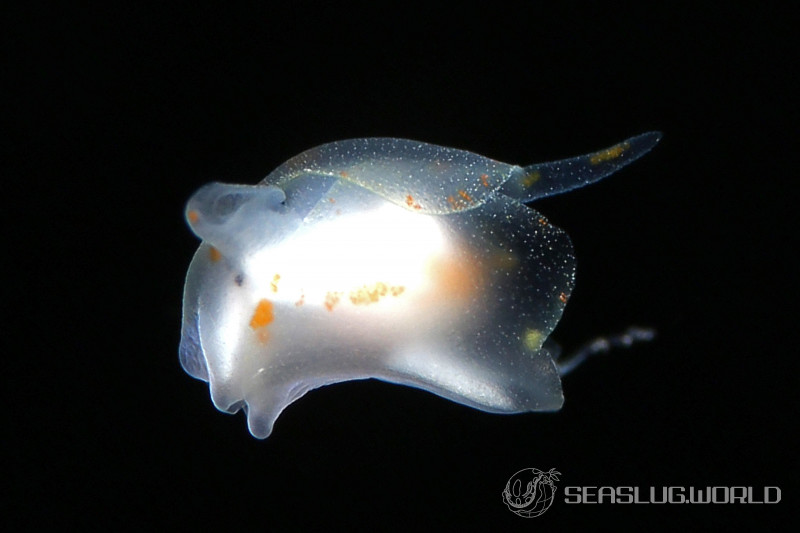
- Location
- Shiosaki Out Coral, Okinawa Island (Chatan and Southern area), Okinawa, Japan
- Date
- 2021/05/27
- Length
- 7mm
- Depth
- 5.0m
- Water temperature
- 26.0℃
Description
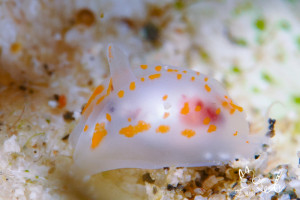
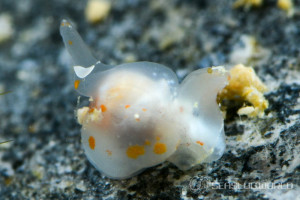
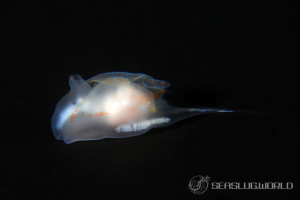
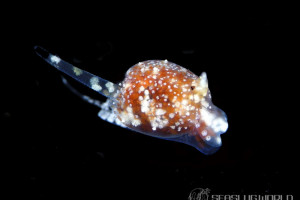
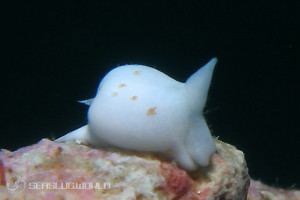
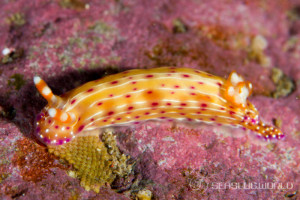
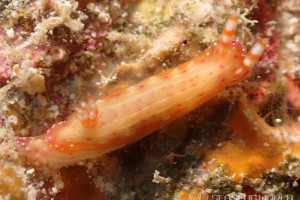
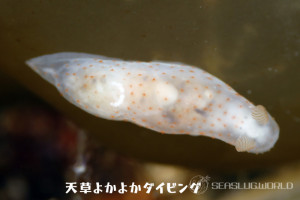
A gastropterid 7–20 mm in length. Colour clear to translucent white with fine orange, brown and white dots speckling the body, or with series of brownish and orange patches. Opaque white digestive gland and ovotestis are visible through the visceral hump. Head shield, parapodia, flagella and foot are translucent whitish. Small orange dots or brown patches cover the body, concentrated on the siphon and flagella.A dorsal flagellum is centred on the midline of the visceral hump. Immediately ventral to this flagellum is a second, slightly wider flagellar process, either longer or shorter than the dorsal one. White spots outline the visceral hump and parapodia. The head shield is shaped roughly like a cauldron, broadest anteriorly, narrowing and then broadening again posteriorly. The head shield terminates in a tubular, simple siphon, lacking a mid-dorsal ridge. Broad parapodia cover the body when the animal is actively crawling. Foot elongate with long, acutely pointed posterior extension. Gill with nine primary folds.
The shell is thinly calcified, slightly dorsal plate, 2 mm in length. Part of the shell appears decalcified. The radular formula is 25 × (5·1·0·1·5) in one specimen (NMP 041181). Inner lateral teeth broad with single primary cusp. Masticatory margin of inner laterals containing 3–16 irregularly pointed denticles on inner edge of masticatory margin. Both species have a simple penis, but the prostate is much shorter than in G. bicornutum.
Distribution
Type locality: Mainit Bubbles, Mabini, Batangas, Luzon, Philippines. Thus far, known only from the Philippines.Etymology
Verbatim from the original description (Ong et al., 2017, p.763):The species epithet, multo, is derived from Tagalog word for ghost, owing to the pale ghostly appearance of this species.
Remarks
Originally described as Gastropteron multo Ong & Gosliner, 2017. This species corresponds to specimens previously figured as Gastropteron sp. 3 (Gosliner, Valdés & Behrens, 2015).The translucent white body colour with orange spots and brown patches clearly differentiates this species from other congeners. Phylogenetically, G. multo is sister to Gastropteron bicornutum Baba & Tokioka, 1965, the only Pacific species with an elongate foot extension. They differ in: (1) G. multo has only the dorsal flagellum prominent and a long, acutely pointed posterior foot extension, whereas G. bicornutum has two prominent dorsal and ventral flagella and a short, triangular posterior foot extension; (2) G. bicornutum has black and yellow spots over the dorsal surface, which are absent in G. multo; (3) the inner lateral radular teeth of G. multo have fewer denticles restricted to the outer edge of the masticatory border, whereas they are evenly distributed in G. bicornutum; and (4) the prostate is much shorter in G. multo. The two species differ by more than 22 % in their COI gene.
References
- Gastropteron sp. 3, Terrence Gosliner, Ángel Valdés and David Behrens. (2015). Nudibranch and Sea Slug Identification Indo-Pacific. New World Pubns Inc.
- Gastropteron multo sp. nov., Ong E., Hallas J.M. & Gosliner T.M. (2017). Like a bat out of heaven: the phylogeny and diversity of the bat-winged slugs (Heterobranchia: Gastropteridae). Zoological Journal of the Linnean Society. 180(4): 755-789. https://doi.org/10.1093/zoolinnean/zlw018
- ハゴロモウミコチョウ(新称)?, 中野理枝. (2018). 日本のウミウシ. 文一総合出版.
Featured in this book
Terrence Gosliner, Ángel Valdés and David Behrens. (2018). Nudibranch and Sea Slug Identification Indo-Pacific 2nd Edition. New World Pubns Inc.
New World Publications
This species, Gastropteron multo, is included in the book.
View on Amazon PR (Amazon Associates)Seasonality
Shooting Locations
Loading shooting locations...
Photos of Gastropteron multo





Same Genus Nudibranchs
Similar Colors Nudibranchs

Academic Database
Sea slug observation data is available in international marine biodiversity databases.