Melanochlamys kohi S. Cooke, Hanson, Y. Hirano, Ornelas-Gatdula, Gosliner, A. V. Chernyshev & Á. Valdés, 2014
Description
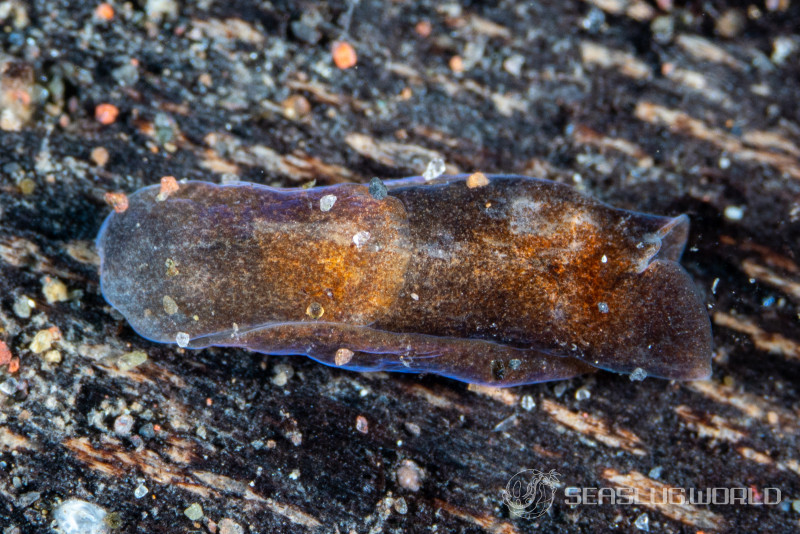
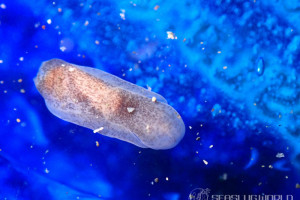
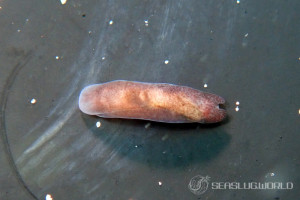
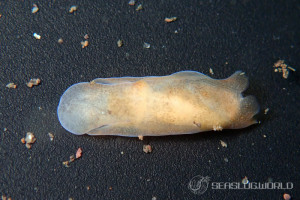
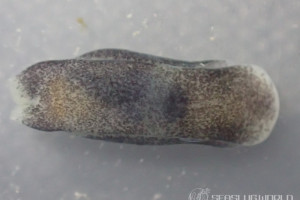
A small headshield slug 5-14 mm in preserved length. Specimens from Tokyo Bay have an elongate body, relatively wide and short. The cephalic shield occupies less than half the length of the animal, rectangular but slightly wider anteriorly and elevated posteriorly. The visceral region is elongate, ending in two short and wide tails of similar size. Parapodia thick and conspicuous, running along almost the entire length of the body. Colour variable brown; body colour uniform except for the digestive gland visible as a dark area and some white pigment on the posteriormost end of the body of some specimens. Male reproductive system (Form I.a): prostate long, simple, curved, with no folds and a wider distal end. Penis very long, with several folds and a cuticularised penial spine on the tip. Penial spine slightly curved with a broad proximal base, narrowing gradually into a sharp distal tip. Spermatic bulb a long, tightly packed folded tube with a retractor muscle attached. Shell broad and flat, with a small spire.Distribution
South Korea (Wando, Jeju) and Japan (Tokyo Bay) (Fig. 4). Type locality: Wando Island, South Jeolla Province, South Korea.Etymology
Verbatim from the original description (Cooke et al. 2014, Zoologica Scripta, p.14):Dedicated to Dong-Bum Koh for his valuable contributions to malacology in Korea and for collecting the type material of this species.
Remarks
Described as a new species in Cooke, Hanson, Hirano, Ornelas-Gatdula, Gosliner, Chernyshev & Valdés 2014 Zoologica Scripta. The author noted:Specimens of Melanochlamys from South Korea have been identified as M. diomedea (Koh 2006). However, sequence data from specimens collected in Wando, South Korea revealed that they are genetically distinct from specimens of M. diomedea from North America and from the two other species found in Japan, M. ezoensis and M. fukudai. The Korean specimens (here described as the new species M. kohi) are also anatomically distinct, as their penises are [longer](p.13-14). The species has only been confirmed from Tokyo Bay in Japan, an area of high international shipping traffic, suggesting the Japanese population may be an artificial introduction from Korea.
References
- Cooke S., Hanson D., Hirano Y., Ornelas-Gatdula E., Gosliner T.M., Chernyshev A.Y. & Valdés A. (2014) Cryptic diversity of Melanochlamys sea slugs (Gastropoda, Aglajidae) in the North Pacific. Zoologica Scripta 43: 351-369.
- 岡山県野生動植物調査検討会. (2019). 軟体動物門. 岡山県野生生物目録 2019 ver.1.0.
- アメイロキセワタ(新称)?, 中野理枝. (2019). 日本のウミウシ. 第二版. 文一総合出版.
Featured in this book
中野理枝. (2019). 日本のウミウシ. 第二版. 文一総合出版.
文一総合出版
This species, Melanochlamys kohi, is included in the book.
View on Amazon PR (Amazon Associates)Seasonality
Shooting Locations
Loading shooting locations...
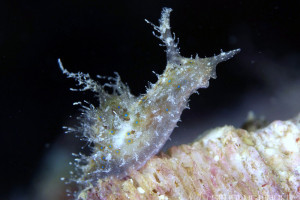
Photos of Melanochlamys kohi


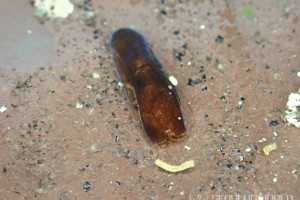

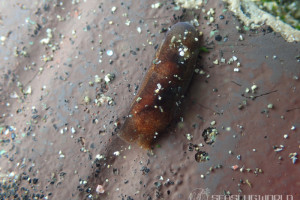

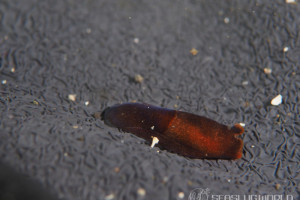

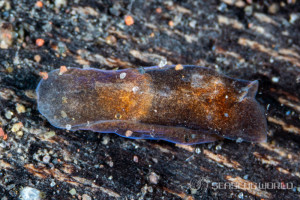

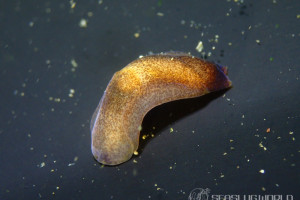

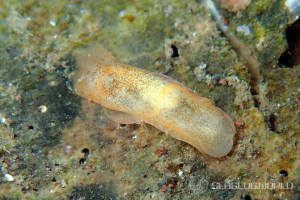
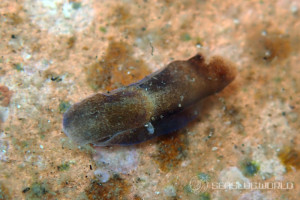
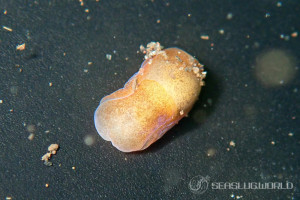

Specimen & DNA
| Observation | Database | COI | 16S | H3 |
|---|---|---|---|---|
| #25738 | BOLD Systems | SSWBP622-25 |
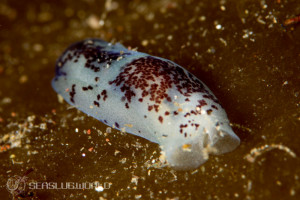
Same Genus Nudibranchs
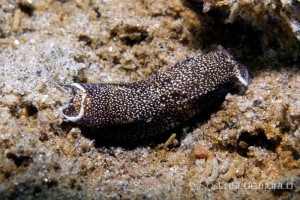
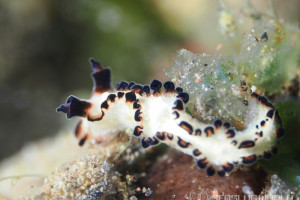
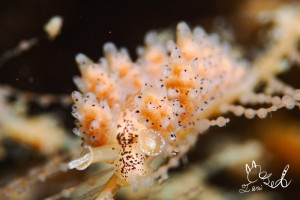
Similar Colors Nudibranchs

Academic Database
Sea slug observation data is available in international marine biodiversity databases.