Kaloplocamus ramosus (Cantraine, 1835)
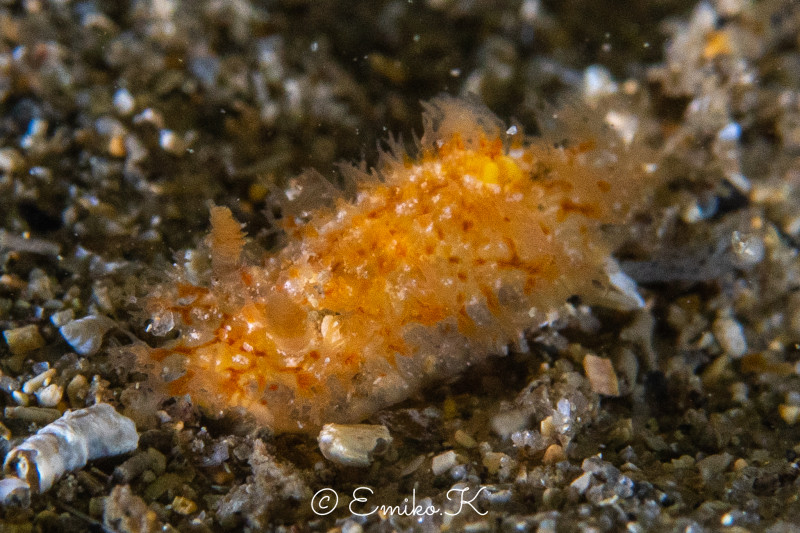
- Location
- Chowder Bay, New South Wales, Australia
- Date
- 2021/07/08
- Length
- 5mm
- Depth
- 5.0m
- Water temperature
- 15.9℃
Description
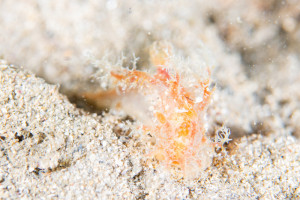
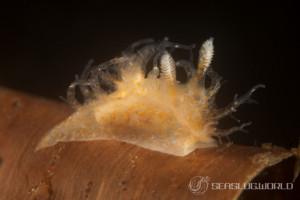
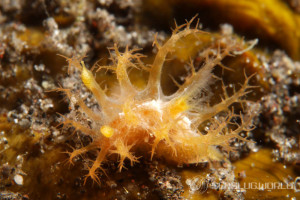
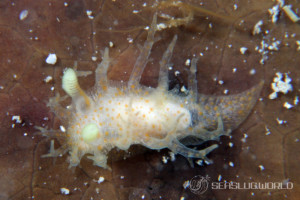
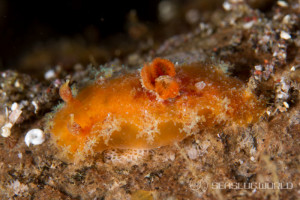
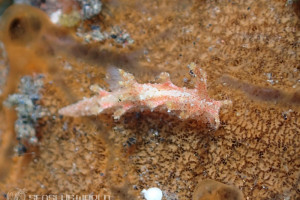
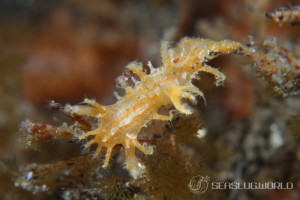
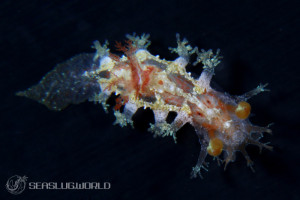
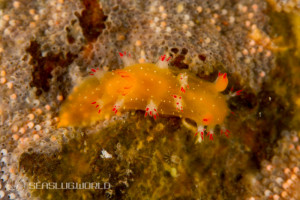
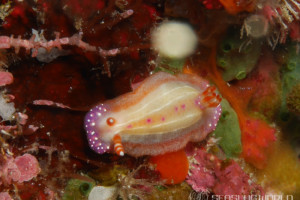
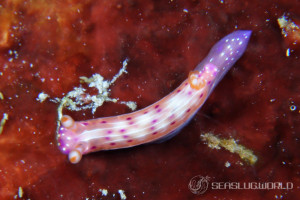
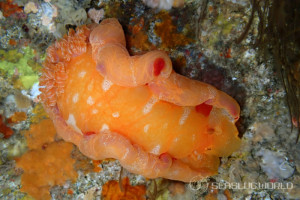
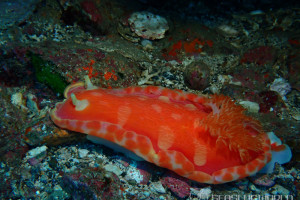
A small to medium-sized polycerid reaching up to 9 mm in preserved length. The living animal has a bright orange-red color. The entire dorsum has small tubercles that are translucent orange. Opaque white pigment is scattered over the dorsum and the notal margin. The veil bears eight ramified appendages that are thin and have secondary sharp, elongate ramifications. The oral tentacles are flat and wide. The rhinophores are the same color as the rest of the body, and the clavus is slightly speckled with small white dots. The rhinophoral sheath is very short and similarly speckled. The dorsum has four pairs of ramified lateral appendages, somewhat flat and wide compared to the velar appendages, with sharp and elongate ramifications at the apex. There are five tripinnate branchial leaves of the same color as the body.The radular formula is 17 × (17·6·0·6·17). Two well-differentiated types of teeth are present: the six inner lateral teeth are sharply hook-shaped with a well-developed secondary cusp, more pronounced in the innermost tooth and less evident toward the outermost. The seventeen outer lateral teeth are rectangular and flat, decreasing in size from innermost to outermost. The papillated rachis is divided into separate rectangular plates. The jaws bear thin, rounded, elongate and densely packed rodlets. The reproductive system is triaulic, with the vas deferens not differentiated into a prostate.
Distribution
Originally described from the Adriatic Sea. The species has been reported from the Mediterranean Sea, the Atlantic Ocean (Azores, South Africa, Angola) and the Indo-Pacific (Japan, Australia, New Zealand, Hong Kong), although these widely distributed populations may include multiple cryptic species.Etymology
The specific epithet ramosus is Latin for "branched," referring to the ramified processes on the body. The genus name Kaloplocamus derives from Greek kalos (beautiful) and plokamos (a braided lock of hair), meaning "beautiful curl."Remarks
Originally described as Doris ramosa Cantraine, 1835 from the Adriatic Sea. Bergh 1879 proposed the new generic name Kaloplocamus to replace Euplocamus Philippi, 1836, because the latter had already been given to a lepidopteran (Loven, 1846). Kaloplocamus japonicus (Bergh, 1879), K. orientalis Thiele, 1925, K. principiswalliae (Collingwood, 1881), K. aureus Odhner, 1932, K. filosus (Cattaneo-Vietti & Sòrdi, 1988) and K. yatesi (Angas, 1864) were synonymized with this species.This is one of the bioluminescent polycerids, with luminescence produced by intracellular cells in the body wall, head and tail. Unlike Plocamopherus, where luminescence occurs extracellularly via discharge of luminous chemicals from globular structures, in Kaloplocamus ramosus the chemical reaction takes place within luminous cells (photocytes).
A subsequent taxonomic revision of Yellow Sea Kaloplocamus populations by a 2023 study resurrected Kaloplocamus japonicus as a valid species, and described the Yellow Sea population as a new species, Kaloplocamus albopunctatus. The Japanese name "エダウミウシ" given by Baba 1930 to Euplocamus croceus (= K. ramosus synonym) is now considered to correspond to K. albopunctatus based on its coloration and white spotting.
References
A Kindle field guide by the site author

Kimoto N. (2026). Sea Slugs of Japan & the Indo-Pacific, 2nd Edition.
Kindle Edition
View on Amazon PR (Amazon Associates)Seasonality
Shooting Locations
Loading shooting locations...
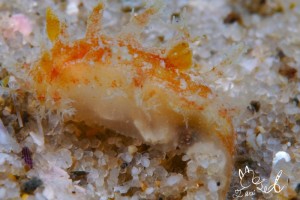
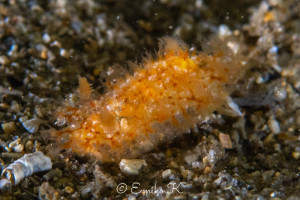
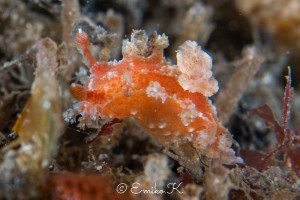
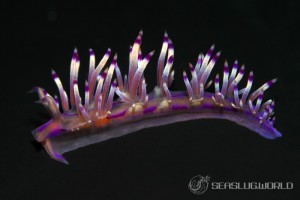
Photos of Kaloplocamus ramosus


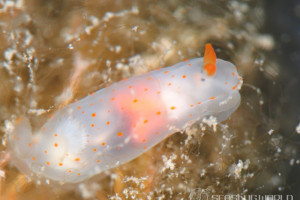
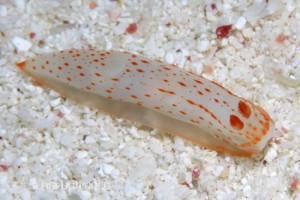
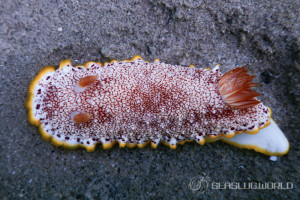
Same Genus Nudibranchs

Similar Colors Nudibranchs
Academic Database
Sea slug observation data is available in international marine biodiversity databases.