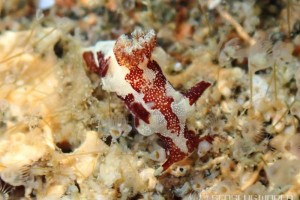
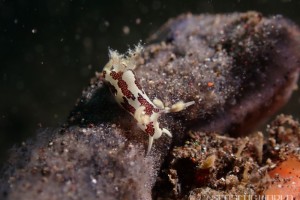
Trapania kamagong Smirnoff, Donohoo & Gosliner, 2022
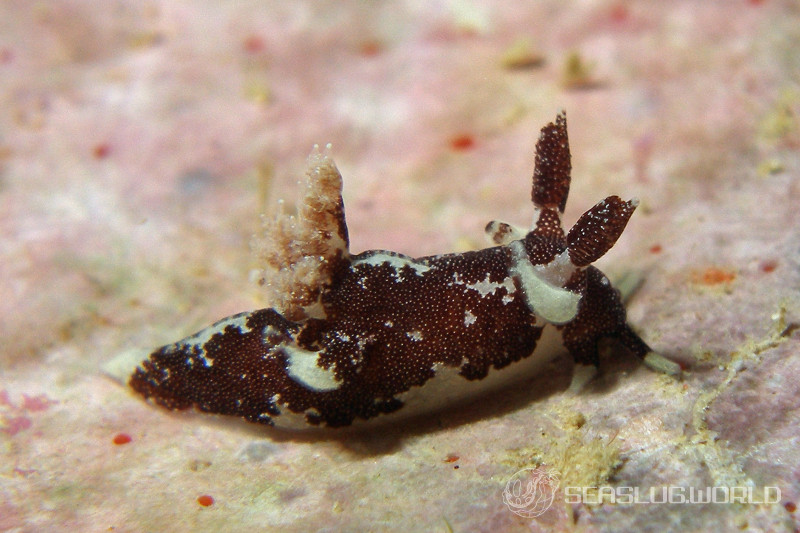
- Location
- Red Beach, Okinawa Island (East coast), Okinawa, Japan
- Date
- 2007/01/18
- Length
- 8mm
- Depth
- 13.0m
- Water temperature
- 20.0℃
MORPHOLOGY
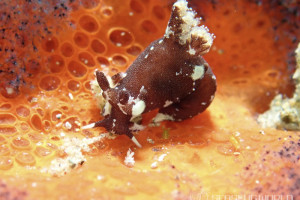
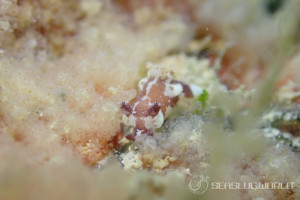
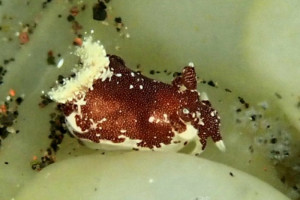
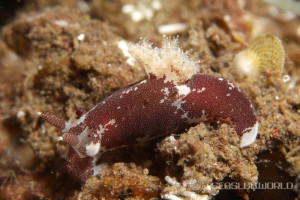
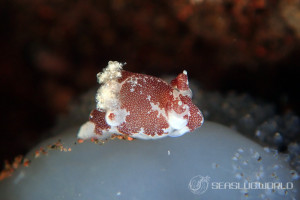
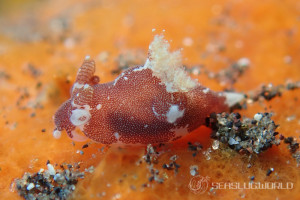
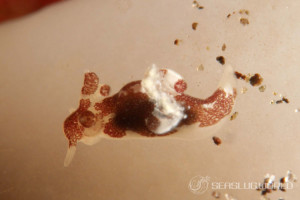
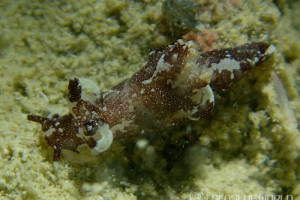
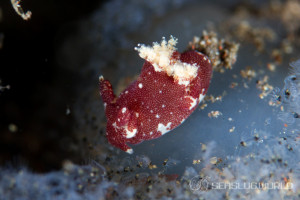
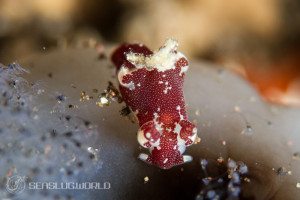
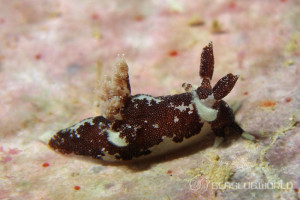
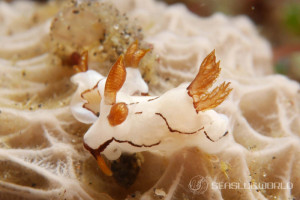
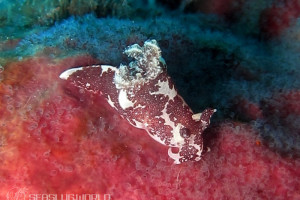
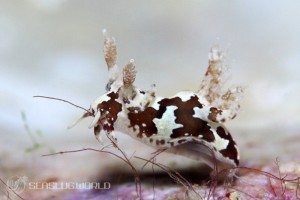
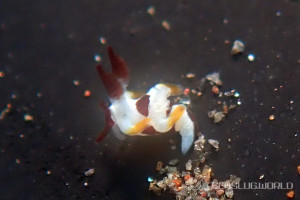
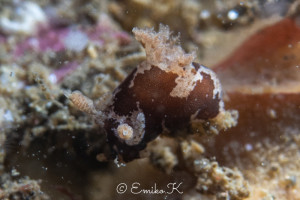
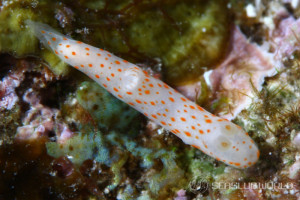
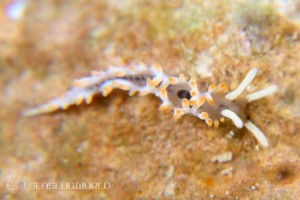
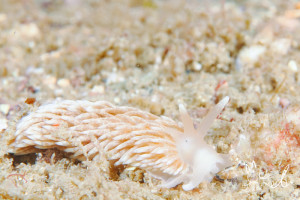
It has an opaque grey body covered dorsally with speckled red-brown colour characterized by small and large blotches of missing pigmentation. Notable blotches reside laterally below the rhinophores, below the gill plum and at the posterior portion of the foot. Extra-rhinophoral and extra-branchial appendages lack coloration from base to the tip, which has the same red-brown coloration as the body. Rhinophores, eight to ten lamellae and a pointed tip, are uniformly wide along their length and the same colour as the red-brown body, except for grey tip. Oral tentacles are coloured at their base and opaque grey at the tip. Similarly, the anterior margins of the foot, which extend laterally as elongate appendages, are coloured at their base and opaque grey at their tip. The gill plum is prominent and a lighter brown than the body. Buccal mass: The buccal mass is muscular with a moderately enlarged buccal pump on the dorsal surface. Inside the anterior portion of the mass is a pair of well-developed jaws. The jaws contain a row of acutely pointed and stubby jaw elements of various sizes that are tightly packed together with a few gaps between them (Fig. 17A). The radular formula of the holotype is 23 × 1.0.1. The older teeth are much smaller (Fig. 17B) than the newer ones (Figs. 17C, D) and the radula widens gradually towards the more newly developed teeth. The teeth bear numerous denticles with the smallest ones being found on the inner edge of the tooth. There are approximately four to 15 denticles on the inner side of the much larger primary cusp, and one to two denticles on the outer side of the cusp. The older teeth have fewer denticles than the more recently developed ones.DISTRIBUTION
Known only from the Philippines.ETYMOLOGY
Kamagong is the Tagalog name for the velvet apple, Diospyros discolor Willd. (Ebenaceae), a species of persimmon tree found in the Philippines and Taiwan. It refers to the distinguishing dark-tipped, extra-rhinophoral and extra-branchial appendages of this species.References
- Trapania sp. 3, Helmut Debelius, Rudie H. Kuiter. (2007). Nudibranchs of the World.
- Trapania sp. 3, Terrence Gosliner, Ángel Valdés and David Behrens. (2018). Nudibranch and Sea Slug Identification Indo-Pacific 2nd Edition. New World Pubns Inc.
- Trapania kamagong sp. nov., Smirnoff D.S., Donohoo S.A. & Gosliner T.M. (2022). Extra-branchial processes manifest extra diversity: systematics of the genus Trapania (Nudibranchia: Goniodorididae) and nine new species descriptions. Zoological Journal of the Linnean Society. 196(1): 270-313. https://doi.org/10.1093/zoolinnean/zlac009
- Paz-Sedano S., Moles J., Smirnoff D., Gosliner T.M. & Pola M. (2024). A combined phylogenetic strategy illuminates the evolution of Goniodorididae nudibranchs (Mollusca, Gastropoda, Heterobranchia). Molecular Phylogenetics and Evolution. 192: 107990. https://doi.org/10.1016/j.ympev.2023.107990
Featured in this book
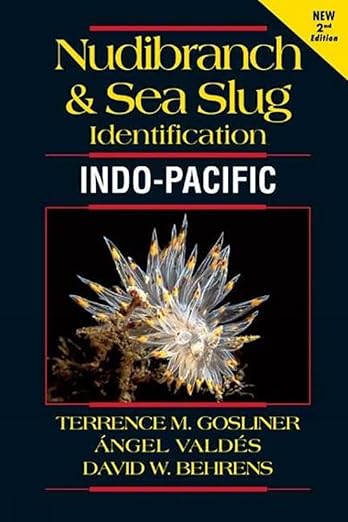
Terrence Gosliner, Ángel Valdés and David Behrens. (2018). Nudibranch and Sea Slug Identification Indo-Pacific 2nd Edition. New World Pubns Inc.
New World Publications
This species, Trapania kamagong, is included in the book.
View on Amazon PR (Amazon Associates)Seasonality
Shooting Locations
Loading shooting locations...
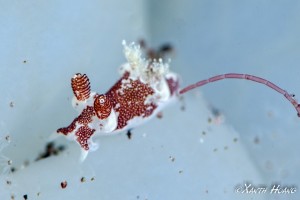
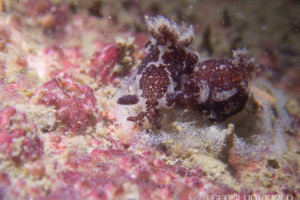
Photos of Trapania kamagong
Tag:








Same Genus Nudibranchs
Similar Colors Nudibranchs

Academic Database
Sea slug observation data is available in international marine biodiversity databases.