Lumpers vs Splitters — The 2025-2026 Flabellinidae Revision
intro
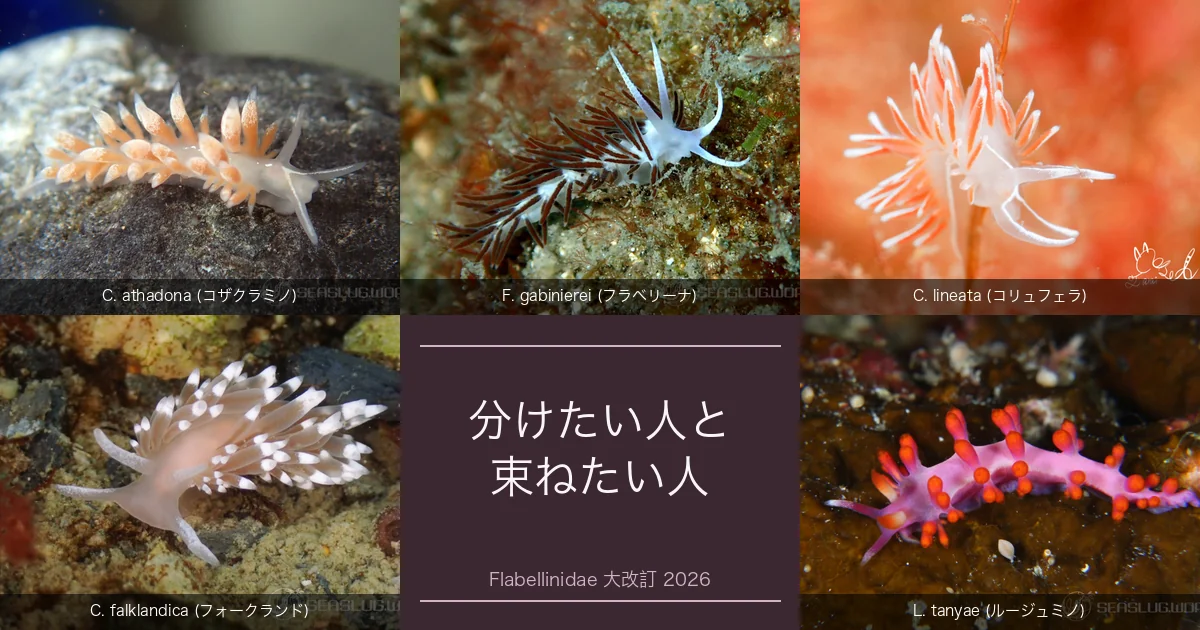
In May 2026, Ekimova et al. published a 43-page global revision of Flabellinidae in PLoS One (e0347759). Beyond the new genus Launsina and species Launsina tanyae covered in the previous post, the paper proposes a sweep of further consolidations (lumping) at the genus and family levels. The net effect on our site: the scientific names of 10 species are changed across the Flabellina, Calmella, and Coryphellina group.
A year earlier (2025, accepted April 2025), a 93-page paper by Korshunova et al. (Zoological Journal of the Linnean Society) argued for the opposite direction — splitting Aeolidina further. The two studies cite each other and recover largely consistent molecular trees, yet their translation into formal classification is in nearly complete conflict.
The disagreement extends well beyond the genera and families of Flabellinidae: the two camps use different names for the suborder containing all aeolid-like nudibranchs (Aeolidina vs Cladobranchia), which would affect hundreds of species across the entire nudibranch tree.
This post summarises what changed on the site beyond Launsina tanyae, and outlines the broader lumpers-vs-splitters debate behind it.
Two papers
The two titles already telegraph the conflict. The first declares a middle ground ("neither lumpers nor splitters"), while the second argues that "endless forms" — borrowing Darwin's phrase — are the most differentiated, and that taxonomic "pseudo-optimization" by lumpers has masked natural diversity.
How we got here
A rough timeline:
- Classical (late 19th century): Coryphella and Flabellina as two main genera, distinguished by whether cerata attach directly to the body or sit on common stalks
- 2017: Korshunova et al. (ZooKeys 717) split 84 species into 29 genera and 7 families (11 of which are monotypic)
- 2022: Ekimova et al. (Zool J Linn Soc 196) consolidate 9 Coryphellidae genera back into a single Coryphella, arguing that monotypic-genus proliferation undermines the predictability of the classification system
- 2025: Korshunova et al. (ZJLS 204) push back, reinstating 11 Coryphellidae genera (9 reinstated + 2 new: Corrupta, Portorchardia), and propose a 10-superfamily, 29-family framework for the whole Aeolidina
- 2026 (this paper): Ekimova et al. (PLoS One) re-evaluate Flabellinidae globally, critique Korshunova 2025, and propose a wave of synonymies — while framing themselves as a middle path
In short, the field has been swinging every ~3 years.
Read together, Ekimova et al. 2026 effectively extends the lumper framework that Ekimova et al. 2022 established for Coryphellidae to the whole of Flabellinidae s.l.. The authors themselves write in the Discussion that "our results are in line with the latter works" (referring to Ekimova 2022), and they reject the two new genera Corrupta and Portorchardia proposed in Korshunova et al. 2025 as junior synonyms of Coryphella. The same lumper stance is applied at the suborder level by adopting Cladobranchia (a broader pre-Korshunova framework) instead of Aeolidina. In other words, the underlying premise of Ekimova 2026 is a rollback to a pre-Korshunova/2017 framework, anchored on the 2022 Ekimova revision and expanded outward.
A second front: Aeolidina vs Cladobranchia at the suborder level
The most uncomfortable conflict for a site operator is actually one level up from Flabellinidae:
- Korshunova/Martynov 2025: reinstates the suborder Aeolidina and organises 10 superfamilies / 29 families under it — preserving the traditional aeolid-centric grouping
- Ekimova 2026: adopts the suborder Cladobranchia (Willan & Morton, 1984), which collapses Aeolidida + Dendronotida + Tritoniida + Arminida into a single suborder, in line with molecular phylogeny
This affects far more than Flabellinidae. Switching to Cladobranchia would require restructuring the upper levels of the classification across Tritoniidae (e.g. Tochuina), Dendronotidae (e.g. Dendronotus), and Arminidae lineages — well outside the Flabellinidae story.
For this reason we left the suborder and superfamily levels alone in the current sprint — they stay on the Korshunova/Martynov 2025 (Aeolidina) framework. The genus- and family-level Ekimova 2026 changes were applied, but the upper hierarchy was deliberately not touched.
The substantive issue is not that updating breadcrumbs is laborious — it is that Ekimova 2026 is focused on Flabellinidae s.l. and does not spell out how the rest of Cladobranchia should be re-arranged. Adopting Cladobranchia at the suborder level would force us to interpret and re-build the upper phylogeny ourselves, going beyond what the paper actually writes. Making taxonomic decisions outside the paper's explicit scope is both painful operationally and weakens the site's reliability as a reference, so we kept the upper hierarchy untouched.
What Ekimova 2026 synonymises
For the site we needed to decide how to reflect the changes. The headline items:
Family-level
The rest of this article is for Premium members
This is one of our in-depth member articles — new species reports, paper walkthroughs, and taxonomy deep-dives. Members read them all. Free for your first month, then USD 3.00/month, cancel anytime.
- New species reports, paper walkthroughs, and taxonomy deep-dives — members only
- No ads (AdSense) across the entire site
- Priority handling of your observations (Premium uploads are identified and published first when the moderation queue is backed up)
- Priority access to the AI identification feature
Already a member? Please log in.
Enjoyed this post? You can tip the author directly —
Tip this post