Tenellia kuiterorum (Rudman, 1981)
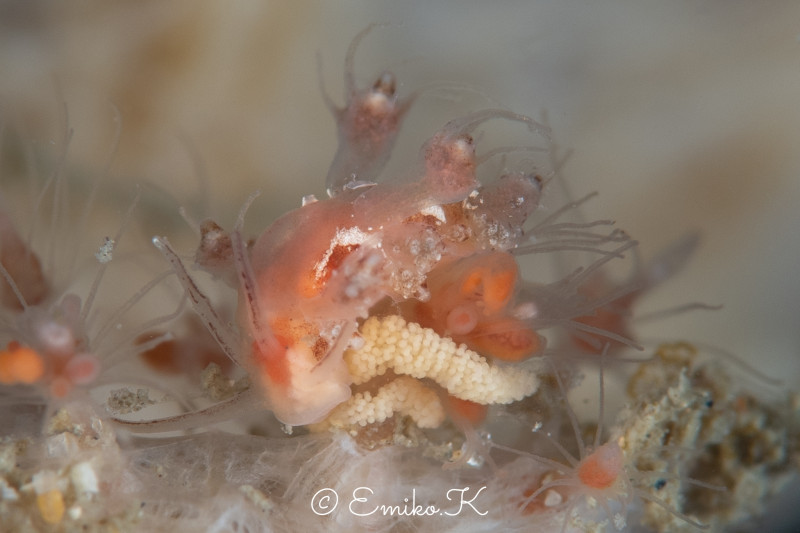
- Location
- Chowder Bay, New South Wales, Australia
- Date
- 2021/05/27
- Length
- 3mm
- Depth
- 5.0m
- Water temperature
- 17.0℃
Description
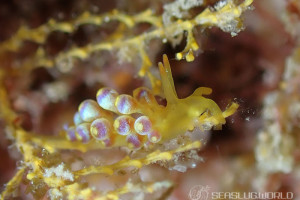
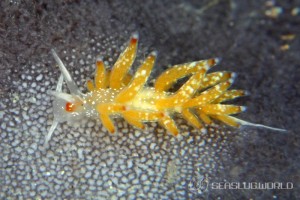
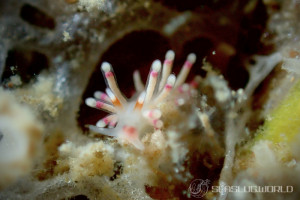
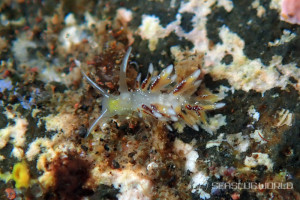
A very small aeolid 5-7 mm in length. The body is long and slender, broadest just behind the head. The rhinophores and oral tentacles are extremely long, slender, smooth, and taper to a rounded tip. The cerata are arranged in two rows in front of the pericardium and four to five rows behind it, with up to four or five cerata per row.The shape of the cerata is unique among the aeolids and is the species' most distinctive feature. Each ceras narrows at the base, swells into a bulbous region just below the tip, and then narrows again to a bluntly rounded apex. Around the widest part of the swelling, six long, slender, tapering tentacular processes are arranged in a ring; three or four smaller processes occur in a second ring above. These tentacular processes can be moved independently and are contractile, giving the ceras a remarkable likeness to the polyps of the tubulariid hydroid Zyzzyzus spongicola on which the slug feeds.
The animal is generally orange with intense white tips to the cerata. Most of this colour comes from the internal organs showing through the translucent body wall: the buccal bulb appears bright orange-red, the digestive gland yellowish-brown basally and reddish orange-brown distally, and the cnidosacs are vivid white. The tentacular processes themselves are translucent white.
The cerata function as active defensive organs: when touched, they bend towards the stimulus and discharge nematocysts through the cnidosac pore at their tips.
Distribution
Type locality: Green Point, Sydney Harbour, New South Wales, Australia, at 15 m on sponge. Paratypes were also collected at Montague Island, off Narooma in southern New South Wales, at 1.5 m on sponge with hydroids.Etymology
The specific epithet honours the Australian underwater photographer Rudie Kuiter and his wife Alison Kuiter, who collected the type material. It was originally published in the singular genitive form kuiteri; the spelling was later emended to the plural genitive kuiterorum to reflect dedication to the couple. The Kuiter surname is of Dutch origin and is pronounced approximately "Koiter" in Dutch.Remarks
The species feeds exclusively on the tubulariid hydroid Zyzzyzus spongicola, whose solitary polyps live partially embedded in sponges. The double ring of tentacular processes on each ceras mirrors the arrangement of oral and aboral tentacles on the hydroid polyp, and is considered the most elaborate example of polyp mimicry known among aeolids. The colour pattern of the prey polyp — straw-coloured stalk, orange body, white oral region — is closely matched by the digestive gland and cnidosac colouring of the ceras.References
A Kindle field guide by the site author
Kimoto N. (2026). Sea Slugs of Japan & the Indo-Pacific, 2nd Edition.
Kindle Edition
View on Amazon PR (Amazon Associates)Seasonality
Shooting Locations
Loading shooting locations...
Photos of Tenellia kuiterorum
Tag:

Same Genus Nudibranchs
Academic Database
Sea slug observation data is available in international marine biodiversity databases.