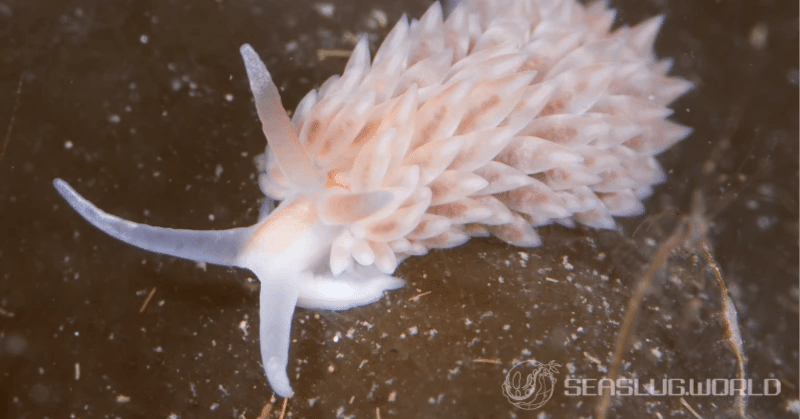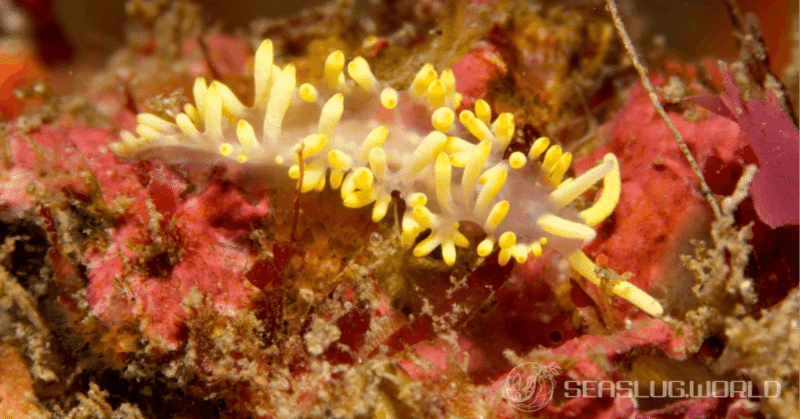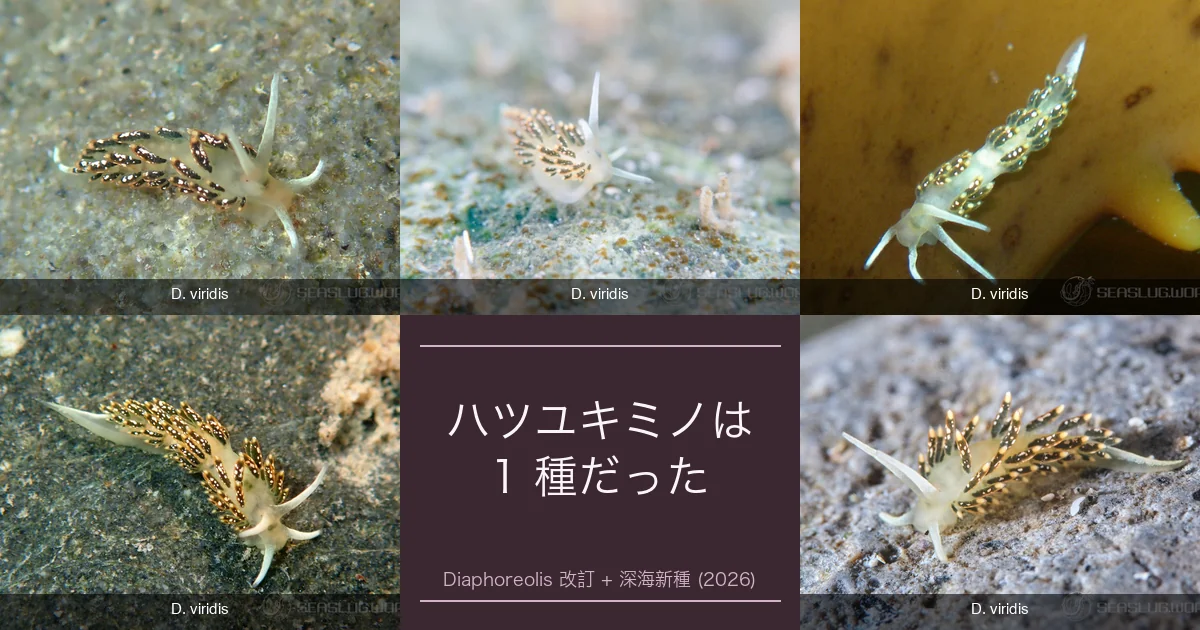
One trans-Arctic Diaphoreolis viridis — and a new deep-sea D. shinkaii (Grishina 2026)
intro
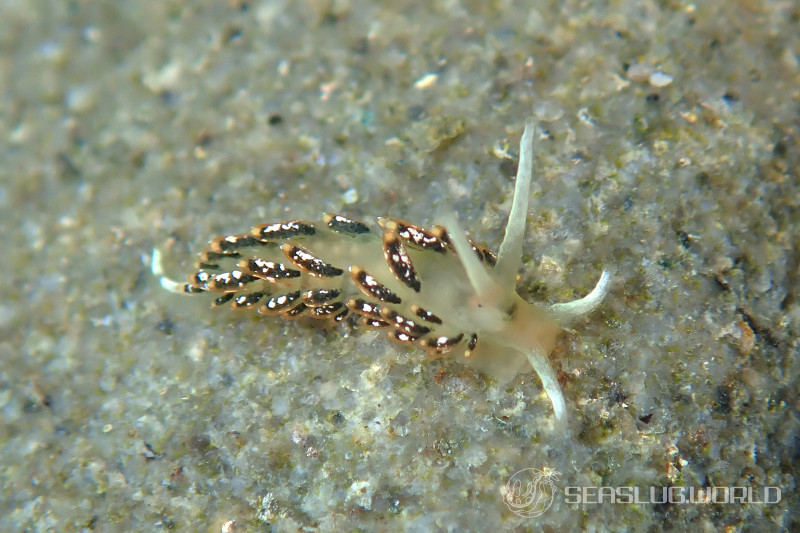
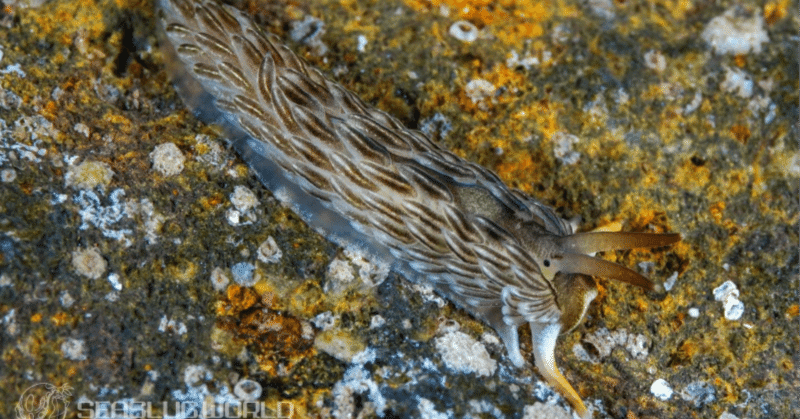
Diaphoreolis viridis — the white-spotted aeolid commonly seen in Japan — is a single species across the entire trans-Arctic range: from the UK, Norway, the White Sea, and the Barents Sea across to the Sea of Japan, the Sea of Okhotsk, the Kuril Islands, and the North-East Pacific. Four well-supported mtDNA haplogroups and substantial colour variation (green to orange to white) — but it is all one species, per Grishina et al. (2026, Zoologica Scripta). D. midori (Martynov, Sanamyan & Korshunova, 2015) and the two subspecies D. v. viridis + D. v. emeraldi erected by Korshunova et al. (2023) are all sunk as synonyms.
In parallel, a new bathyal species D. shinkaii sp. nov. is described from 705 m off Iturup Island in the Sea of Okhotsk; the epithet is from Japanese 深海 (shinkai), "deep sea". Same Ekimova lab vs Korshunova lab dynamic as last month's Flabellinidae revision — now at the species level, plus a deep-sea new description.
The paper
What changed
The paper makes four taxonomic decisions.
Synonymies (3)
| Name (description) | → Now treated as |
|---|---|
| Diaphoreolis midori (Martynov, Sanamyan & Korshunova, 2015) | Synonym of D. viridis |
| Diaphoreolis viridis viridis (Korshunova et al., 2023) — nominotypical subspecies | Synonym of D. viridis (subspecies division withdrawn) |
| Diaphoreolis viridis emeraldi Korshunova et al., 2023 — NE Pacific subspecies | Synonym of D. viridis |
New species (1)
| Species | Type locality | Depth |
|---|---|---|
| Diaphoreolis shinkaii sp. nov. | Sea of Okhotsk, off Iturup Island (44°51.833' N, 149°09.475' E) | 705 m |
Net effect: the entire shallow-water North Atlantic + North Pacific population of Diaphoreolis (green, orange, yellow, white colour morphs included) is one species, D. viridis. Plus, a separately diverged lineage from the deep waters of the Sea of Okhotsk is named as D. shinkaii.
Why one species, but four mtDNA clades?
The paper analysed 77 specimens and recovered four well-supported mtDNA haplogroups (COI + 16S + H3):
| Haplogroup | Distribution | Historical association |
|---|---|---|
| Clade A (North Pacific I) | Sea of Japan, Sakhalin | (type material of former D. midori) |
| Clade B (North Pacific II) | largest clade — Russian coast, Kuril Islands, Sakhalin, Washington | (some former D. v. emeraldi) |
| Clade C (North Pacific III) | single specimen from Sakhalin, sister to the Atlantic Clade D | — |
| Clade D (North Atlantic) | UK, Norway, White Sea, Barents Sea | (former D. v. viridis) |
COI p-distances between haplogroups range from 1.2% to 6.3%, overlapping with typical inter-species distances in nudibranchs. The default move would be to split into four species. The authors went the other way, based on three lines of evidence:
- Nuclear markers (18S, ITS2) show zero fixed substitutions between haplogroups — i.e. ongoing gene flow at the genome level, irrespective of mtDNA divergence
- Morphology (body form, rhinophore / oral tentacle proportions, cerata arrangement, jaw plates, radula, reproductive system) is congruent across haplogroups
- The mtDNA divergences are best explained by transient isolation during Pleistocene glacial maxima, followed by gene-flow restoration during interglacials when the Bering Strait reopened (TMRCAs match MIS5, MIS9, MIS11 isotope stages)
The paper's central methodological argument: an mtDNA haplogroup is not automatically a species. Korshunova et al. (2023) maintained D. midori and two subspecies based on essentially mtDNA + coloration; the new analysis says the integrative + sample-size threshold was not met.
Diaphoreolis shinkaii sp. nov. — a new deep-sea species
The holotype is a single 7 mm specimen, collected by trawl from 705 m off Iturup Island. Single-specimen descriptions are unusual, but the COI p-distance to all other Diaphoreolis species is 9.9 – 12%, the coloration is distinctively pale (translucent greyish-white, almost without pigmentation), the cerata arrangement differs (14 continuous rows rather than the up-to-6 preanal rows of D. viridis), and the radular dentition is different — enough for the authors to formalise the species.
The etymology is explicit in Appendix S1:
Etymology: «深海» (shinkai) means «deep sea» in Japanese
Same shape as the Flabellinidae revision
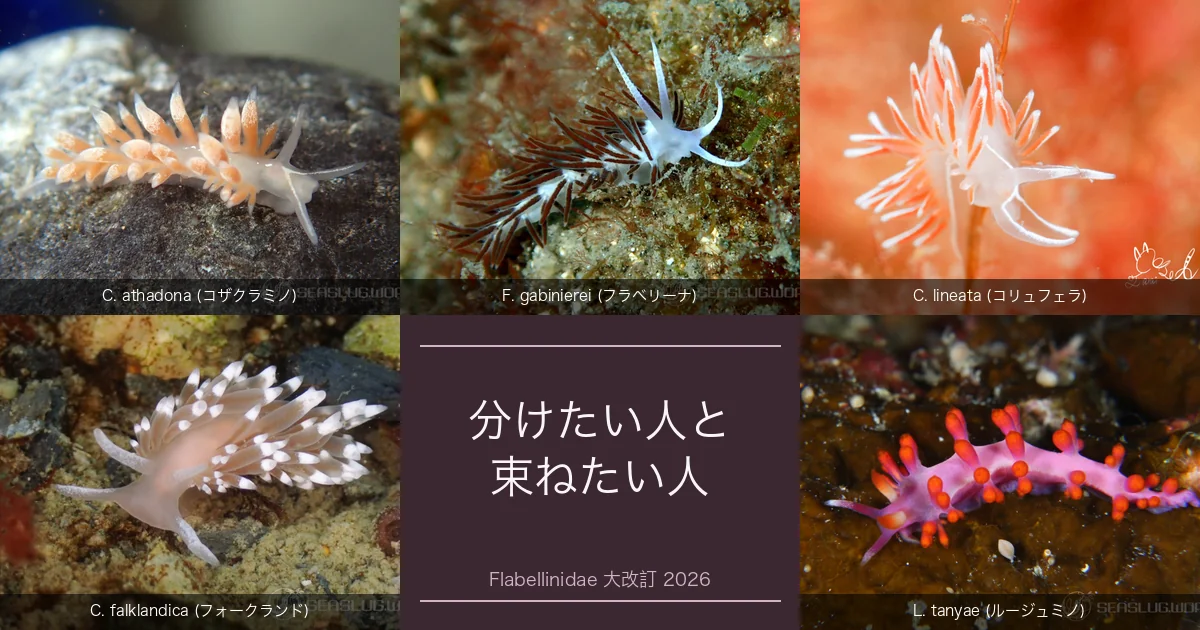
As discussed in last month's Flabellinidae revision post, the Ekimova lab and the Korshunova lab have been publishing back-to-back rebuttals. This paper continues the same pattern, one rank down:
| Paper | Camp | Stance |
|---|---|---|
| Korshunova et al. 2023 | Korshunova/Martynov | D. midori as separate species; D. viridis split into two subspecies (mtDNA + coloration) |
| Grishina et al. 2026 (this paper) | Ekimova | All one species (D. viridis) + one new deep-sea species (D. shinkaii). Integrative + large sample size required |
Whereas Flabellinidae was the genus-level fight (whether to break Coryphella into multiple genera), this is the species-level analog. Importantly, this paper is not pure lumping — the same integrative pipeline also surfaces a new species from the deep. That is the "neither lumpers nor splitters" framing the Ekimova group has been using.
What we changed on the site
After reading this paper, we consolidated Japanese-water specimens previously registered under D. midori into the D. viridis entry.
| Species page | Change |
|---|---|
| Diaphoreolis viridis | Stays published (status=1); Grishina et al. (2026) added to the references column |
| Diaphoreolis midori | Retired (status=3), treated as a synonym of D. viridis |
| Diaphoreolis shinkaii sp. nov. | Not registered. Would add if submissions arrive, but unlikely given the 705 m bathyal habitat |
The two subspecies D. v. viridis and D. v. emeraldi were never registered on the site, so no rollback is required.
Closing
D. viridis is a commonly observed shallow-water species in Japan, recognisable for the white pigment dots arranged along its cerata. According to this paper, individuals from the Sea of Japan through Sakhalin, the Kuril Islands, North-East Pacific, and North-East Atlantic — spanning green, orange, yellow, and white colour morphs — are all polymorphism within a single species. Japanese specimens can now be treated as the same D. viridis shared with the trans-Arctic range.
Enjoyed this post? You can tip the author directly —
Tip this post