What do "sp.", "spp.", "cf." mean in sea slug names? A guide to provisional naming
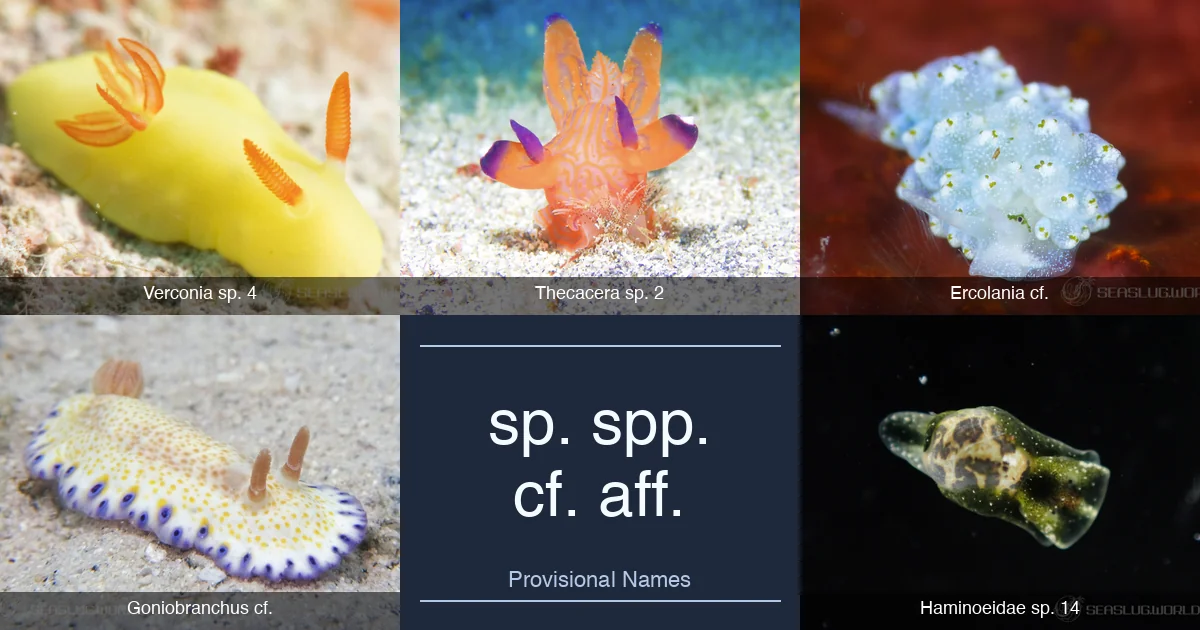
Browsing a sea slug field guide, you will sooner or later run into names like Costasiella sp. 3 or Jorunna cf. pantherina. These are provisional notations used when a species has not yet been formally named, or when its identity cannot be pinned down from external features alone. Because sea slugs are a group with a huge number of undescribed species, you see these markers constantly. This article walks through sp. / spp. / cf. / aff. / n. sp. and how we number undescribed species on SEASLUG.WORLD, plus tips for using these notations in observation records and on social media.
Binomial nomenclature in one minute
The scientific name of a sea slug consists of a genus name plus a species epithet — the binomial system. For example, Costasiella kuroshimae: Costasiella is the genus and kuroshimae is the species epithet. The epithet is fixed by a formal description paper in line with the ICZN (International Code of Zoological Nomenclature).
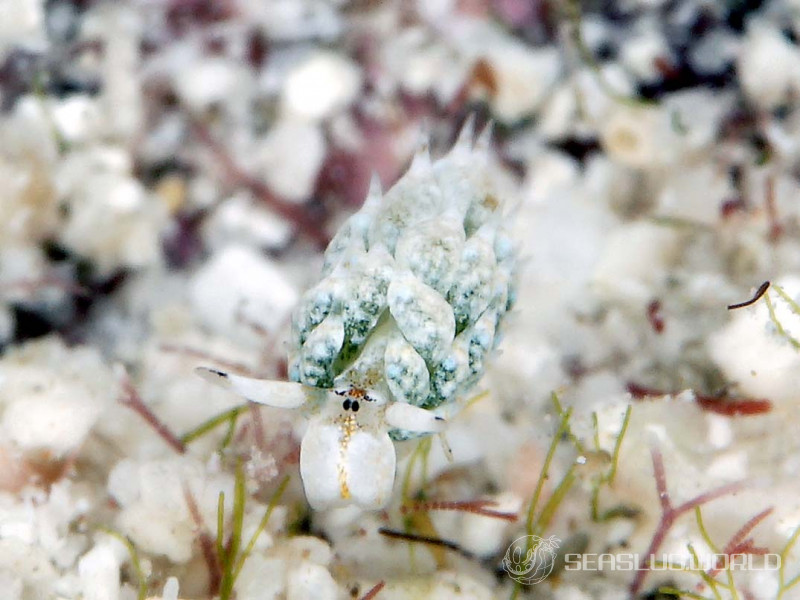
But not every sea slug seen in the field has a description paper yet. New, undescribed forms turn up every year, and photographs alone are often not enough to identify an animal to species. That is where provisional notations come in.
sp. = species
sp. is short for the Latin "species" and is used when the genus is known but the exact species is not. It is placed after the genus with a space, e.g. Costasiella sp.
When several undescribed species exist in the same genus, researchers and field guides add their own numbers — Costasiella sp. 1, sp. 2, and so on. On SEASLUG.WORLD we currently host eight such forms, from Costasiella sp. 1 through Costasiella sp. 8.
Important: "Costasiella sp. 3" on our site refers to a specific undescribed Costasiella, but the same label in another guide may point to an entirely different undescribed species. The number is an internal identifier within a single resource, not a global ID.
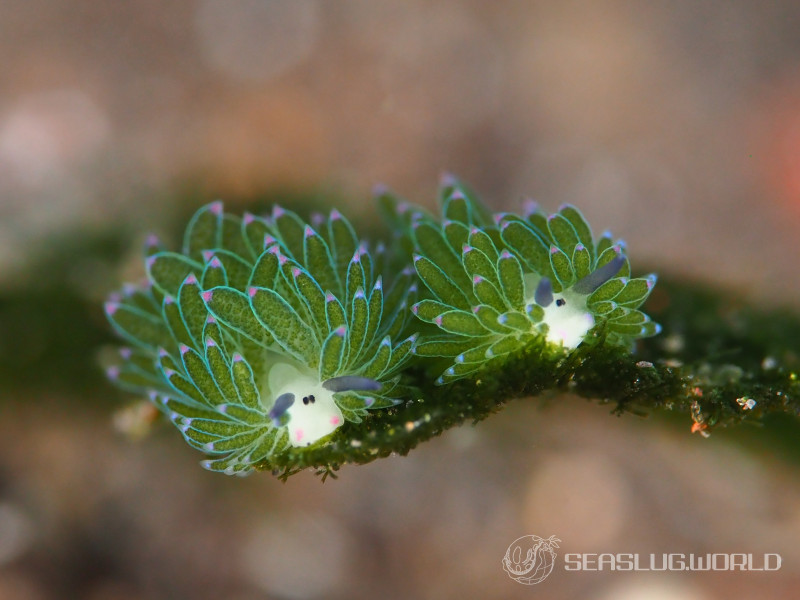
spp. = species pluralis (multiple species)
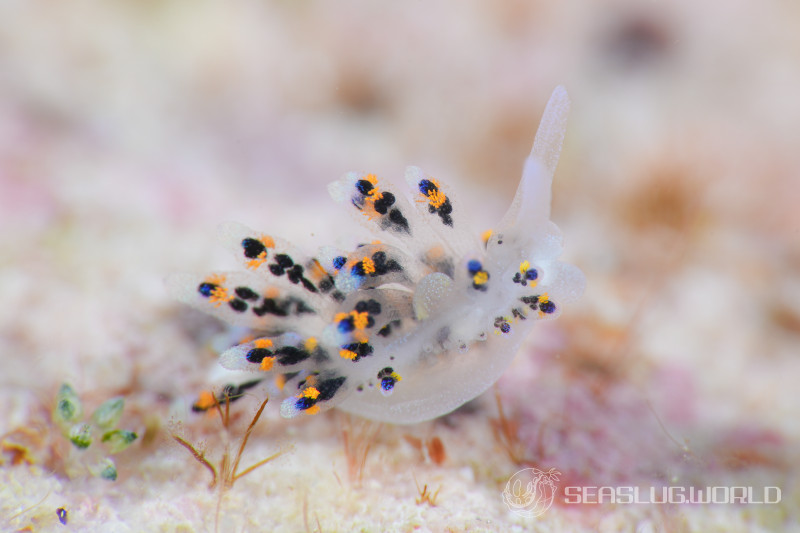
Adding an "s" to make spp. denotes multiple species. Costasiella spp. means "several species belonging to the genus Costasiella". You see it in sentences like "Phyllodesmium spp. feed on corals", where the writer wants to talk about the genus as a whole rather than any single species.
So "Phestilla sp." (one undescribed species) and "Phestilla spp." (multiple species) carry quite different meanings. When logging an observation, pick the one that matches the number of distinct species shown in the record.
cf. = confer (compare with; identity uncertain)
cf. is short for the Latin "confer" ("compare with"). It signals "this looks like the named species, but anatomical or molecular confirmation is pending, so we cannot commit". For example, Jorunna cf. pantherina resembles the Australian Jorunna pantherina (type locality: Port Jackson, NSW), but Japanese material has not been formally checked to confirm conspecificity with the type-locality population. We currently use cf. notation for 11 species on the site.
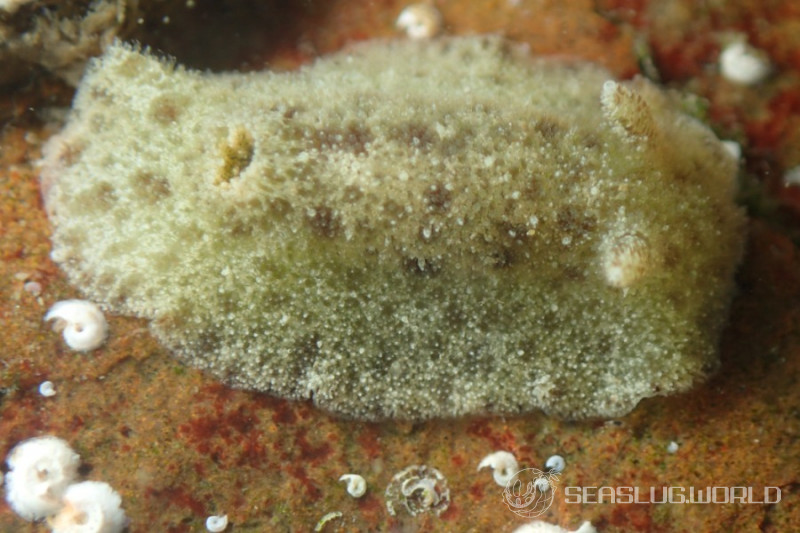
aff. = affinis (close relative; probably different)
aff. (from Latin "affinis", "akin to") is stronger than cf.: it implies "this is probably a different species, closely related to the named one". It is most often seen in pre-description literature, when an author wants to flag that the material is recognizably distinct from the named relative. We do not currently use aff. on the site, but it is worth recognizing in the wider literature.
n. sp. / sp. nov. = "new species" inside a paper
Both n. sp. (new species) and sp. nov. (species nova) are used inside description papers to declare "this is a brand-new species". Once the paper is published, the species name is formally established, and from then on the marker drops away — you write the plain binomial. "Phestilla viei sp. nov. (Mehrotra et al. 2020)" in the paper becomes simply Phestilla viei afterwards.
In other words, sp. nov. is a paper-internal label, not something that should persist in field guides or observation logs.
Tips for using sp. in observation records and social media
Numbers attached to undescribed species are resource-specific, so when you post "Costasiella sp. 3" online, it helps to make the source explicit:
- "Costasiella sp. 3 via SEASLUG.WORLD"
- "Phestilla sp. (Rudman 2001, Sea Slug Forum)"
- "Trapania sp. (sensu Gosliner et al. 2018)"
If you upload your photos to SEASLUG.WORLD, your observation will be updated with the formal scientific name once that undescribed species is eventually described.
Why we even need sp. at all
Sea slugs are a famously under-described group; dozens of new species are formally named every year. Many forms are also cryptic — easily separable by anatomy or DNA but nearly identical externally — so the gap between "first photographed in the field" and "officially named in a paper" routinely stretches from a few years to a decade. Provisional markers like sp., cf. and aff. let divers, field-guide authors and scientists talk about these animals in the meantime.
Right now we host more than 557 species under sp. notation and 11 under cf. notation. The sheer scale of these placeholders is itself a measure of how active sea slug taxonomy remains.
Cheat sheet
- sp. = one species, genus known, species unconfirmed
- spp. = multiple species within a genus
- cf. = looks like the named species; not confirmed
- aff. = closely related to the named species but probably distinct
- n. sp. / sp. nov. = paper-internal label for "new species being described here"
Once you can read these markers, taxonomic papers, field guides and social media posts about sea slugs become much more transparent. If the sea slug you photographed has "sp." in its name, do not be discouraged — it just means the formal name is still pending.
Enjoyed this post? You can tip the author directly —
Tip this post