Bill Rudman's Sea Slug Forum — The Web Archive That Still Feeds Formal Taxonomy
A One-Person Project, Twelve Years Long
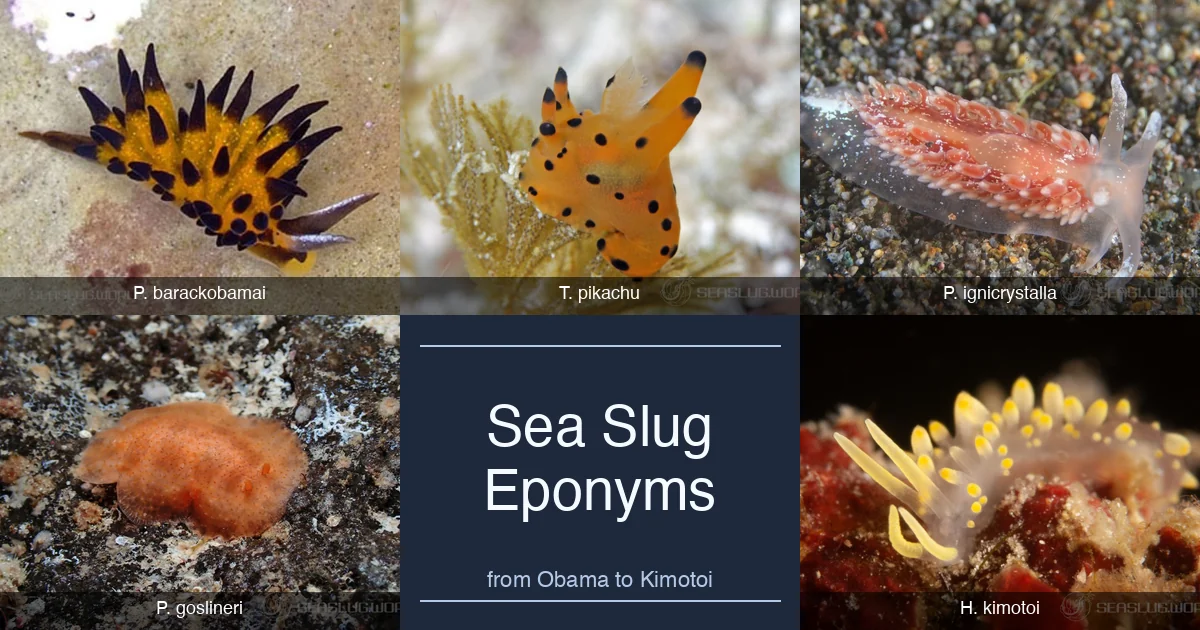
For twelve years between 1998 and 2010, divers and underwater photographers around the world uploaded their unidentified sea-slug photos to a single website: the Sea Slug Forum (seaslugforum.net), run almost single-handedly by William B. Rudman (born 1944, New Zealand-Australian), mollusc curator at the Australian Museum (Sydney), alongside his regular curatorial duties.
By the time it closed, Rudman had personally answered 14,523 user posts, accumulated several thousand per-species fact sheets, hundreds of provisional "sp. X" pages for undescribed species, and tens of thousands of photographs (source: Wikipedia: William B. Rudman).
1998 was the year Google was founded. Wikipedia (2001), WoRMS (online 2007, formal launch 2008), and iNaturalist (2008) did not yet exist. The very idea of "upload a photo and a specialist replies" was, at the time, close to science-fictional. Every subsequent online identification community — WoRMS, iNaturalist, and curated atlases including seaslug.world — stands on the demonstration the Forum made first: that citizen science and academic taxonomy could be productively bridged on the open web.
What the Forum was — two layers: fact sheets and message board
Fact sheets (per-species pages)
One page per species, accumulating scientific name, vernacular names, distribution, observational records, taxonomic notes and photographs. Several thousand pages in total. URLs were stable (seaslugforum.net/factsheet/<short>), which proved crucial for later citation. The 1 March 1999 factsheet for Flabellina sp. 1 is still readable at seaslugforum.net/factsheet/flabsp1 today.
Message board (per-post replies)
Divers, photographers and beginners posted "what is this nudibranch?" enquiries and Rudman replied with identification and commentary. Every exchange was preserved as a thread. 14,523 messages in total by the time the Forum was frozen.
The critical detail is that the answer always came from Rudman himself. Not from a crowd of amateur identifiers, but from a single specialist's authoritative reply. "If Rudman says so, the identification is reliable" became a shared assumption across the 1998-2010 diving community worldwide.
The 'sp. X' system: web-persistence of a classical convention
To be precise: writing "sp." for an unidentified or undescribed species is a classical taxonomic convention dating back to 19th-century museum labels. Rudman's predecessors Bergh and Pruvot-Fol routinely wrote "Doris sp." in their papers. This site itself has 873 species with "sp." in their scientific names.
What Rudman did differently was to run a stable, web-indexed sp. X numbering system on a public platform with persistent URLs. Why this mattered:
- A "Trapania sp. 5" inside a paper is only meaningful to readers of that paper, and there is no guarantee that another author's "Trapania sp. 5" refers to the same animal.
- A
seaslugforum.net/factsheet/trapsp5page, by contrast, is uniquely addressable and globally accessible. Photographs, observation records and locality data accompany the designation.
This let later researchers writing formal descriptions write a single line — "this corresponds to Phyllodesmium sp. 11 on the Sea Slug Forum" — and inherit, by cross-reference, all the distribution data, photographs and observations that the web archive had accumulated. It enabled a new kind of pre-DNA morphological identification workflow.
Concrete example 1: Phyllodesmium sp. 11 → Phyllodesmium rudmani (Burghardt & Gosliner, 2006)
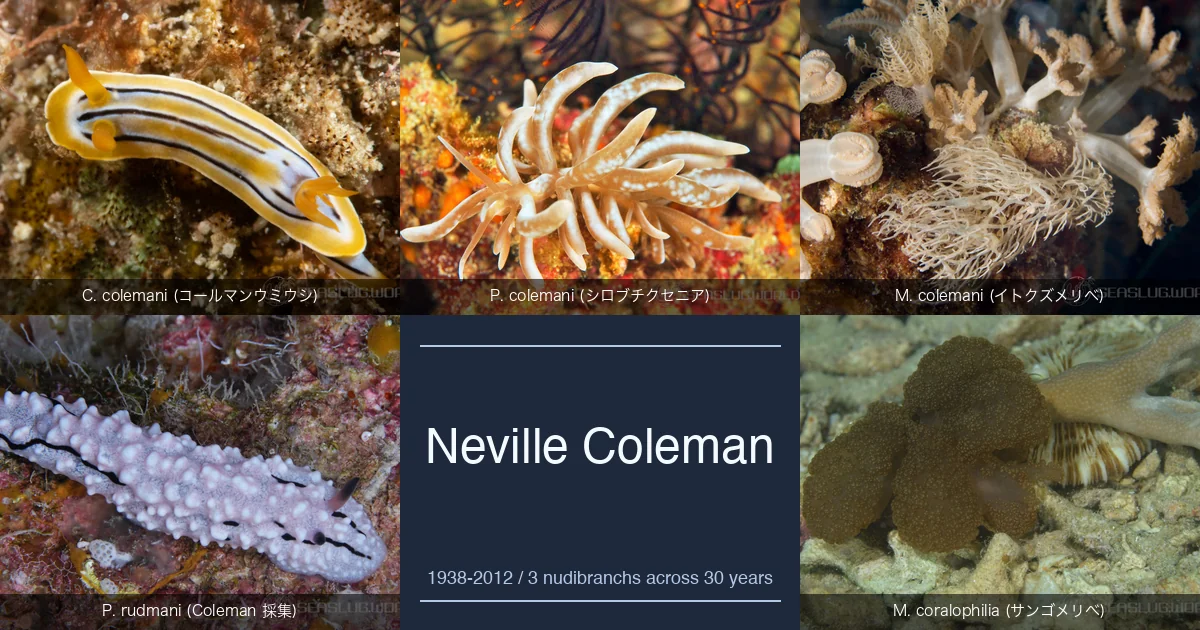
An undescribed solar-powered Phyllodesmium that had accumulated multiple records on the Sea Slug Forum as "Phyllodesmium sp. 11" was formally described in 2006 by Burghardt & Gosliner as Phyllodesmium rudmani (Zootaxa 1308: 31-47). The species was named, of course, after Rudman himself — the very person whose web platform had accumulated the records that made the description possible (P. rudmani). A perfect closed loop: sp. X → formal description → eponymous dedication to the platform's creator.
Concrete example 2: Thecacera sp. 2 → Thecacera pikachu (Pola et al., 2026)
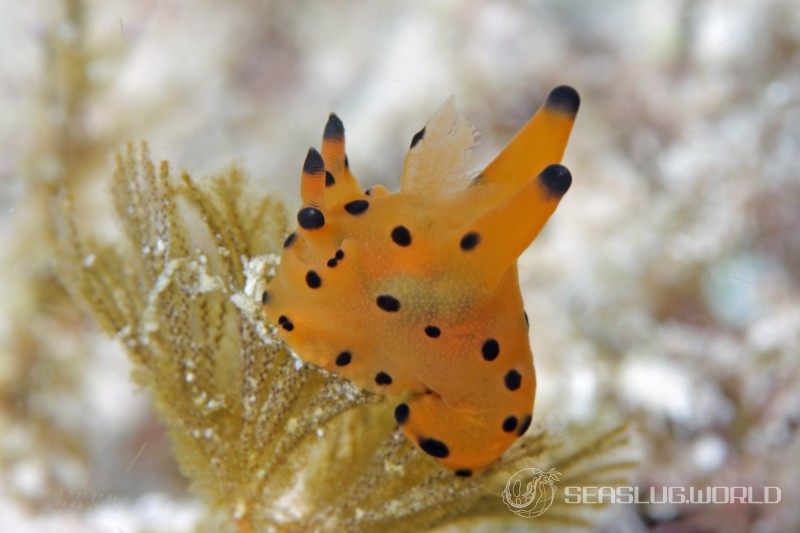
The same pipeline is still in operation 20 years later. Pola et al. (Zootaxa 5793(1): 193-217) describe new polycerids from East Timor, including Thecacera pikachu (named for the Pokémon character). Its synonymy list directly cites "Thecacera sp.2 — http://www.seaslugforum.net/showall/thecsp2". Sixteen years after the Forum stopped accepting new posts in 2010, its provisional sp. designation continues to function unchanged as a formal synonym in new species descriptions.
Two other published citations
The Forum also appears in formal species descriptions. Yonow (2018) describing chromodorids from the Red Sea (ZooKeys 770: 9-42) cites the Forum in the Remarks of her new species Doriprismatica kyanomarginata sp. n. as supporting negative evidence (no records elsewhere; seaslugforum.net/showall/gloscinc). Chow et al. (2022) in their Hong Kong sea-slug checklist (Zoological Studies 61: e52, PMC9810844) explicitly cite the Forum in their Methods as a primary source for prior records. A peer-reviewed paper from 2022 citing a web archive that stopped accepting new posts in 2010 testifies to the Forum's continuing value.
Rudman as host
Rudman was born in 1944 in New Zealand and earned his PhD at the University of Auckland on the bullomorph opisthobranchs — the cephalaspidean / head-shield group of opisthobranchs (sea slugs and relatives), which includes burrowing forms like Bulla, Haminoea and Philine. He spent his career as mollusc curator at the Australian Museum in Sydney. WoRMS attributes 186 marine species described by Rudman between 1968 and 2007.
His most substantial published work includes:
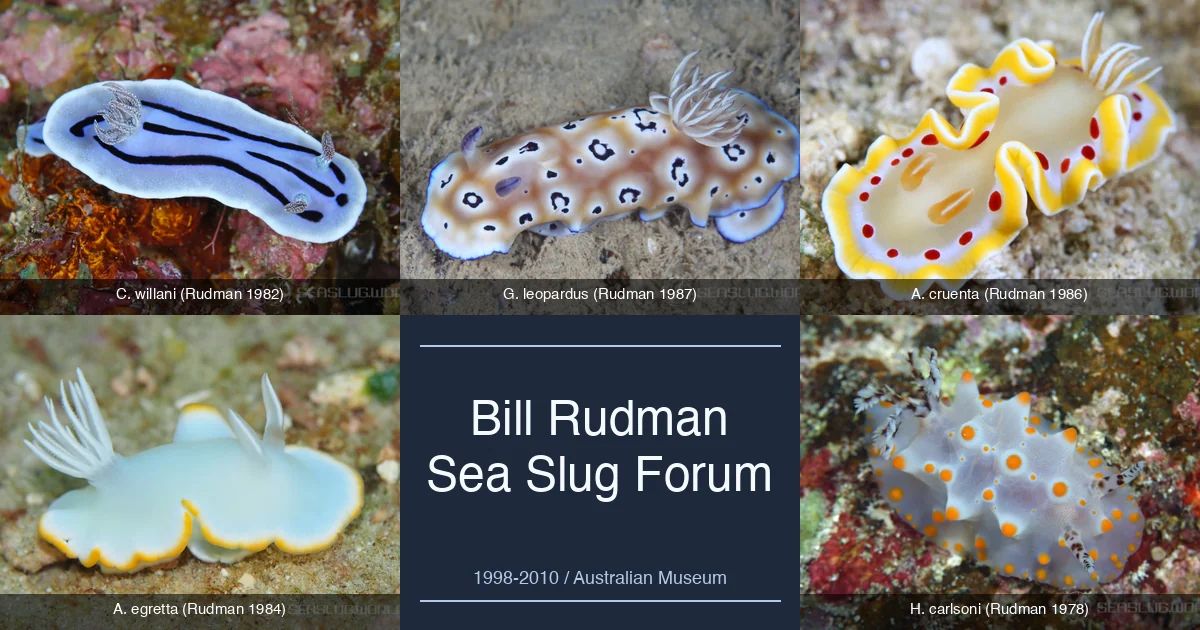
- The Chromodorididae (Opisthobranchia: Mollusca) of the Indo-West Pacific series (1980s-1990s, in Zool. J. Linn. Soc. and Molluscan Research) — the systematic base layer for the entire Indo-West Pacific Chromodorididae
- Phyllodesmium revisions (1981, 1991) — pioneering work on the octocoral-feeding, zooxanthellate aeolid genus
- Many Bornellidae, Tritoniidae, Aeolidiidae, Goniodorididae papers spanning 1971 to 2009
- On this site, 55 species cite a Rudman-authored paper as their description reference, and 79+ species mention Rudman somewhere in their body text
That he produced this volume of academic work while spending hours each day on the Sea Slug Forum is the measure of his dedication. Two factors made the workload sustainable: the Australian Museum hosted the infrastructure (servers, bandwidth, archive guarantee) as part of his curatorial role, and his deep Indo-West-Pacific museum knowledge allowed him to identify the vast majority of incoming photographs from memory.
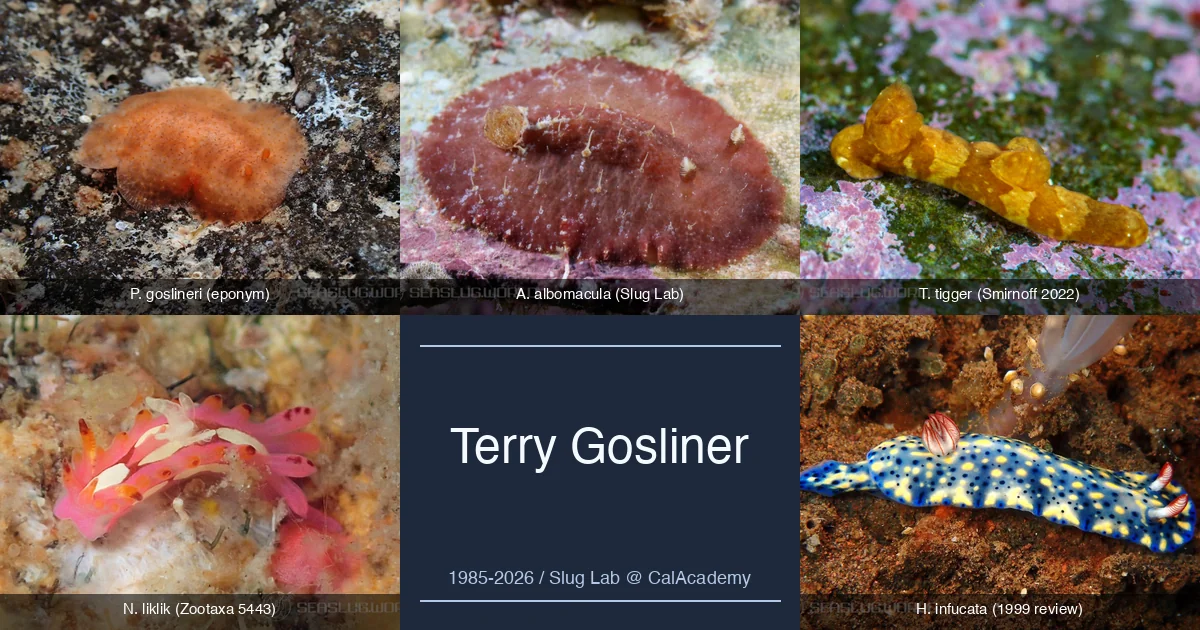
His standing in the academic community is captured by Austin et al. (2018), who dedicated Phanerophthalmus rudmani sp. nov. (from Vanuatu) to him in their Phanerophthalmus revision (Invertebrate Systematics 32: 1336-1387) with this etymology (verbatim):
This species is named after Bill Rudman, former curator of Mollusca at the Australian Museum, Sydney, for his contributions to Indo-West Pacific sea slug research. Dr Rudman was the mastermind and curator of the Sea Slug Forum, likely the most used web platform by opisthobranch researchers.
Austin et al. (2018), Phanerophthalmus revision, Invertebrate Systematics 32: 1336-1387
Three representative Rudman-described species, all also found in Japan:
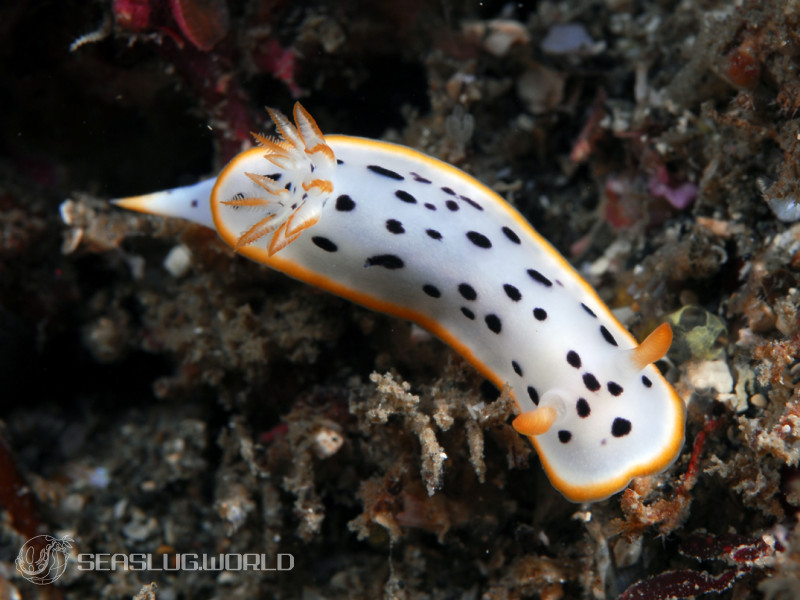
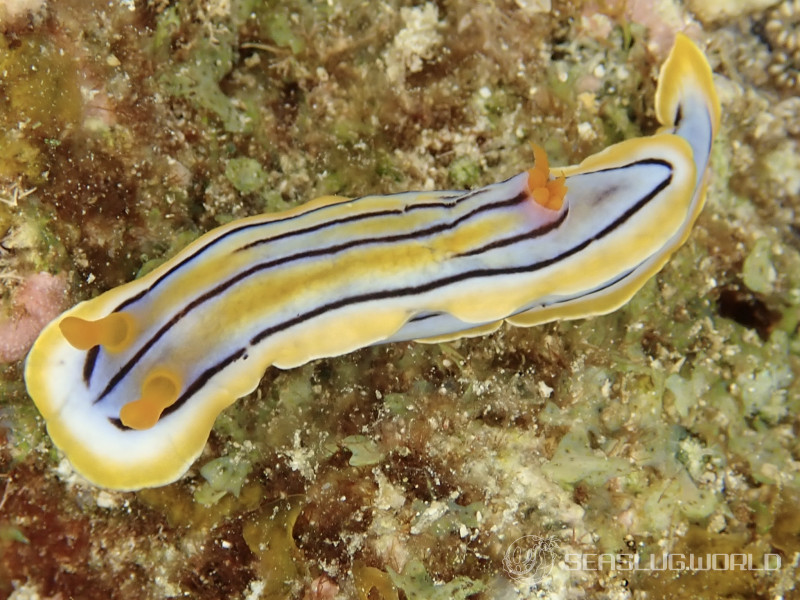
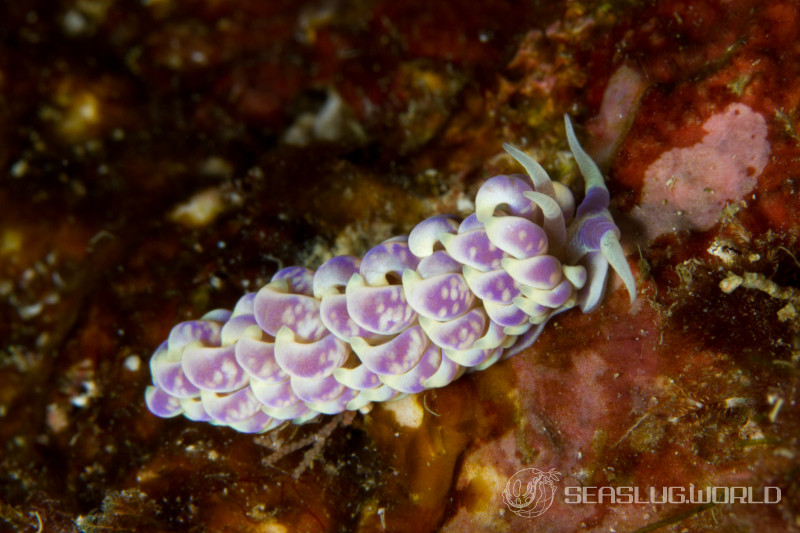
The 2010 closure and the static archive
In 2010 the Sea Slug Forum stopped accepting new posts and was frozen as a static archive. Rudman had already retired from the Australian Museum in 2005, but continued operating the Forum personally for another five years; when he stepped back in 2010 no successor curator was appointed. The archive itself remains available 24/7 at seaslugforum.net, with every fact sheet, every thread and every photo URL intact.
The web-resident "living atlas" mode is over, but the archive is, if anything, cited more steadily after closure than before. The Yonow (2018) and Chow et al. (2022) examples above demonstrate that the Forum continues to function as a primary source years after it stopped accepting input.
One point worth underlining: the archive is still live because the Australian Museum, as a public institution, keeps the server up. Privately or independently run websites can vanish entirely on the retirement, funding shortfall or hosting migration of a single individual. The Forum's continued accessibility in 2026, fifteen years after it stopped, is owed directly to that institutional backing. This is the most structurally important lesson for any independently-run nudibranch atlas, including seaslug.world: the long-term durability of a species atlas ultimately depends on some organisation committing to maintain it for the long term.
The lineage after Sea Slug Forum
The Sea Slug Forum's operating model — a single editor answering identifications directly and maintaining persistent per-species pages on the open web — is distinct from iNaturalist's crowd-consensus model.
seaslug.world also belongs to this lineage, issuing persistent URLs not only per species but also per submitted photograph, with a single editor responding to identification queries directly.
Three species named after Rudman
Three species registered on this site bear the epithet rudmani:
- Hypselodoris rudmani Gosliner & Johnson, 1999 — from Algoa Bay, South Africa. Named after Rudman in recognition of his contributions to the systematics of the Chromodorididae.
- Phyllidiella rudmani Brunckhorst, 1993 — classical "named in honour of Dr W.B. Rudman" style.
- Phyllodesmium rudmani Burghardt & Gosliner, 2006 — the formal description of the Forum's P. sp. 11, described above.
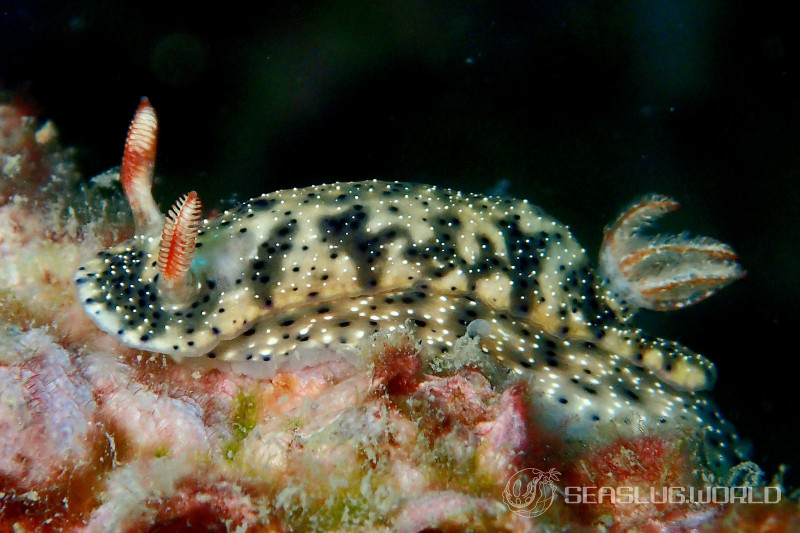
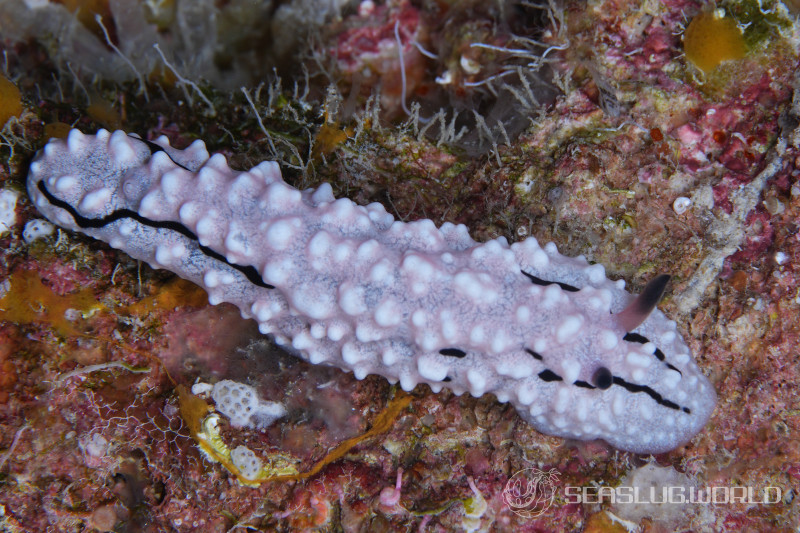
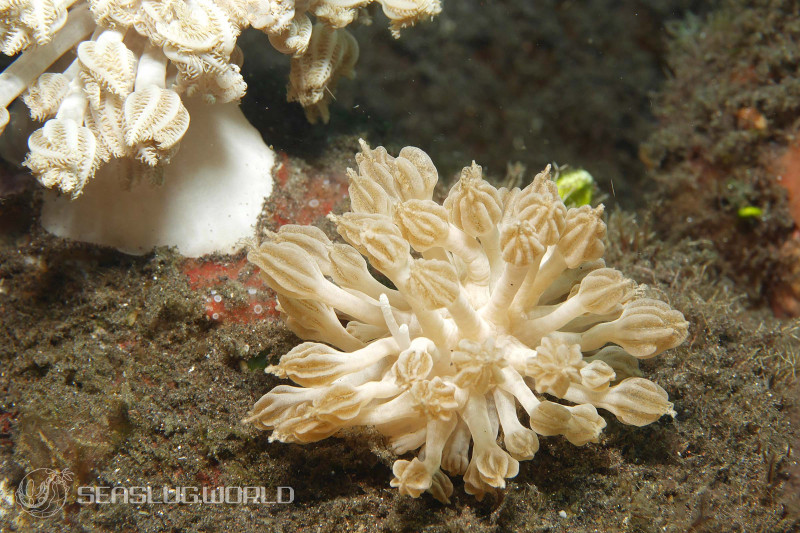
All three dedications honour Rudman both as a working systematist and as the community builder who pulled the world's scattered observational records into a single web archive.
Closing
The Sea Slug Forum began as one museum curator's small initiative in the very early days of the web, and grew over twelve years into an archive of 14,523 messages, several thousand species pages and hundreds of provisional sp. numbers. Its data is still alive and cited as a primary source in peer-reviewed work from 2018 through 2026.
What Rudman demonstrated over those twelve years was that academic papers are not the only output of taxonomy: persistent URLs on the open web, and the observations that accumulate around them, can themselves serve as primary sources for systematic work. That demonstration arrived before Wikipedia, before WoRMS and before iNaturalist — a pioneering move toward what would later be called Web 2.0, but executed for marine taxonomy in the late 1990s.
Enjoyed this post? You can tip the author directly —
Tip this post