Neville Coleman — The Australian Underwater Naturalist Whose Name Lives On in Three Nudibranchs
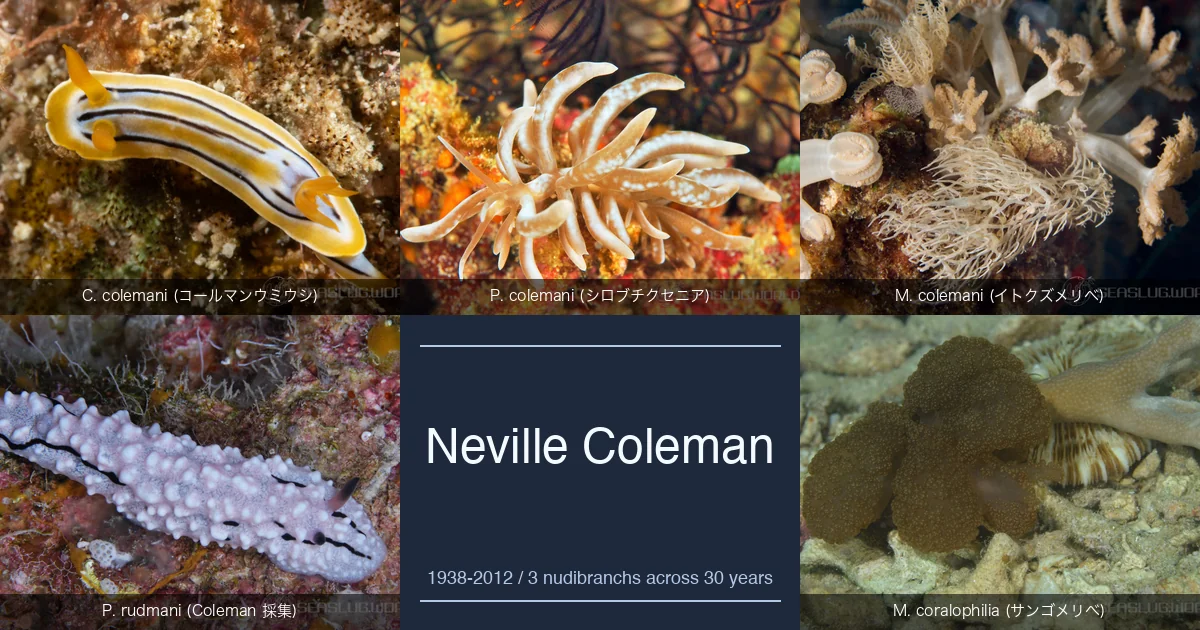
Three nudibranchs in the SEASLUG.WORLD database carry the species epithet colemani:
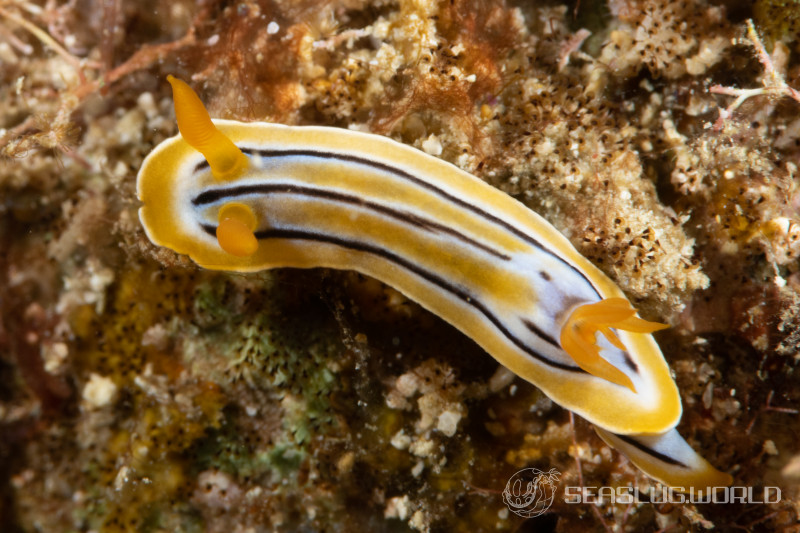
- Chromodoris colemani Rudman, 1982
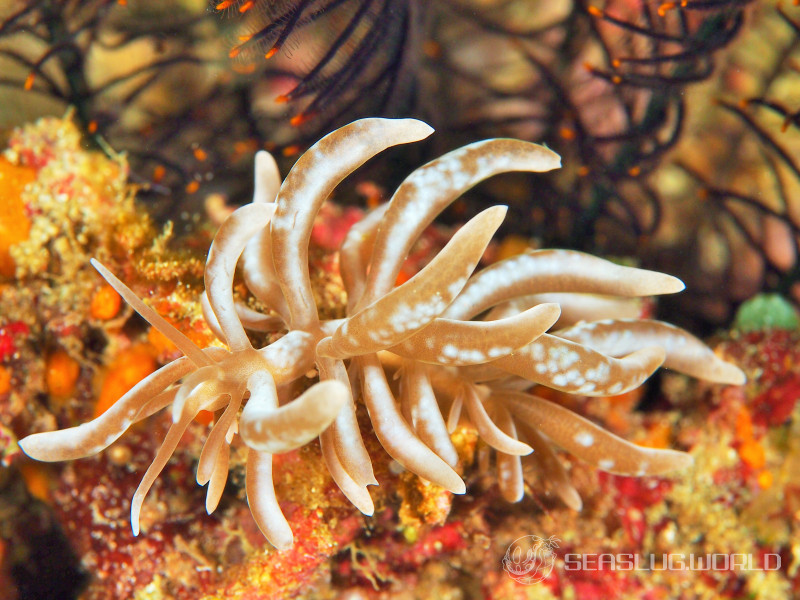
- Phyllodesmium colemani Rudman, 1991
- Melibe colemani Gosliner & Pola, 2012
All three are dedicated to one person: Neville Coleman OAM (1938–2012), the Australian underwater naturalist and photographer. He was not a taxonomist. Yet his name was inscribed in three new species across a 30-year span. This post follows how an observer-photographer-collector can drive the taxonomic record itself, through Coleman's 30-year story of eponyms.
Profile
Neville Coleman OAM (1938–2012) was an Australian underwater naturalist. He left school early to support his family and was entirely self-taught in marine biology. Between 1969 and 1973 he undertook the self-financed Australian Coastal Marine Expedition, a four-year journey covering 64,000 km of Australian coastline during which he systematically photographed marine life — the starting point of his lifelong work.
He then extended his activity across the Indo-West Pacific, publishing over 65 field guides and reference books in his lifetime, photo-documenting more than 450 new species, and curating the Australasian Marine Photographic Index (AMPI) — the largest scientifically curated visual identification database in the Southern Hemisphere, holding over 11,500 marine species cross-referenced against 150,000 colour transparencies linked to museum specimens. His base was the family-run Neville Coleman's Underwater Geographic Pty Ltd, in Springwood, Queensland. Our reference shelf includes his Nudibranchs Encyclopedia: Catalogue of Asia/Indo-Pacific Sea Slugs (2008, 416 pp), his magnum opus.
He had no formal training in taxonomy, and never described a new species. What he did do was spend more time underwater than just about anyone, photograph more individuals than just about anyone, and donate a substantial portion of those specimens to the Australian Museum in Sydney and other institutions. Those specimens went on to become the type material in papers by Rudman, Brunckhorst, Gosliner, and others — and that is how his name has come to live in the literature.
In 2007 he was inducted into the International Scuba Diving Hall of Fame. In 2011 he was awarded the Medal of the Order of Australia (OAM) for "service to conservation and the environment through the photographic documentation of Australian marine species". That a state honour recognised "photographic documentation" itself as the contribution is inseparable from the taxonomic legacy examined below.
1982–2012: A 30-Year Story of Eponyms
The three species named for Coleman span almost exactly 30 years:
| Year | Species | Author | Etymology style | Coleman's status |
|---|---|---|---|---|
| 1982 | Chromodoris colemani | Rudman | Brief | Alive, active |
| 1991 | Phyllodesmium colemani | Rudman | One-paragraph motivation | Alive, active |
| 2012 | Melibe colemani | Gosliner & Pola | Posthumous motivation ("the late") | Deceased |
In 1982 Rudman named C. colemani in his series The Chromodorididae of the Indo-West Pacific. The 1991 description of P. colemani is an unusual case in which Rudman added a full paragraph of dedication motive, recounting specific research episodes with Coleman. And in 2012, Coleman died; that same year Gosliner & Pola published the description of M. colemani invoking "the late Neville Coleman" — a posthumous dedication.
Rudman 1991 — A Dedication in One Paragraph
The etymology section of Phyllodesmium colemani (Rudman, 1991, J. Mollusc. Stud. 57(2): 187–190) reads very differently from the terse "named in honour of Dr X." formula seen in, e.g., Brunckhorst 1993. Rudman wrote out a full paragraph of motive:
"This species differs from all other species in colour, food preference and radular morphology. Some years ago when I first found cryptic nudibranchs on tropical scleractinian and alcyonarian corals I discussed with Neville Coleman, a prominent Australian underwater naturalist, the possibility of finding a nudibranch specifically feeding on Tubipora. Although I have searched many thousands of colonies in many parts of the Indo-West Pacific without success, I have much pleasure in naming this species after Neville Coleman, who recently found the specimens described here at Lord Howe Is. In recent years Neville Coleman has presented many specimens and photographs of nudibranchs he has collected to the collections of the Australian Museum."
— Rudman (1991, J. Mollusc. Stud. 57(2): 190)
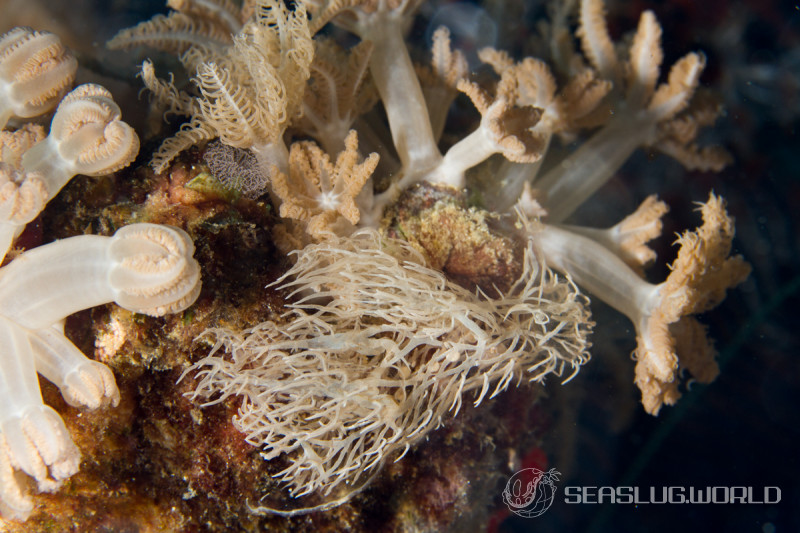
There is a lot packed into that one paragraph. Rudman and Coleman had been long-standing research discussion partners, sharing the working hypothesis that a nudibranch must exist somewhere that feeds specifically on the organ-pipe coral Tubipora. Rudman himself searched for it in vain. It was Coleman, at Lord Howe Island, who actually found it.
The type specimen (AM C161935, 18 mm preserved, 23 October 1987, 2 m depth, on a colony of Tubipora musica) was likewise collected by Coleman himself.
Gosliner & Pola 2012 — A Posthumous Dedication
Coleman died in 2012. Gosliner & Pola's paper from later that same year (Systematics and Biodiversity 10(3): 333–349), which describes the new species Melibe colemani, carries his passing into its etymology:
"ETYMOLOGY: this species is named in honour of its discoverer, the late Neville Coleman, a friend and colleague who contributed greatly to our understanding and documentation of marine diversity, particularly in the tropics of the Indo-Pacific and Australia. His dynamic presence will be greatly missed."
— Gosliner & Pola (2012, Syst. Biodivers. 10(3): 335–336)
Note that Gosliner & Pola identify Coleman explicitly as the discoverer of the species. Not themselves, the formal describers — but Coleman, the photographer-collector. That recognition is placed at the very beginning of the dedication.
The type specimen (MV 112465) was in fact collected by Coleman himself in August 2004 at Mabul Island, Malaysia. The paratype of the paper's other new species, Melibe coralophilia, was likewise collected by Coleman on the same trip at Mabul. Two new species emerged from a single dive trip, with Coleman's name embedded in both type series.
Brunckhorst 1993 — As a Specimen Provider
Coleman's contribution also shows up in papers that do not bear his eponym.
In David Brunckhorst's large-scale revision of Phyllidiidae (Brunckhorst, 1993, Records of the Australian Museum Supplement 16), part of the type series of Phyllidiella rudmani — the species named for Bill Rudman — consists of specimens Coleman collected in 1972 at Warroora, Western Australia. The same paper also draws on type material from Gosliner, Willan, Burn, and other workers; Coleman was one supplier within that broader network.
In other words, Coleman appears not only in species named after him, but also as a specimen provider in species named after others — for instance Bill Rudman's namesake, Phyllidiella rudmani. His field activity underwrote not any single taxonomist's work but the broader specimen base of Australian nudibranch research.
Coleman 1988 / 2008 — Photographs Published First
Coleman also published through his own books, and the notable thing is that he had photographed and published these species, under "sp." labels, years before the formal descriptions appeared:
- Phyllodesmium colemani was figured as Phyllodesmium sp. in Coleman's 1988 and 1989 books — Rudman 1991 cited these images in his formal description three years later.
- Melibe colemani was figured as Melibe sp. (and as Melibe sp. 4) in Coleman's 2008 Nudibranchs Encyclopedia and in Gosliner, Behrens & Valdés's 2008 Indo-Pacific Nudibranchs and Sea Slugs — Gosliner & Pola 2012 cited these images in the formal description four years later.
In both cases the same cycle runs through: observer publishes a photograph as "sp." → taxonomist follows up with a formal description years later → the species ends up dedicated to the observer. With Coleman, that cycle ran twice.
The Reach of colemani — Not Just Three Nudibranchs
The species epithet colemani extends well beyond the three nudibranchs in our database. Other marine animals confirmed to bear his name include:
- Lysiosquilla colemani (a mantis shrimp)
- Hippocampus colemani (Coleman's pygmy seahorse)
- Parapercis colemani (a sand perch)
Nudibranchs, crustaceans, syngnathids, percomorphs alike. The breadth of "colemani" reflects a documentation effort that ran across marine invertebrates in general plus reef fish, sustained alongside parallel collaborations with taxonomists in each of those fields. The three eponyms visible within our nudibranch-scope database are only a fragment of his legacy.
Closing
Neville Coleman never published a taxonomic paper. Yet across three decades his name kept turning up in the literature as new species were described — because he kept delivering photographs and specimens to the taxonomists who did.
There is no need to elevate eponyms as something special. But the next time you are sorting dive photos and land on Chromodoris colemani, it is, perhaps, a little interesting to know that there is a self-taught underwater naturalist sitting behind that name.
Enjoyed this post? You can tip the author directly —
Tip this post