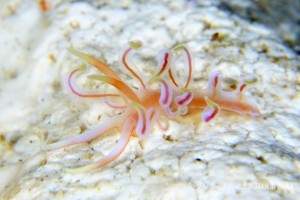
Phyllodesmium colemani Rudman, 1991
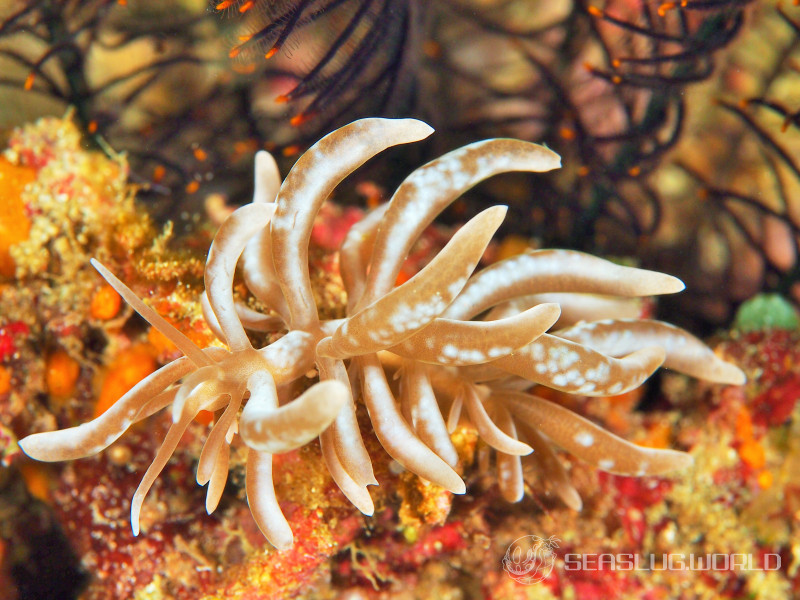
- Location
- Arthur's Rock, Anilao, Philippines
- Date
- 2015/01/29
- Length
- 20mm
- Depth
- 15.0m
- Water temperature
- 25.0℃
Description
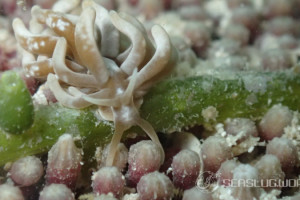
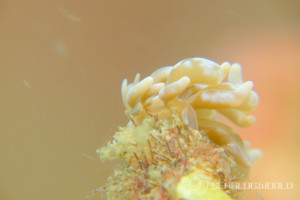
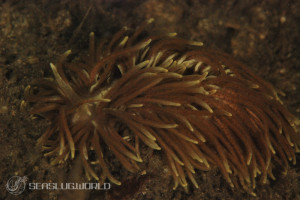
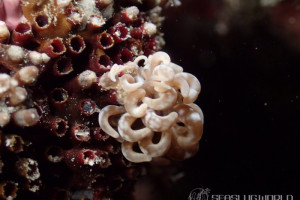
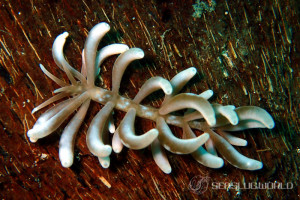
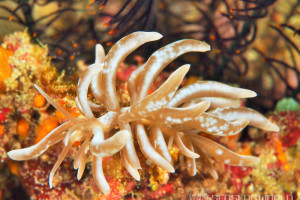
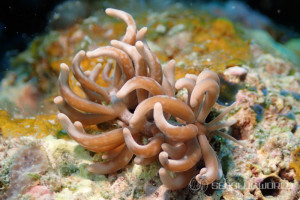
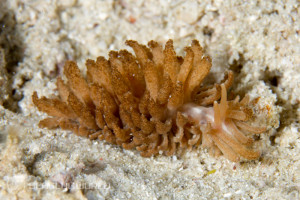
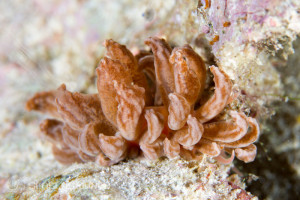
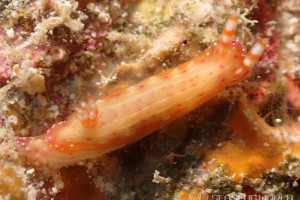
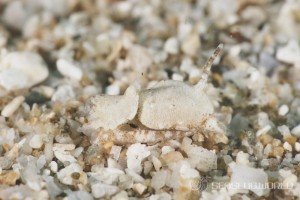
Body narrow and elongate, with up to eleven groups of cerata down each side. Long tapering oral tentacles arise from the anterior edge of the head and are similar in length to the smooth tapering rhinophores. Foot narrow, no wider than the body; anterior end broadens into a wide semicircular leading edge with angular corners. Precardiac cerata on each side form a single-rowed arch of about ten cerata, the uppermost the longest. Postcardiac cerata are arranged in up to ten vertical rows spaced evenly down the body; the number per row decreases posteriorly. Cerata have a cylindrical basal stalk that broadens and becomes somewhat flattened distally; at rest the cerata are somewhat coiled.Body and cerata translucent greenish brown with small brown specks visible on the dorsal body surface and cerata. Greenish-white patches run down each side below and between the cerata. The ventral edge of each ceras carries a greenish-white band; along the slightly flattened dorsal edge a pair of white lines runs and merges at the tip. A central digestive gland duct runs along each ceras, giving off branches that radiate to the ceratal wall; zooxanthellae are retained within the digestive gland branches, sustaining a photosymbiotic lifestyle. Reaches 12-18 mm.
Distribution
Type locality: Lagoon, Lord Howe Island, Coral Sea, Australia, 2 m, on a colony of Tubipora musica. Subsequently recorded elsewhere in the western Pacific including the Philippines.Etymology
The specific epithet colemani honours Neville Coleman, the Australian underwater naturalist who collected the type material and donated many nudibranch specimens and photographs to the Australian Museum.Remarks
Extremely well camouflaged on its food, the stoloniferan "Organ Pipe Coral" Tubipora musica — the background colour of the nudibranch matches the colour of the polyp tentacles, and the white edges to the central axis of each Tubipora tentacle are matched by the whitish edges to the cerata. Within Phyllodesmium, this species is unique in feeding on the stoloniferan octocoral Tubipora musica; congeners typically feed on alcyonaceans such as Xenia or Sinularia.References
Featured in this book
小野篤司 & 加藤昌一. (2020). 新版 ウミウシ. 誠文堂新光社.
誠文堂新光社
This species, Phyllodesmium colemani, is included in the book.
View on Amazon PR (Amazon Associates)Seasonality
Shooting Locations
Loading shooting locations...
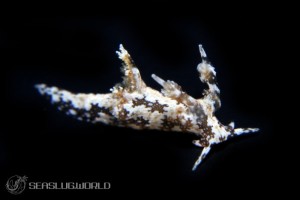
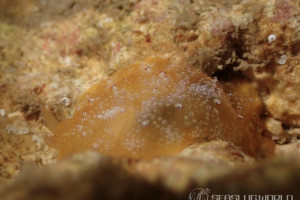
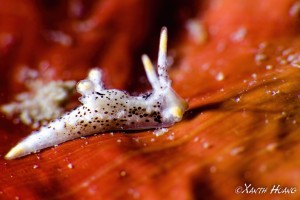
Photos of Phyllodesmium colemani







Same Genus Nudibranchs

Similar Colors Nudibranchs

Academic Database
Sea slug observation data is available in international marine biodiversity databases.