Phyllodesmium tuberculatum E. Moore & Gosliner, 2009
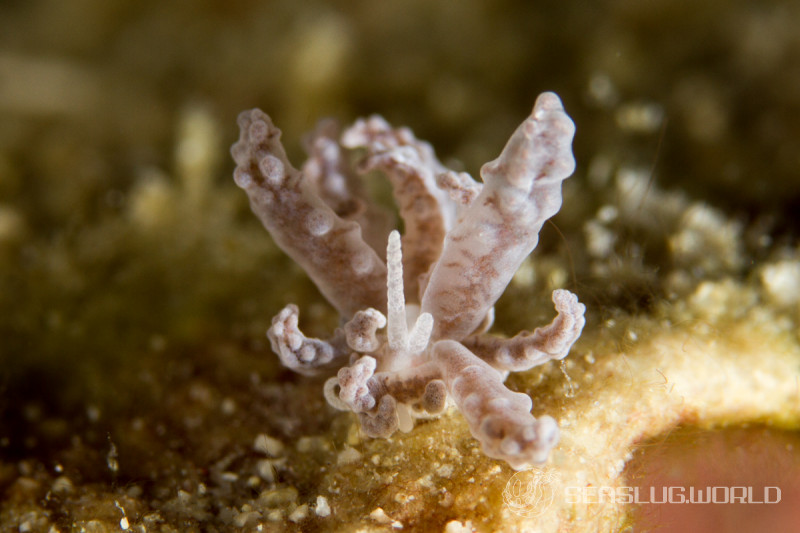
- Location
- Romblon Island, Philippines
- Date
- 2018/02/21
- Length
- 10mm
- Depth
- 15.0m
- Water temperature
- 28.0℃
Description
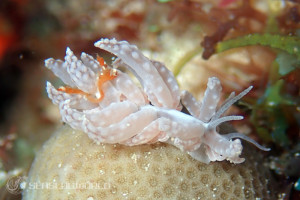
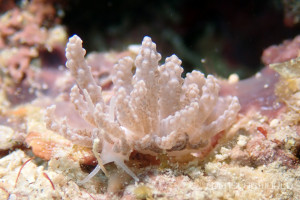
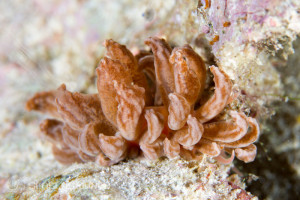
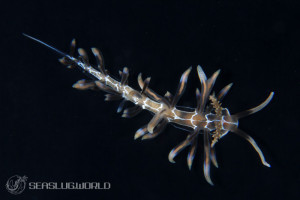
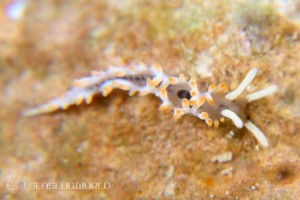
A small aeolid nudibranch reaching about 13–14 mm in preserved body length. The body is elongate, with large cerata that cover most of the dorsum and mantle. The animal is predominantly bluish grey throughout — body, rhinophores, oral tentacles, cerata and foot — and the large cerata are themselves bluish grey and bear non-uniformly distributed, rounded, nodulose tubercles, concentrated along the narrow margins and ends of the cerata. The cerata terminate bluntly with a small but distinctive cnidosac that lacks nematocysts. Smaller cerata along the posterior and lateral margins lack tubercles and are smooth, cylindrical and pointed. The digestive gland branches secondarily and possibly tertiarily through the cerata; symbiotic zooxanthellae occur in great numbers in the digestive tissue of the larger cerata but are absent from the smallest lateral cerata. The rhinophores are smooth (with a slightly wrinkled surface), conical with blunt tips, and roughly the same length as the smooth, tapering oral tentacles.Distribution
Type locality: Twin Rocks, Mabini, Batangas Province, Luzon Island, Philippines (0–17 m depth). At the original description (Moore & Gosliner 2009) the species was known only from southern Luzon Island, with paratype material additionally collected at Sepok (Batangas Province).Etymology
From Latin tuberculatus (= warty, covered with small tubercles), in reference to the round nodulose tubercles on the cerata.Remarks
The species lives on coral and rubble close to its prey, a soft coral in the genus Anthelia (family Xeniidae), and is one of the solar-powered (kleptoplastic) members of Phyllodesmium, retaining symbiotic zooxanthellae in the digestive gland branches within the larger cerata. Other tuberculate congeners include Phyllodesmium crypticum, Phyllodesmium hyalinum, Phyllodesmium lizardensis, Phyllodesmium lembehensis, and Phyllodesmium koehleri; Phyllodesmium tuberculatum is distinguished from all of these by the conspicuous, spherical and highly raised nodules that occur over all parts of the largest cerata.References
- Phyllodesmium sp. 2, Gosliner T.M., Behrens D.W. & Valdés Á. (2008). Indo-Pacific Nudibranchs and Sea Slugs: A field guide to the world's most diverse fauna. Sea Challengers Natural History Books, 426 pp.
- Phyllodesmium tuberculatum sp. nov., Moore E.J. & Gosliner T.M. (2009). Three new species of Phyllodesmium Ehrenberg (Gastropoda: Nudibranchia: Aeolidoidea), and a revised phylogenetic analysis. Zootaxa. 2201: 30-48. https://doi.org/10.11646/zootaxa.2201.1.6
- Phyllodesmium tuberculatum, Terrence Gosliner, Ángel Valdés and David Behrens. (2015). Nudibranch and Sea Slug Identification Indo-Pacific. New World Pubns Inc.
- イボクセニアウミウシ(新称), 中野理枝. (2018). 日本のウミウシ. 文一総合出版.
Featured in this book

Terrence Gosliner, Ángel Valdés and David Behrens. (2018). Nudibranch and Sea Slug Identification Indo-Pacific 2nd Edition. New World Pubns Inc.
New World Publications
This species, Phyllodesmium tuberculatum, is included in the book.
View on Amazon PR (Amazon Associates)Seasonality
Shooting Locations
Loading shooting locations...
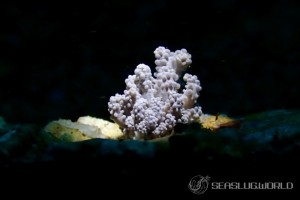
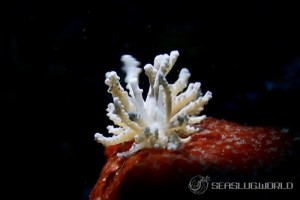
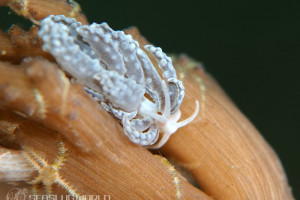
Photos of Phyllodesmium tuberculatum





Same Genus Nudibranchs
Similar Colors Nudibranchs

Academic Database
Sea slug observation data is available in international marine biodiversity databases.