Aeolidiella glauca (Alder & Hancock, 1845)
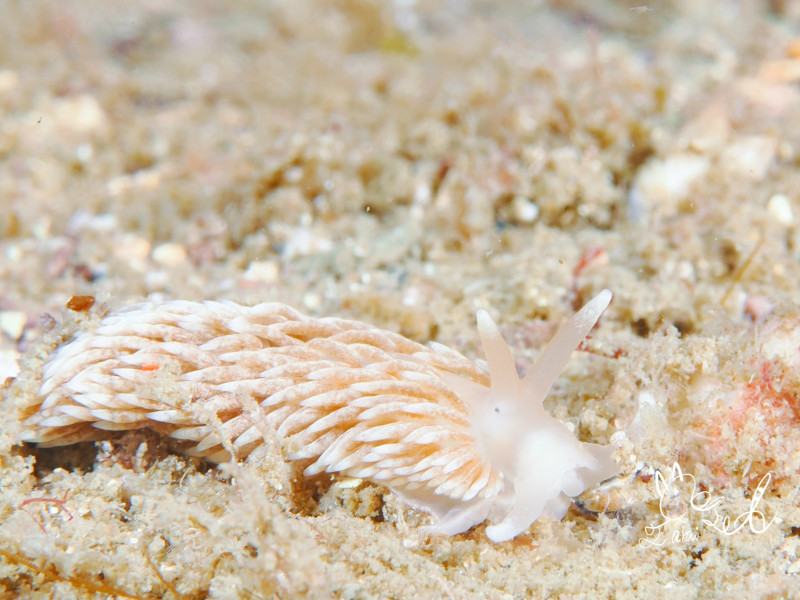
- Location
- Norra Klätten, West Coast of Sweden, Sweden
- Date
- 2025/06/29
- Length
- 25mm
- Depth
- 20.0m
- Water temperature
- 15.0℃
Description
A medium-sized aeolidiid reaching up to 40–45 mm in length. Body elongated and broad, tapering posteriorly. Background coloration translucent white to cream, variably overlaid by pale orange, yellowish or beige pigments concentrated along the central dorsum from the cephalic region to the post-pericardial zone. Iridescent opaque-white speckles scattered on the back, foot edges and rhinophores; conspicuous white spots along the edges of the translucent foot are diagnostic of this species. Rhinophores orange or yellow with white tips, smooth and moderately long. Oral tentacles translucent with iridescent white pigment on the inner surface, conical, slightly longer than the rhinophores. Cerata densely arranged in many transverse rows. Anatomy: jaw masticatory border smooth; radular formula 11–16 × 0.1.0, teeth bilobed with up to 31 elongate, acutely pointed denticles on each side of a minute triangular central cusp; reproductive system diaulic with an unarmed penial papilla.Distribution
North-eastern Atlantic. Molecular re-evaluation by Carmona et al. 2026 confirms records from Norway, Scotland and France; reports from Sweden, Denmark, the Netherlands, Portugal and Spain require further barcoding because of confusion with the cryptic Aeolidiella avatar Carmona et al., 2026. Type locality: Torbay, England, UK.Etymology
The specific epithet 'glauca' (Latin) is the feminine form of 'glaucus', meaning 'bluish-grey' or 'sea-green', referring to the body coloration.Remarks
Originally described by Alder & Hancock 1845 as Eolis glauca and transferred to Aeolidiella by Bergh 1867. Carmona et al. 2026 revealed that A. glauca sensu lato is a species complex; Aeolidiella avatar sp. nov. was segregated, and A. rubra Bergh, 1871 is treated as nomen dubium. Eolis angulata Alder & Hancock, 1844 (in part), Eolis inornata Alder & Hancock, 1845 (in part) and Quatrefages's Eolidina paradoxum, 1843 are listed as synonyms. Restricted to the Atlantic Ocean and Mediterranean Sea following the new generic concept.References
- Aeolidiella glauca (Alder & Hancock, 1845), Carmona L., Martín-Hervás M.R., Pola M., Gosliner T.M. & Cervera J.L. (2026). Unfinished symphony: updating the systematics of Aeolidiidae (Nudibranchia, Gastropoda), with special focus on Aeolidiella Bergh, 1867. Invertebrate Systematics, 40: IS24105. https://doi.org/10.1071/IS24105
A Kindle field guide by the site author

Kimoto N. (2026). Sea Slugs of Japan & the Indo-Pacific, 2nd Edition.
Kindle Edition
View on Amazon PR (Amazon Associates)Seasonality
Shooting Locations
Loading shooting locations...
Photos of Aeolidiella glauca

Academic Database
Sea slug observation data is available in international marine biodiversity databases.