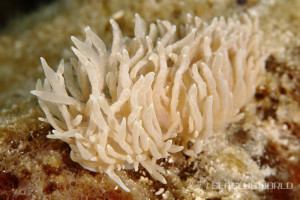
Phyllodesmium hyalinum Ehrenberg, 1831
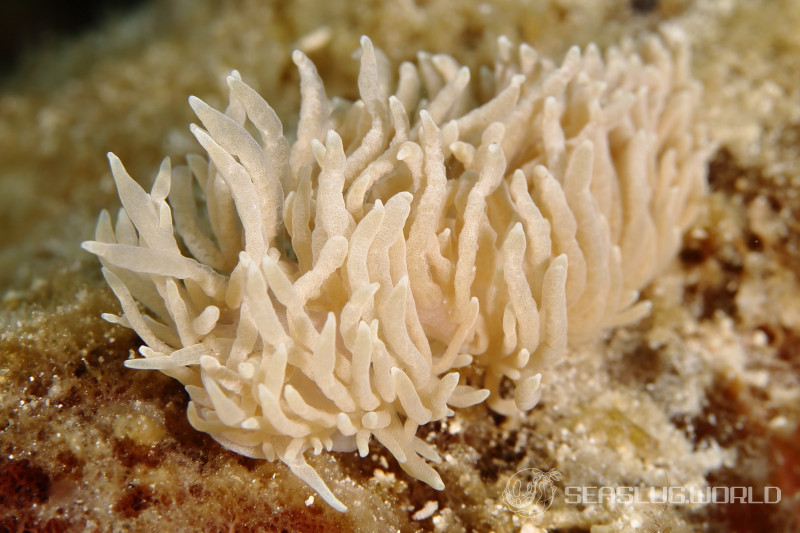
- Location
- Lighthouse, Cabilao Island, Bohol, Philippines
- Date
- 2015/08/31
- Length
- ??mm
- Depth
- 20.0m
- Water temperature
- 26.0℃
Description
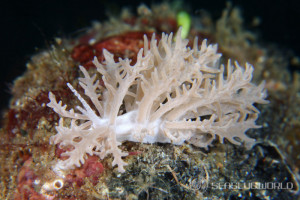
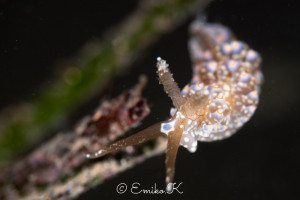
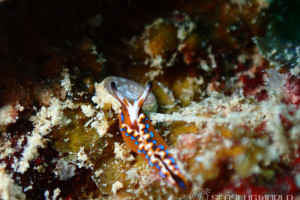
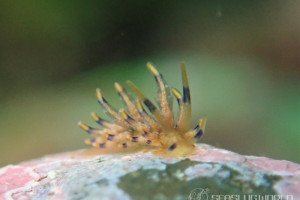
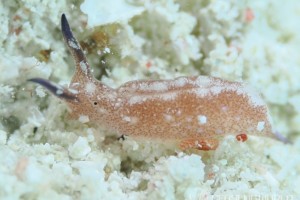
A small aeolid-like nudibranch reaching about 25 mm in length. Body elongate, linear, sub-quadrangular, anteriorly truncate and posteriorly tapering into an acute tail. Body and rhinophores translucent (hyaline), with the yellowish digestive gland visible through the integument. Five clusters of cerata on each side, each ceras lanceolate-flattened with a brown sheath enclosing a whitish vascular brush. The first cluster contains 8 cerata per side, the second 7, the third and fourth 4 each, and the fifth 2 — totalling about 50 cerata. The first three clusters are dorsally separated; the last two contiguous. Four anterior dorsal filiform white tentacles (no labial tentacles), the frontal ones not reaching the largest gills in length. Two indistinct dark eyes behind the rhinophore bases. Mouth without jaws; radula a narrow elongate denticulate ribbon with a double dense alternating series of strong hooks. Anal aperture as a small tubule on the right side near the second ceratal cluster. Eats Xenia and similar octocorals.Distribution
Indo-West Pacific. The type locality is Tor (El-Tor, Sinai), Red Sea, where Ehrenberg recorded the species as common; subsequently widely reported across tropical and subtropical Indo-Pacific waters.Etymology
The specific epithet hyalinum is the Latin for "transparent" or "glassy" (from Greek hyalos, "glass"), in reference to the translucent body that diagnostically reveals the yellowish digestive gland through the integument.Remarks
Originally described as the type species of the new genus Phyllodesmium erected by Ehrenberg in Symbolae Physicae, Animalia evertebrata, Pars I (Mollusca) (Berlin, 1831). Ehrenberg observed feeding behaviour first-hand: "Like terrestrial slugs gnawing herbs and flowers, Phyllodesmia devour the floral processes of polyps. I have always found these in various Xenia, of which they had eaten parts; they are therefore carnivorous." This is the first record of zooxanthellate-coral predation by the genus, now known to include several solar-powered species harbouring symbiotic zooxanthellae.References
- Phyllodesmium hyalinum, Ehrenberg C.G. (1831). Symbolae physicae, seu Icones et descriptiones corporum naturalium novorum aut minus cognitorum, quae ex itineribus per Libyam, Aegyptum, Nubiam, Dongalam, Syriam, Arabiam et Habessiniam ... Decas prima. Animalia evertebrata exclusis insectis. Pars I. Mollusca. Berolini, ex Officina Academica.
- ボブクセニアウミウシ(新称), 小野篤司 & 加藤昌一. (2020). 新版 ウミウシ. 誠文堂新光社.
Featured in this book
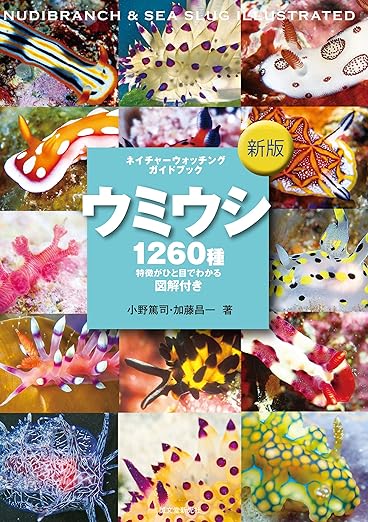
小野篤司 & 加藤昌一. (2020). 新版 ウミウシ. 誠文堂新光社.
誠文堂新光社
This species, Phyllodesmium hyalinum, is included in the book.
View on Amazon PR (Amazon Associates)Seasonality
Shooting Locations
Loading shooting locations...
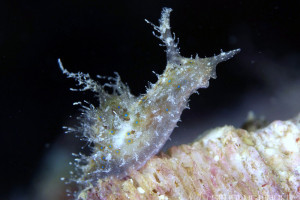
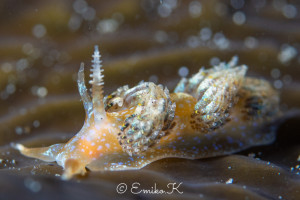
Photos of Phyllodesmium hyalinum
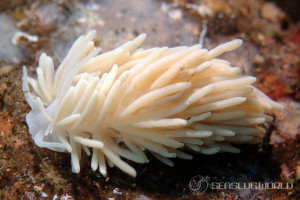

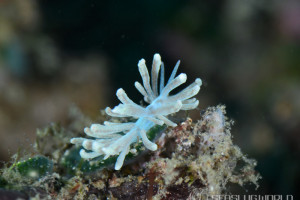


Same Genus Nudibranchs

Similar Colors Nudibranchs
Academic Database
Sea slug observation data is available in international marine biodiversity databases.