Bursatella ocelligera (Bergh, 1902)
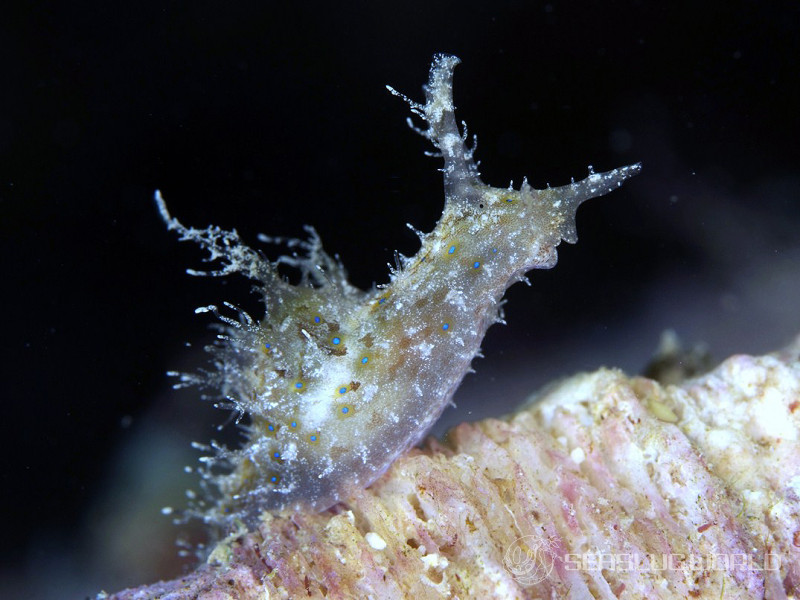
- Location
- Ishikiri(Awa), Okinawa Island (Motobu and Northern area), Okinawa, Japan
- Date
- 2012/05/10
- Length
- 10mm
- Depth
- 8.0m
- Water temperature
- 24.0℃
Description
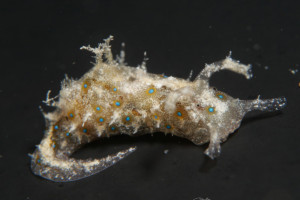
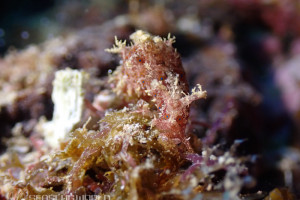
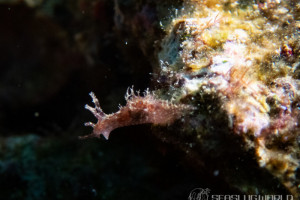
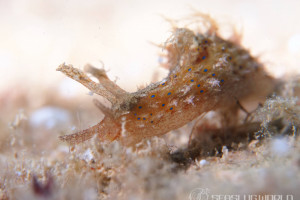
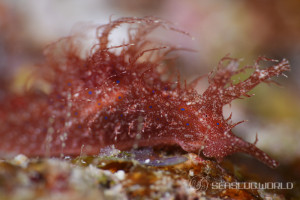
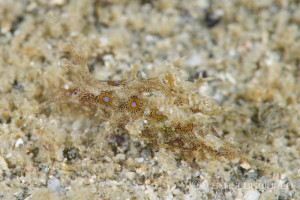
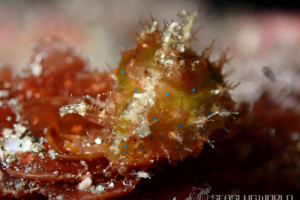
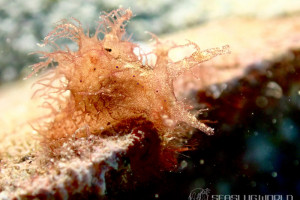
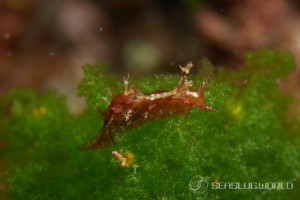
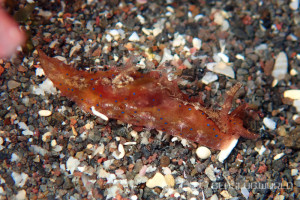
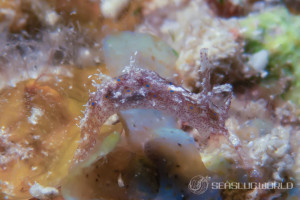
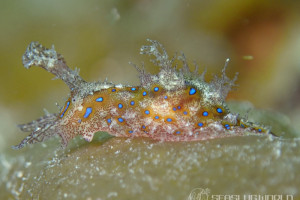
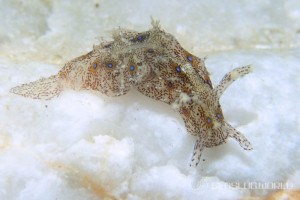
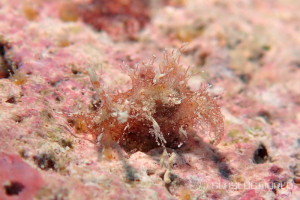
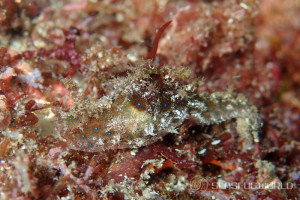
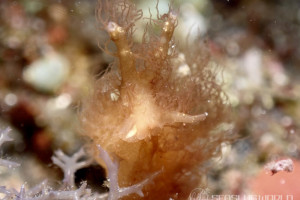
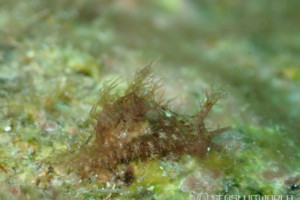
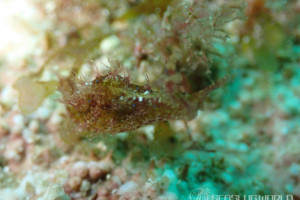
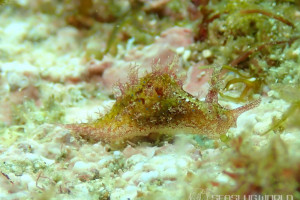
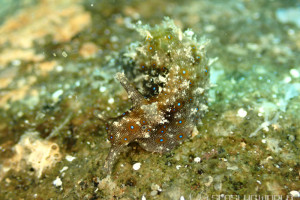
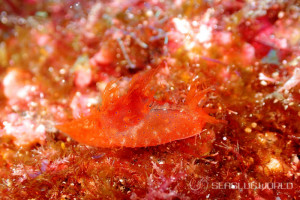
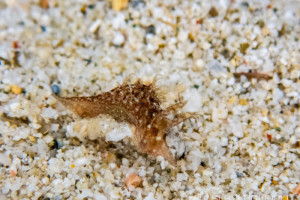
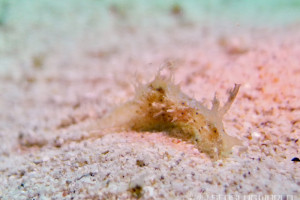
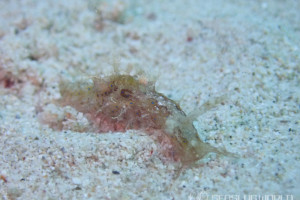
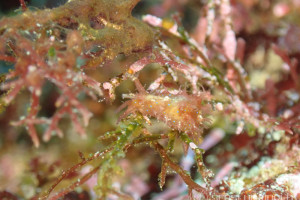
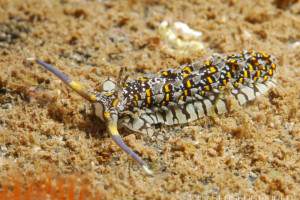
A medium-sized aplysiid, about 30 mm in body length. The ground colour is yellowish white, appearing here and there as small spots and narrow stripes (especially anteriorly) but mostly displaced by close-standing black points which often form small rings. Between the rhinophores, on the gill-covers and at the base of the tentacles, groups of somewhat larger black spots with a light halo are seen.Along each side of the body lies a series of 6-7 irregularly arranged eye-like spots (1.25-1.5 mm in diameter), with another 3-4 of the same kind on the gill-covers. These eye-like spots are round or oval, with a whitish pupil framed inwardly by a brownish-yellow ring and outwardly by a somewhat broader light ring. A fine eye-spot lies between the rhinophore and the tentacle on each side. The dorsal tufts are whitish, only the hindmost being brown at their bases. The front third of the foot brim bears whitish small tubercles; the rest of the brim shows whitish narrow transverse furrows; the foot sole carries numerous confluent greyish points and spots.
Dorsal tufts are sparse on the upper anterior body; on the hinder body, with the rudimentary foot-lobes (gill-covers), 4-5 irregular series of tufts are present, each with about 7-8 tufts. The gill-slit is narrow, wider in front; the gill-cover is rather thin.
Distribution
Type locality: coast of Koh Chang, southeastern Thailand. The original description also reports a specimen from the coast of Lem Ngob; both were collected by the Danish Expedition to Siam. The species is now known broadly across the tropical western Pacific.Etymology
The specific epithet is built from Latin ocellus ("little eye, eye-spot") and -gera ("bearing, carrying"), meaning "ocellus-bearing", referring to the conspicuous eye-like spots along the sides and on the gill-covers.Remarks
Originally described as Aclesia ocelligera. Aclesia is now treated as synonymous with Bursatella, and the species is accordingly placed in Bursatella; the parentheses in the author citation reflect this transfer.References
- Aclesia ocelligera Bgh. n. sp., Bergh R. (1902). The Danish Expedition to Siam. I. Gasteropoda opisthobranchiata. Det Kongelige Danske Videnskabernes Selskabs Skrifter, 6. Række, Naturvidenskabelig og Mathematisk Afdeling. 12(2): 153-218, pls. I-III.
- Bursatella ocelligera, Bazzicalupo E., Crocetta F., Gosliner T.M., Berteaux-Lecellier V., Camacho-García Y.E., Chandran B.K.S. & Valdés Á. (2020). Molecular and morphological systematics of Bursatella leachii de Blainville, 1817 and Stylocheilus striatus Quoy & Gaimard, 1832 reveal cryptic diversity in pantropically distributed taxa (Mollusca
A Kindle field guide by the site author

Kimoto N. (2026). Sea Slugs of Japan & the Indo-Pacific, 2nd Edition.
Kindle Edition
View on Amazon PR (Amazon Associates)Seasonality
Shooting Locations
Loading shooting locations...
Photos of Bursatella ocelligera























Same Genus Nudibranchs
Similar Colors Nudibranchs

Academic Database
Sea slug observation data is available in international marine biodiversity databases.