Armina semperi (Bergh, 1866)
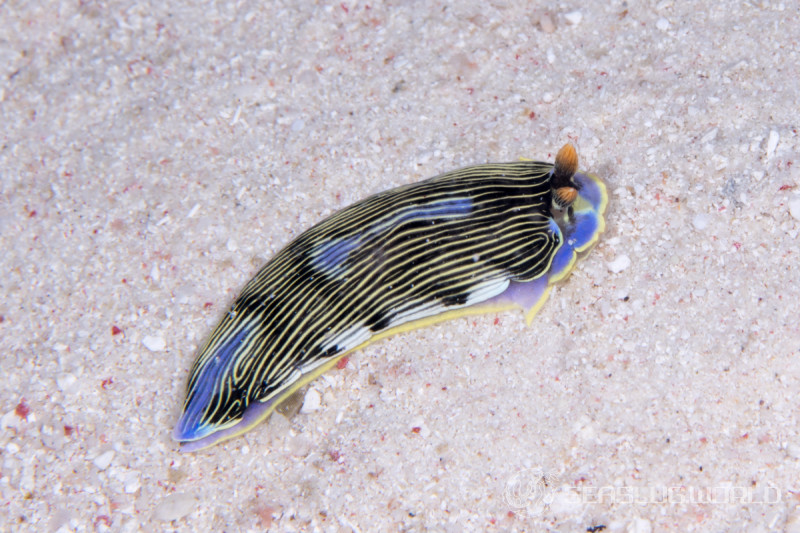
- Location
- Dorodoro Park II, Miyakojima, Okinawa, Japan
- Date
- 2018/07/05
- Length
- 25mm
- Depth
- 15.0m
- Water temperature
- 26.0℃
Description
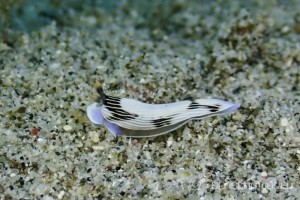
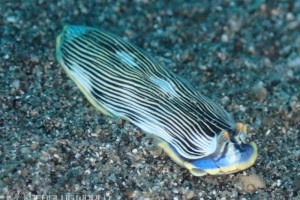
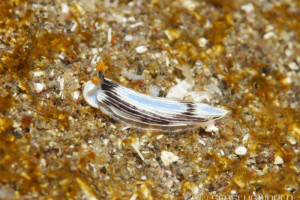
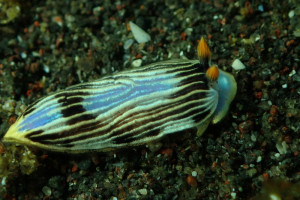
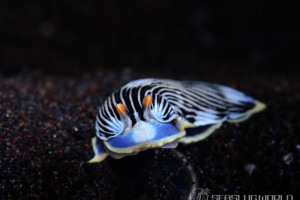
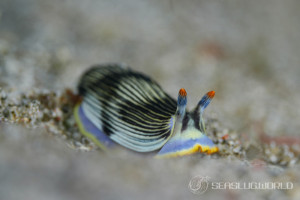
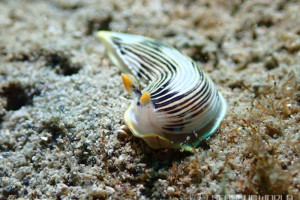
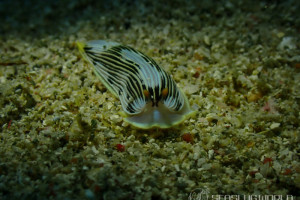
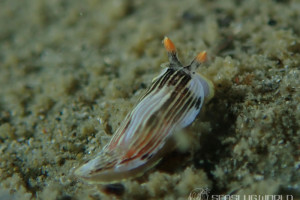
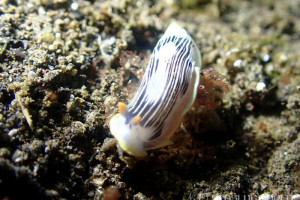
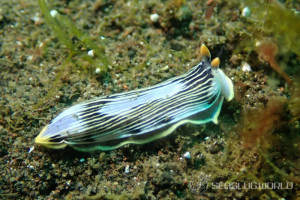
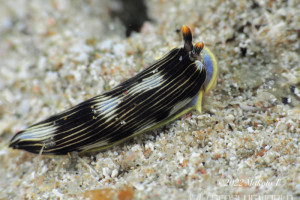
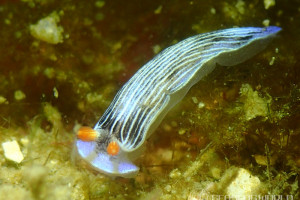
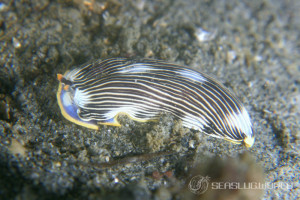
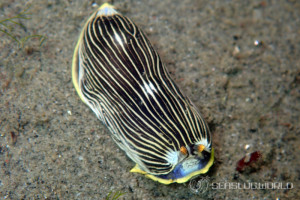
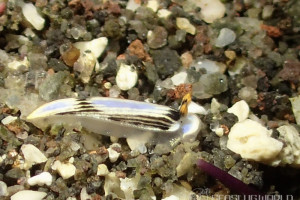
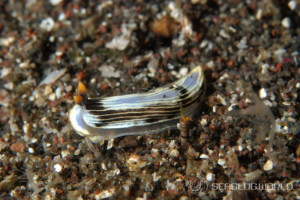
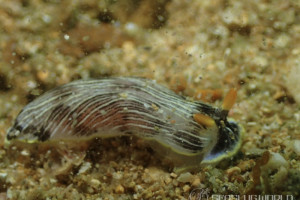
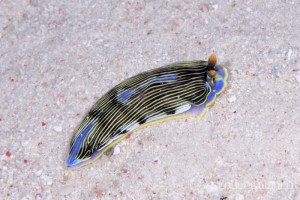
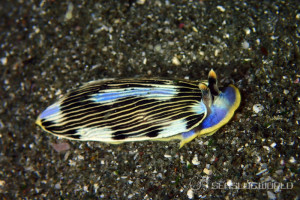
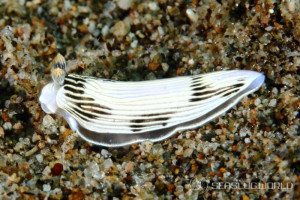
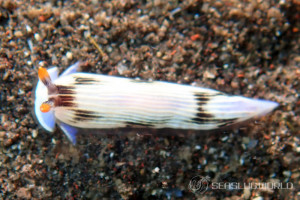
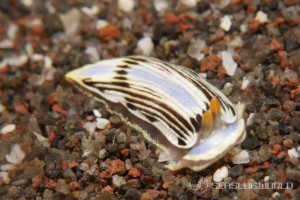
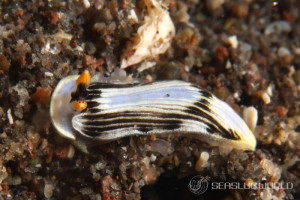
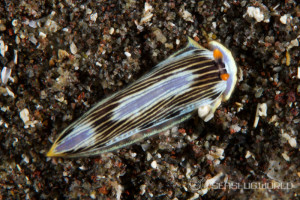
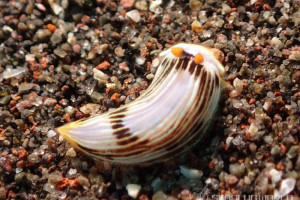
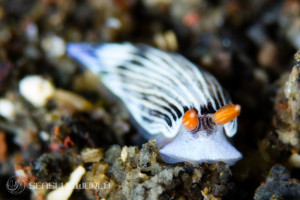
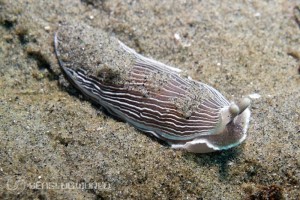
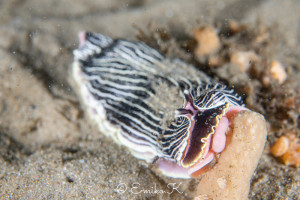
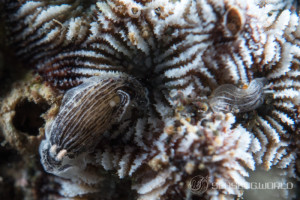
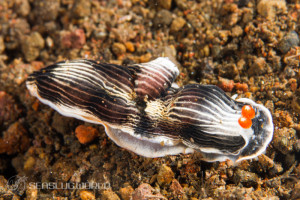
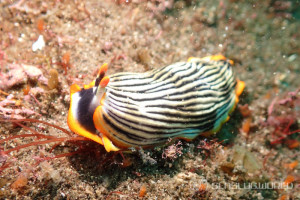
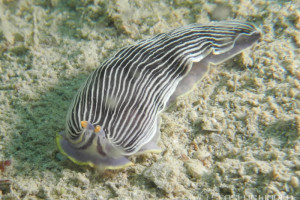
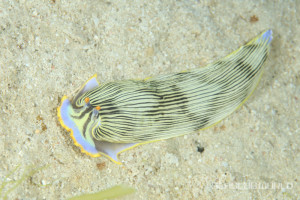
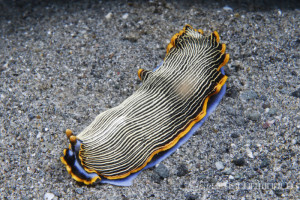
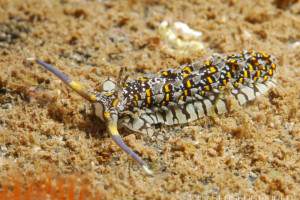
The original description (Bergh, 1861) is based on four specimens collected by Carl Semper at Masinloc near Zamboanga, Luzon, Philippines, on 28 October 1859, in low water between stones on a coral bank; Semper later took a single individual of the same or a closely related form at Ubay on Bohol. Bergh characterised the species in a Latin diagnosis: "Corpus depressum. Pallium nigerrimum, lineis flavis, postice sat divergentibus pervagatum, margine rufum; rhinophoria pedunculo nigerrimo, clavo rubido; clypeus tentacularis coeruleo-cinerascens, antice et postice niger, margine antico rubido; podarium superne caeruleo-cinerascens." — body depressed; mantle deeply black, traversed by yellow lines that diverge somewhat posteriorly, with a reddish margin; rhinophores with a black peduncle and a reddish club; tentacular shield bluish-grey, black anteriorly and posteriorly with a reddish front edge; the upper side of the foot bluish-grey.The caruncle is small and bifid; the anterior lateral lamellae are elongate and continuous, and the rest are leaf-like and closely set. The radula has 50-55 rows in total, of which 22-24 are exposed on the tongue. The median tooth carries 4-5 strong denticles on either side; there are 30-32 lateral teeth, the inner 7-8 denticulate, the rest smooth. The first lateral tooth bears 4-5 fine denticles on its outer cutting edge; the next 6-7 carry one or two denticles on the outer edge behind the apex. Bergh describes the animal as "diese schöne Art" — this beautiful species.
Distribution
Type locality: Masinloc, near Zamboanga, Luzon, Philippines. Bergh also refers to additional material from Ubay on Bohol. The species ranges across the Indo-West Pacific including Japan, where it is a nocturnal predator on soft bottoms, emerging from the sediment at night to feed on octocorals.Etymology
The specific epithet semperi honours the German zoologist Carl Gottfried Semper (1832-1893) of Würzburg, who collected the type material on his Philippine expedition and supplied Bergh with the bulk of the Pleurophyllidiidae specimens treated in Heft I. In the same volume Bergh also dedicated Flabellina Semperi and Chelyonotus Semperi to him.Remarks
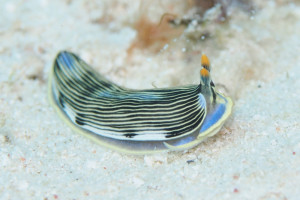
Many specimens identified as Armina semperi across the Indo-West Pacific, including Japan, have been shown by recent re-examination of the type material to differ from Bergh's original description. Thai specimens have been redescribed as Armina scotti; Japanese specimens currently treated as A. semperi show rhinophore-tip coloration (white to yellow) that does not match the reddish tip described from the type, and likely represent a separate undescribed species.Closely resembles the syntopic Armina japonica (タテジマウミウシ) and is often confused with it in life. The two are best distinguished by the arrangement of the lateral lamellae (gill-bearing longitudinal ridges along the body sides), which run obliquely in this species and vertically (parallel) in A. japonica.
References
- Armina semperi, Rafinesque C.S. (1814). Précis des découvertes et travaux somiologiques de Mr. C.S. Rafinesque-Schmaltz entre 1800 et 1814. Royale Typographie Militaire, Palerme. 56 pp.
- ホソハスエラウミウシ(新稱), 生物學御研究所編. (1955). 相模湾産後鰓類図譜〈補遺〉. 岩波書店.
- ホソハスエラウミウシ, 鈴木敬宇. (2000). ウミウシガイドブック〈2〉. TBSブリタニカ.
- ホソハスエラウミウシ, 中野理枝. (2004). 本州のウミウシ. ラトルズ.
- ホソハスエラウミウシ, 小野篤司 & 加藤昌一. (2009). ウミウシ. 誠文堂新光社.
- Armina semperi (Bergh, 1866), Mehrotra R., Caballer Gutierrez M. & Chavanich S. (2017). On the genus Armina (Gastropoda: Heterobranchia: Nudibranchia) in Thailand. Marine Biodiversity. 47(2): 549-559. https://doi.org/10.1007/s12526-017-0691-6
A Kindle field guide by the site author
Kimoto N. (2026). Sea Slugs of Japan & the Indo-Pacific, 2nd Edition.
Kindle Edition
View on Amazon PR (Amazon Associates)Seasonality
Shooting Locations
Loading shooting locations...
Photos of Armina semperi
























Same Genus Nudibranchs

Similar Colors Nudibranchs

Academic Database
Sea slug observation data is available in international marine biodiversity databases.