Bursatella leachii Blainville, 1817
Description
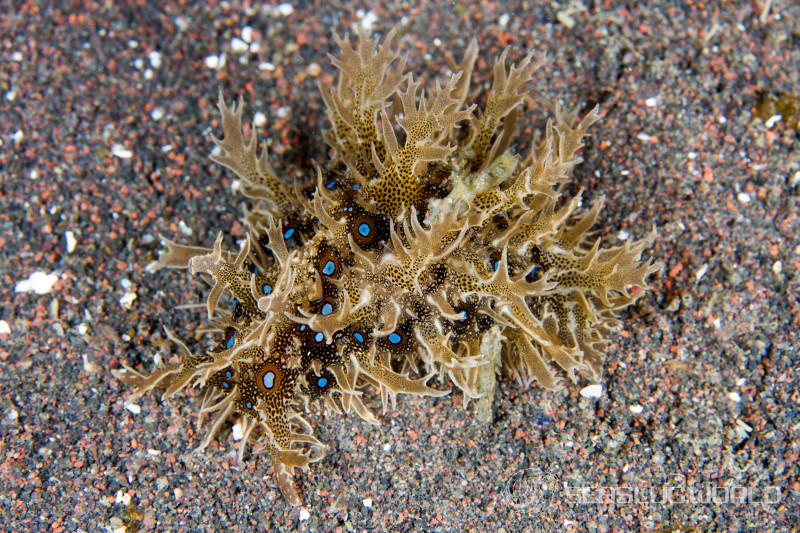
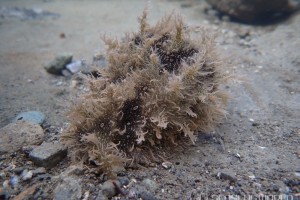
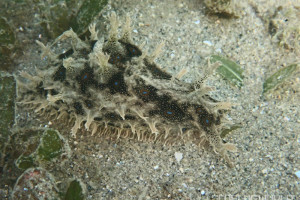
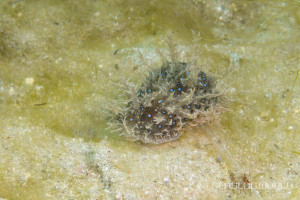
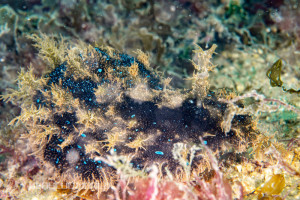
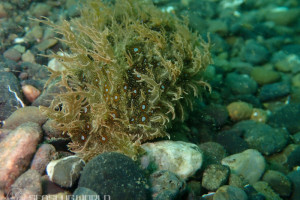
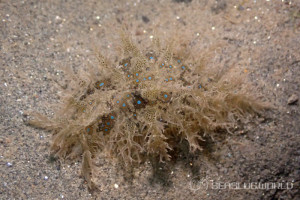
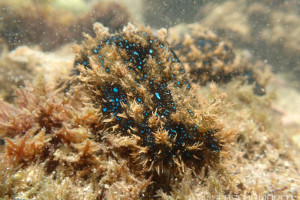
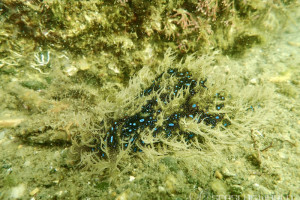
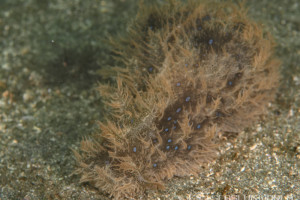
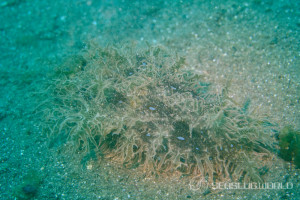
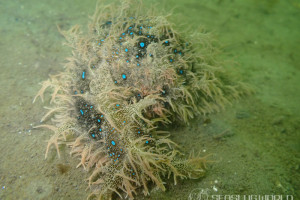
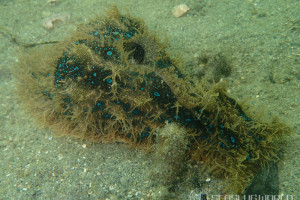
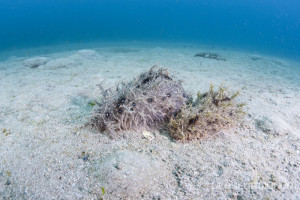
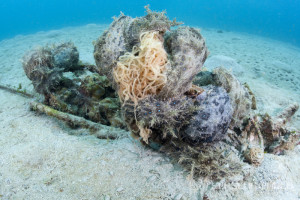
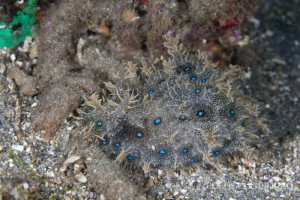
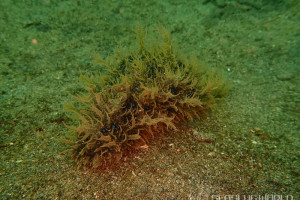
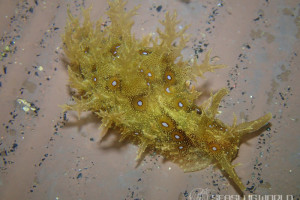
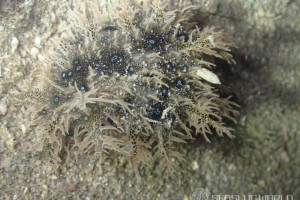
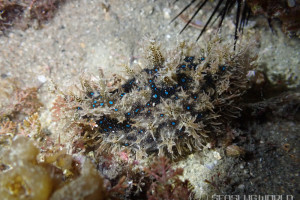
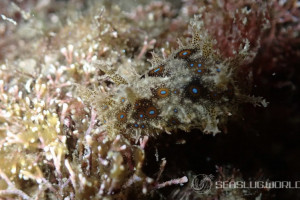
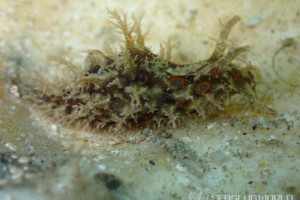
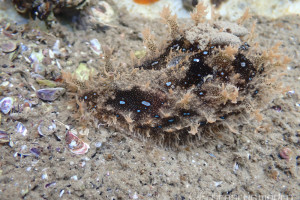
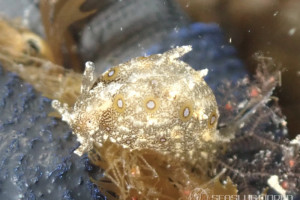
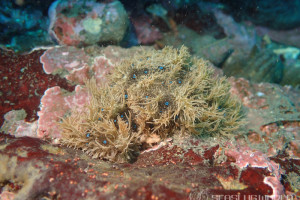
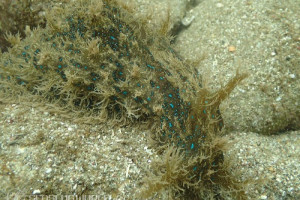
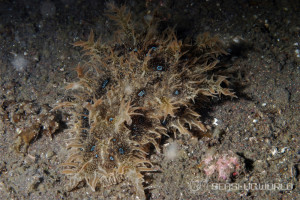
A large aplysiid reaching up to 150 mm in length. The entire body surface is densely covered with elongate, branching dendritic papillae interspersed with shorter conical ones, giving the animal its characteristic shaggy or ragged appearance. Ground colour ranges from amber to greenish or dark brown, scattered with fine pale dots and conspicuous pale-blue eyespots ringed in black. The rhinophores and oral tentacles match the body in colour and are dotted with the same fine pale flecks. Unlike Aplysia, the parapodia are completely fused dorsally and leave only a small opening communicating with the mantle cavity, so the animal has essentially no swimming ability and lives strictly on the bottom.Distribution
A pantropical species recorded across tropical and warm-temperate seas, including the western Atlantic (West Indies, Florida), West Africa, the Mediterranean, the Red Sea, the Indian Ocean and the western Pacific south to southern Japan. The integrative phylogeny by a 2020 study found no records from the Hawaiian Islands or the Eastern Pacific. In the Indo-Pacific the species co-occurs with Bursatella ocelligera Bergh, 1902 (resurrected from synonymy, type locality Koh Chang, Thailand), the two being externally near-identical but separable by the penis: B. leachii bears numerous large conical penial spines, whereas B. ocelligera has an unarmed penis. The same paper inferred that gene flow between Atlantic and Indo-Pacific populations of B. leachii has been maintained through the Agulhas Leakage at the Cape of Good Hope, accounting for the persistence of a single pantropical species despite measurable inter-ocean genetic structure. The type locality was already noted as unknown by Blainville 1817, who wrote "On ignore sa patrie".Etymology
The specific epithet leachii honours the British zoologist William Elford Leach (1791–1836), a curator at the British Museum and prolific describer of crustaceans and molluscs, after whom more than a hundred animal species have been named. The genus name Bursatella is a Latin diminutive of bursa ("bag, purse"), referring to the swollen, bag-like body form.Remarks
A herbivorous-detritivorous sea hare of shallow sandy and muddy bottoms and seagrass beds, feeding mainly on cyanobacteria, diatoms and detrital material, occasionally on green or red macroalgae. The species is well known for forming massive aggregations: individuals tend to gather at dusk and disperse at dawn, with population blooms sometimes producing dense swarms reported from the Mediterranean and Red Sea (Lowe & Turner, 1976; Paige, 1988). When disturbed it releases purple ink like other aplysiids. Egg masses are long, greenish, stringy ribbons, with larvae completing metamorphosis in only about 19 days.A 2020 study explicitly rejected the geographic-subspecies scheme established by Eales & Engel 1935, finding no consistent molecular differentiation among the historical subspecies B. leachii hirasei, B. leachii lacinulata, B. leachii pleii, B. leachii rosea, B. leachii savigniana and B. leachii guineensis, which they synonymised with B. leachii as a single pantropical species. B. leachii africana had earlier been elevated to Bursatella africana by Bazzicalupo & Crocetta 2018. The Japanese name "フレリトゲアメフラシ" derives from Aclesia freeri Griffin, 1912, a junior synonym; some Japanese sources use the alternative form "トゲアメフラシ".
References
- Bursatella, Blainville H.M.D. de (1817). Bursatelle, Bursatella. In: Cuvier F. (ed.) Dictionnaire des Sciences Naturelles. Vol. 5 (Supplément). Paris: F.G. Levrault. p. 138.
- ふれりとげあめふらし(新稱), 内田清之助ほか. (1927). 日本動物圖鑑. 北隆館.
- Bursatella leachii leachii, Eales N.B. & Engel H. (1935). The genus Bursatella de Blainville. Proceedings of the Malacological Society of London. 21(5): 279-303.
- フレリトゲアメフラシ, Baba K. (1949). Opisthobranchia of Sagami Bay collected by His Majesty the Emperor of Japan (相模湾産後鰓類図譜). Iwanami Shoten, Tokyo. 4+2+194+7 pp., pls. 1-50.
- フレリトゲアメフラシ, 高岡高等学校生物研究会(編). (1964). 富山湾産後鰓類図譜.
- Bursatella leachii pleii, Lowe E.F. & Turner R.L. (1976). Aggregation and trail-following in juvenile Bursatella leachii pleii. The Veliger. 19(2): 153-155.
- Bursatella leachii plei, Paige J.A. (1988). Biology, metamorphosis, and postlarval development of Bursatella leachii plei Rang (Gastropoda: Opisthobranchia). Bulletin of Marine Science. 42(1): 65-75.
- フレリトゲアメフラシ, 益田一. (1999). 海洋生物ガイドブック. 第2刷. 東海大学出版会.
- フレリトゲアメフラシ, 鈴木敬宇. (2000). ウミウシガイドブック〈2〉. TBSブリタニカ.
- トゲアメフラシ, 奥谷喬司. (2000). 日本近海産貝類図鑑. 東海大学出版会.
- トゲアメフラシ, 殿塚孝昌. (2003). ウミウシガイドブック〈3〉. TBSブリタニカ.
- Bursatella leachii leachii, Terrence Gosliner, Ángel Valdés and David Behrens. (2015). Nudibranch and Sea Slug Identification Indo-Pacific. New World Pubns Inc.
- Bursatella leachii, Bazzicalupo E., Crocetta F., Gosliner T.M., Berteaux-Lecellier V., Camacho-García Y.E., Chandran B.K.S. & Valdés Á. (2020). Molecular and morphological systematics of Bursatella leachii de Blainville, 1817 and Stylocheilus striatus Quoy & Gaimard, 1832 reveal cryptic diversity in pantropically distributed taxa (Mollusca
Featured in this book

Terrence Gosliner, Ángel Valdés and David Behrens. (2018). Nudibranch and Sea Slug Identification Indo-Pacific 2nd Edition. New World Pubns Inc.
New World Publications
This species, Bursatella leachii, is included in the book.
View on Amazon PR (Amazon Associates)Seasonality
Shooting Locations
Loading shooting locations...
Photos of Bursatella leachii
Tag:



















Same Genus Nudibranchs
Academic Database
Sea slug observation data is available in international marine biodiversity databases.