Goniobranchus thompsoni (Rudman, 1983)
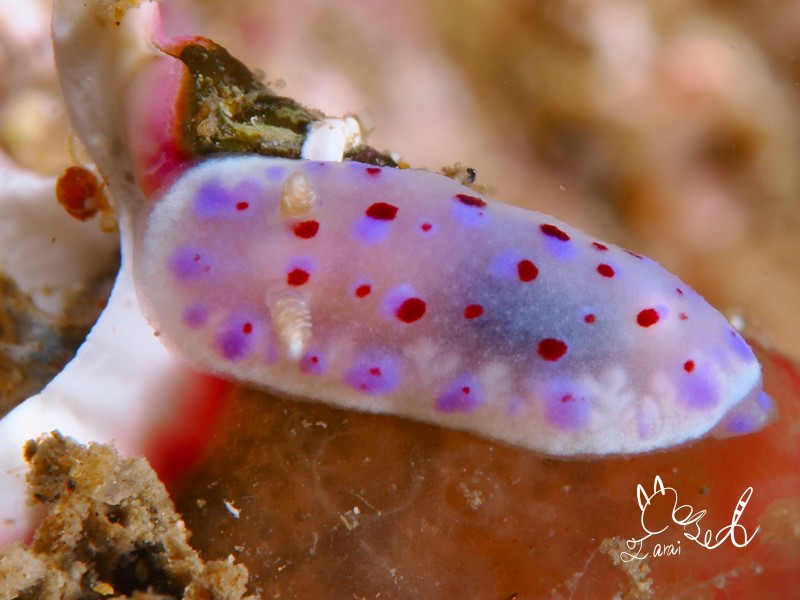
- Location
- The Steps, Kurnell, New South Wales, Australia
- Date
- 2026/04/28
- Length
- 10mm
- Depth
- 8.0m
- Water temperature
- 20.0℃
Description
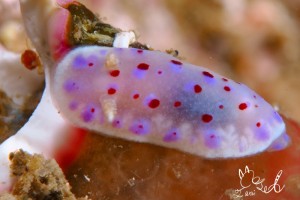
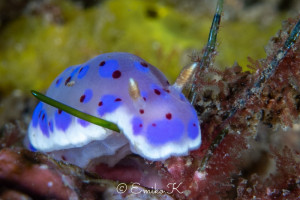
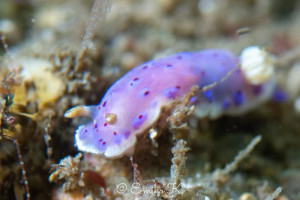
A small chromodorid reaching about 23 mm in extended length. The mantle is ovate with a fairly broad overlap, particularly along the sides; the posterior foot extends only slightly beyond the mantle margin. Background color is usually pale pink with a bluish tinge, the dark brown and cream patches of the viscera showing through; in less pigmented specimens, the ground color appears yellowish brown. The extreme edge of the mantle is translucent, with a creamy white band just inside it; from the inner side of this band, tongues of opaque white subepithelial pigment extend irregularly inwards. Across the dorsum are milky bluish-purple patches together with smaller red spots; the red spots are commonly placed eccentrically within the purple patches. The rhinophores are translucent straw colored with cream dashes along the edges of the lamellae. The gills are similar in color, with cream-edged leaflets, and consist of up to about ten simple, upright filaments arranged in a cup-shaped circle around the anus. The foot and lateral body wall are translucent with a faint pinkish hue, with red spots along the body sides and blue patches on the posterior dorsal surface of the foot.Distribution
The type locality is Providential Head, Wattamolla Bay, Royal National Park, Sydney, New South Wales, Australia, at 24 m. At the time of the original description, the species was recorded only from the temperate-to-subtropical coast of New South Wales (including Batemans Bay, Jervis Bay, Port Hacking, and Sydney-area sites such as Clovelly, Botany Bay, Coogee and North Bondi), and was noted as not extending into tropical Australian waters.Etymology
The specific epithet thompsoni honours Dr T. E. Thompson of the University of Bristol, who led much of the modern taxonomic and biological work on opisthobranchs. In the original description, Rudman dedicates the species to Thompson "as a friend and colleague who has done much to stimulate interest in the taxonomy and biology of the Opisthobranchia".Remarks
Within the family Chromodorididae, this species belongs to the Chromodoris aspersa colour group (white-to-pale background, purple spots, and a contrasting marginal band). However, in G. thompsoni the marginal band is creamy white rather than the orange-to-yellow seen in most members of the group, the ground color carries a distinctive pale-pink tinge, and the red spots are typically nested eccentrically inside the larger purple patches. The species was erected after Rudman recognised that material earlier identified as Goniobranchus loringi in fact represented an externally and anatomically distinct undescribed species.References
A Kindle field guide by the site author
Kimoto N. (2026). Sea Slugs of Japan & the Indo-Pacific, 2nd Edition.
Kindle Edition
View on Amazon PR (Amazon Associates)Seasonality
Shooting Locations
Loading shooting locations...
Photos of Goniobranchus thompsoni


Same Genus Nudibranchs
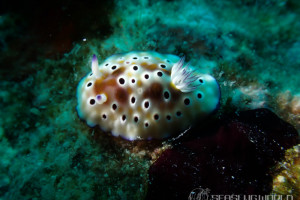
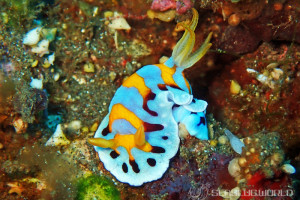
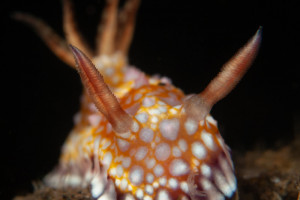
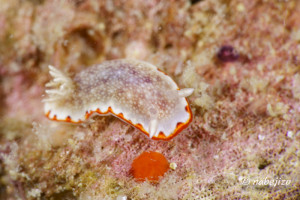


Similar Colors Nudibranchs
Academic Database
Sea slug observation data is available in international marine biodiversity databases.