Goniobranchus woodwardae (Rudman, 1983)
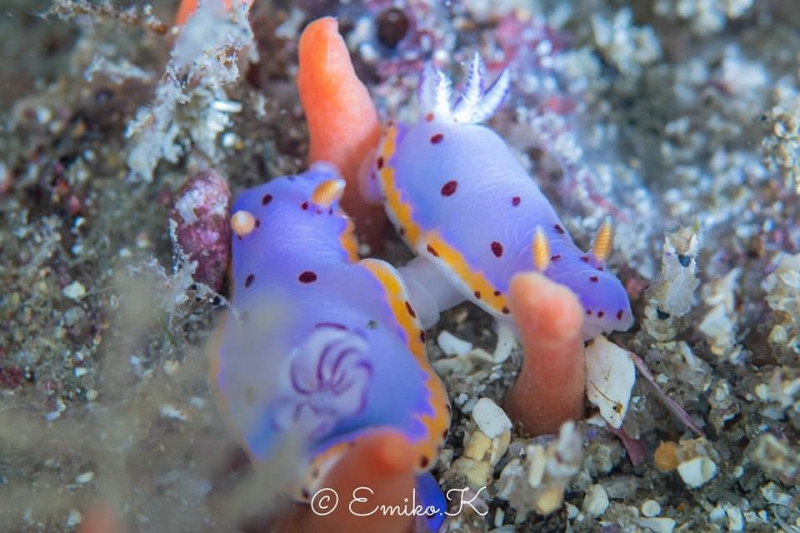
- Location
- The Leap, Kurnell, New South Wales, Australia
- Date
- 2020/04/15
- Length
- 20mm
- Depth
- 15.0m
- Water temperature
- 19.0℃
Description
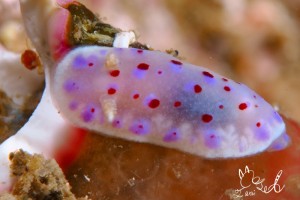
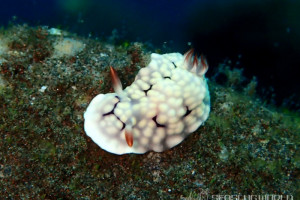
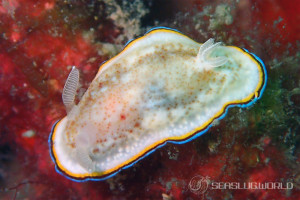
Mantle deep pink with a dusting of blue pigment specks giving a bluish sheen. Small red spots are scattered over the mantle, varying in number among specimens. The border is clear translucent and there is a distinct submarginal thin yellow line, somewhat irregular in width, running right around the mantle, in some specimens broken into a series of dashes anteriorly and posteriorly. Inside the yellow line are massive subepithelial white lobulate glands, easily visible both dorsally and ventrally. Small red spots also occur along the inside of the yellow line, in front of the rhinophores, and sometimes on or outside the yellow line as well. Traces of red dusting (microscopic red specks) along the translucent edge of the border, with patches of red specks elsewhere on the dorsum. Rhinophores translucent, with traces of white pigment internally; gills translucent with a white internal core. Gill and rhinophore pockets edged with red. Foot and sides of body the same colour as the mantle, with a translucent border and a row of small red spots along its inner edge. Body elongate; rounded anterior part of the mantle held out horizontally; the posterior mantle has only a small overlap, giving a spatulate appearance. Up to eight simple gills, arranged in a circle open posteriorly. Radular formula 31.0.31 × 44 (+2), no central thickening. The innermost lateral tooth on each side is a long flattened plate with a recurved pointed cusp at the distal end and three triangular pointed denticles on the outer edge just below the cusp. Other teeth of similar size and shape but with four to six long pointed denticles on the outer edge. Outermost teeth much shorter with smaller denticles. The flattened plate-like radular morphology is unique among Chromodoris. Body length 5-17 mm preserved.Distribution
Type locality is Providential Hd, Wattamolla Bay, Royal National Park, New South Wales, Australia (24 m, 1 December 1981, holotype AM C133158, 11 mm preserved). The type series is entirely from sublittoral sites near Sydney, NSW: Jibbon Head, Port Hacking (12 m, 13 Aug. 1981; 20 m, 20 Aug. 1981); Clovelly, Sydney (15 m, 9 Sept. 1981). Apparently endemic to the temperate-subtropical New South Wales coast.Etymology
The specific epithet woodwardae honours Miss Helen Woodward of Sydney, who, in collaboration with Miss Judith Hunter, presented nudibranch material to The Australian Museum over many years.Remarks
Originally described as Chromodoris woodwardi, the species was later transferred to Goniobranchus in a revision of the Indo-Pacific Chromodorididae (the epithet emended to woodwardae for grammatical agreement with the feminine genus). Distinguished from C. loringi by the bluish-tinged deep pink ground (uniform bluish-violet in loringi), the complete submarginal yellow border (interrupted in front of the rhinophores in loringi), the small numerous red spots (large and few in loringi), and the red edging of the gills and rhinophores (absent in loringi).References
A Kindle field guide by the site author
Kimoto N. (2026). Sea Slugs of Japan & the Indo-Pacific, 2nd Edition.
Kindle Edition
View on Amazon PR (Amazon Associates)Seasonality
Shooting Locations
Loading shooting locations...
Photos of Goniobranchus woodwardae


Same Genus Nudibranchs


Academic Database
Sea slug observation data is available in international marine biodiversity databases.