Goniobranchus tasmaniensis (Bergh, 1905)
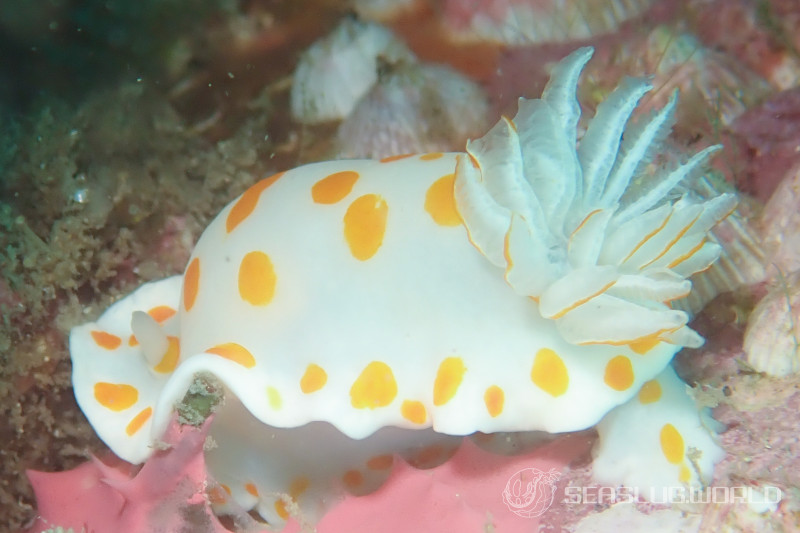
- Location
- Cabbage Tree Bay Wrecks, Nelson Bay, New South Wales, Australia
- Date
- 2022/12/03
- Length
- ??mm
- Depth
- ??m
- Water temperature
- 20.0℃
Description
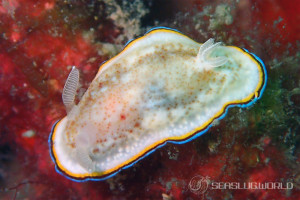
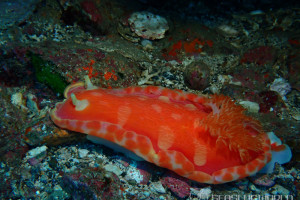
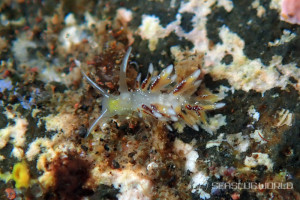
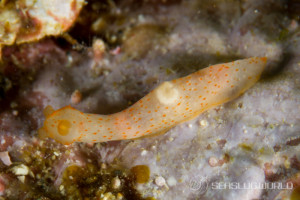
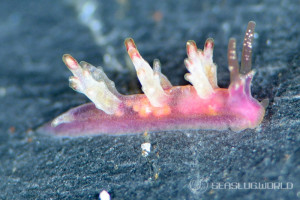
A small chromodorid reaching about 32 mm in body length. The live animal is semitransparent white with red markings; in alcohol the ground colour becomes the dirty yellowish-white typical of preserved nudibranchs, in places turning entirely yellow on the dorsum, with numerous small to medium round and oval spots and chalk-white annular markings scattered over the dorsum and body sides. The body is elongate, the dorsum broader than the foot, slightly arched and smooth all over; the dorsal margin only slightly projects around its circumference. The rhinophores lie well forward and are of normal structure. The gill consists of two arcs that meet anteriorly in front of the large anal papilla, each arc with about 20 simple, sometimes deeply forked plumes whose posterior ends are slightly inrolled. The almost sessile eyes are 0.18 mm in diameter with a strongly yellow lens.Distribution
Southwestern Pacific. Type locality: northwest coast of Tasmania (vicinity of Ulverstone). Subsequently recorded from southeastern mainland Australia.Etymology
The specific epithet tasmaniensis is a Latinised geographical adjective meaning "of Tasmania", referring to the type locality.Remarks
Originally described as a new species of Chromodoris. Following several intermediate placements within Glossodoris and Chromodoris sensu lato, the species is now placed in Goniobranchus on the basis of molecular phylogeny; the parentheses in the author citation reflect this generic transfer.References
- Chromodoris Tasmaniensis Bgh. n. sp., Bergh R. (1905). Malacologische Untersuchungen. In: Semper, C. Reisen im Archipel der Philippinen. Wissenschaftliche Resultate. Theil VI, Lieferung 2 (Nudibranchiata). Wiesbaden: C. W. Kreidel's Verlag, pp. 57-114, Taf. V-VIII.
- Goniobranchus tasmaniensis, Johnson R.F. & Gosliner T.M. (2012). Traditional taxonomic groupings mask evolutionary history: a molecular phylogeny and new classification of the chromodorid nudibranchs. PLoS ONE 7(4): e33479.
A Kindle field guide by the site author
Kimoto N. (2026). Sea Slugs of Japan & the Indo-Pacific, 2nd Edition.
Kindle Edition
View on Amazon PR (Amazon Associates)Seasonality
Shooting Locations
Loading shooting locations...
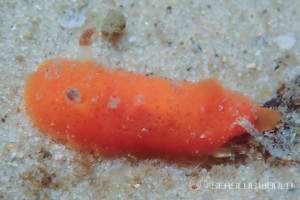
Photos of Goniobranchus tasmaniensis

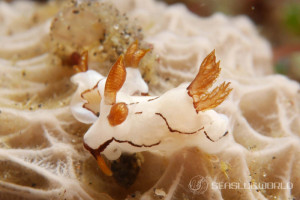
Same Genus Nudibranchs


Similar Colors Nudibranchs
Academic Database
Sea slug observation data is available in international marine biodiversity databases.