Hexabranchus sanguineus (Rüppell & Leuckart, 1830)
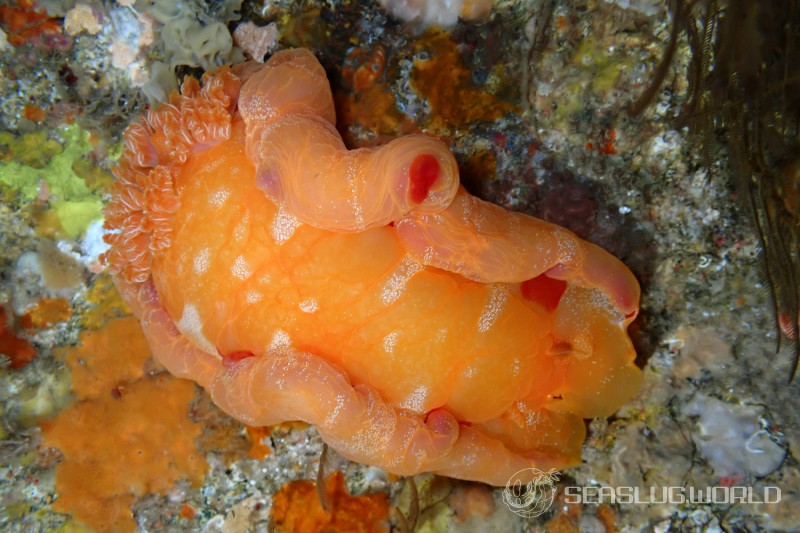
- Location
- Ushitsuki Rock, Kumomi, Shizuoka, Japan
- Date
- 2022/01/29
- Length
- 180mm
- Depth
- ??m
- Water temperature
- 15.0℃
What is the Spanish dancer (Hexabranchus sanguineus)?
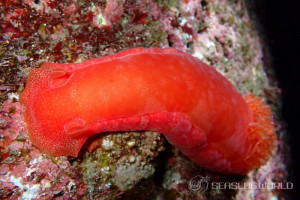
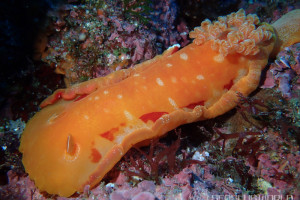
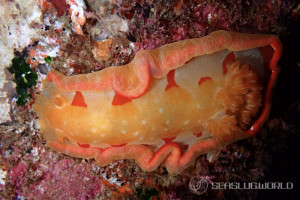
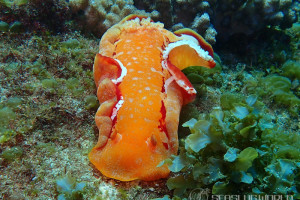
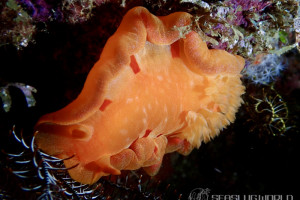
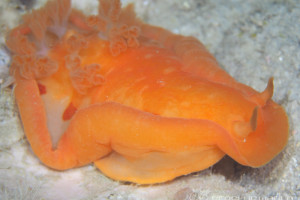
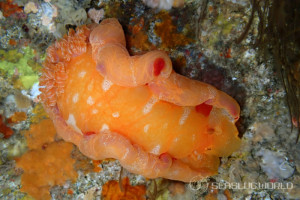
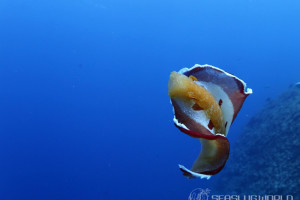
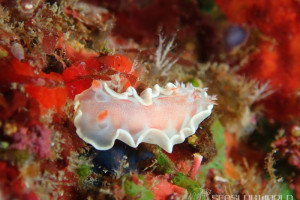
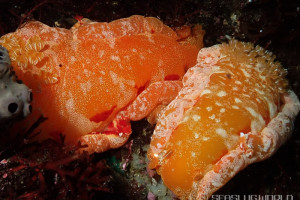
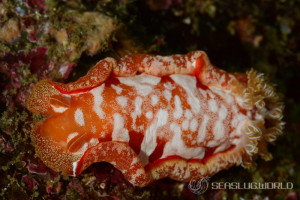
The Spanish dancer (Hexabranchus sanguineus) is a very large crimson to blood-red dorid nudibranch (sea slug) of the Indo-Pacific, named for the flamenco-like way it swims by undulating its flared mantle.Description
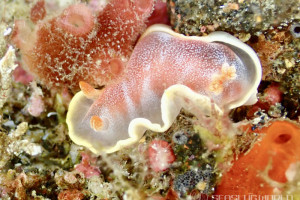
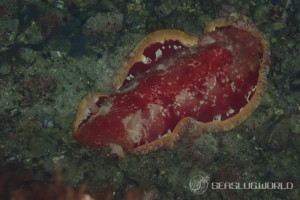
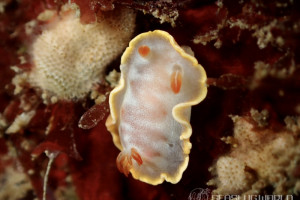
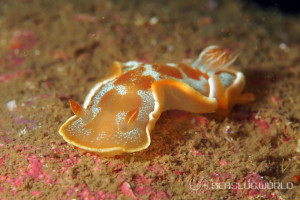
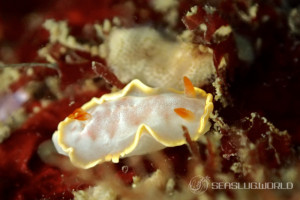
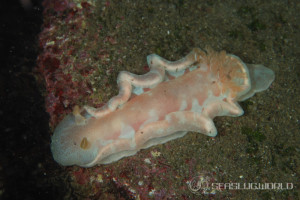
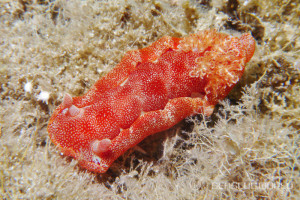
A very large dorid reaching well over 250 mm in length. Body crimson to deep blood-red, with a broad white border along the mantle margin (interrupted at the anterior). On each side of the convex dorsum a longitudinal band is formed by numerous very short transverse white striations. The six branched, non-retractile gills are pale rose and arranged around the anus. Recent molecular work has identified at least four colour-pattern lineages within what has long been treated as a single species. Distinguished from Hexabranchus lacer (ミカドウミウシ) by colour pattern and gill morphology.Spanish Dancer Nudibranch
"Spanish dancer" is the English common name for Hexabranchus sanguineus, from the species' undulating swimming display — flaring its deep red mantle skirt rhythmically as it crosses open water at night, evoking a flamenco dancer's dress in motion. The display is most commonly observed during night dives across the tropical Indo-Pacific. Hexabranchus is the only nudibranch genus capable of sustained free-swimming; resting individuals remain coiled and crimson on the reef and rely instead on a sequestered fish-deterrent macrolide (oxazole alkaloid) derived from sponge prey.Distribution
Widely reported across the tropical and subtropical Indo-Pacific, although molecular evidence suggests this distribution corresponds to a complex of cryptic species. The type locality is El-Tor on the Sinai Peninsula, Red Sea, where Rüppell collected the species in March on coral.Etymology
The specific epithet sanguinea is the Latin feminine of sanguineus, "blood-red" or "of blood", referring to the conspicuous crimson body colour.Remarks
Originally described as Doris sanguinea by Rüppell & Leuckart (Atlas zu der Reise im nördlichen Afrika, Wirbellose Thiere, p. 28, 1830), who regarded it as one of the largest and most beautiful dorids then known — specimens reaching over 6 Zoll (about 15 cm) in life and contracting to 3⅞ inches in spirit. Subsequently transferred to Hexabranchus Ehrenberg, 1828, of which it is the type species. Known in English as the "Spanish dancer" for the flared swimming display.References
- Doris sanguinea, Rüppell E. & Leuckart F.S. (1828-1830). Atlas zu der Reise im nördlichen Afrika von Eduard Rüppell. Erste Abtheilung. Zoologie, Neue wirbellose Thiere des Rothen Meers. Frankfurt am Main: H.L. Brönner. iv + 47 pp., 12 pls.
- ミカドウミウシ, 小野篤司. (2004). 沖縄のウミウシ. ラトルズ.
- Hexabranchus sanguineus, Terrence Gosliner, Ángel Valdés and David Behrens. (2018). Nudibranch and Sea Slug Identification Indo-Pacific 2nd Edition. New World Pubns Inc.
- Hexabranchus sanguineus (Rüppell & Leuckart, 1830), Tibiriçá Y., Pola M., Pittman C., Gosliner T.M., Malaquias M.A. & Cervera J.L. (2023). A Spanish dancer? No! A troupe of dancers: a review of the family Hexabranchidae Bergh, 1891 (Gastropoda, Heterobranchia, Nudibranchia). Organisms Diversity & Evolution. 23(4): 697-742. https://doi.org/10.1007/s13127-023-00611-0
Featured in this book

Terrence Gosliner, Ángel Valdés and David Behrens. (2018). Nudibranch and Sea Slug Identification Indo-Pacific 2nd Edition. New World Pubns Inc.
New World Publications
This species, Hexabranchus sanguineus, is included in the book.
View on Amazon PR (Amazon Associates)Seasonality
Shooting Locations
Loading shooting locations...
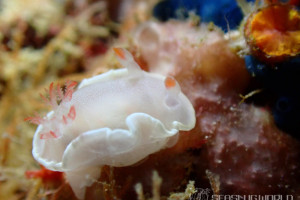
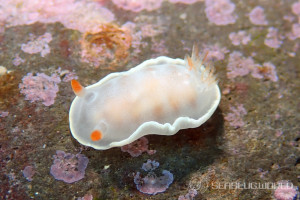
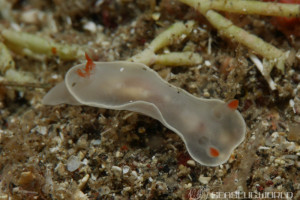
Photos of Hexabranchus sanguineus
Tag:
























Same Genus Nudibranchs

Similar Colors Nudibranchs
Academic Database
Sea slug observation data is available in international marine biodiversity databases.