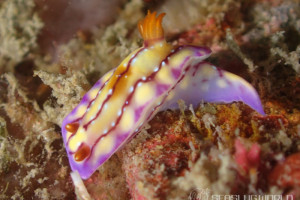
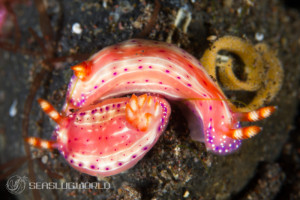
Hypselodoris obscura (W. Stimpson, 1855)
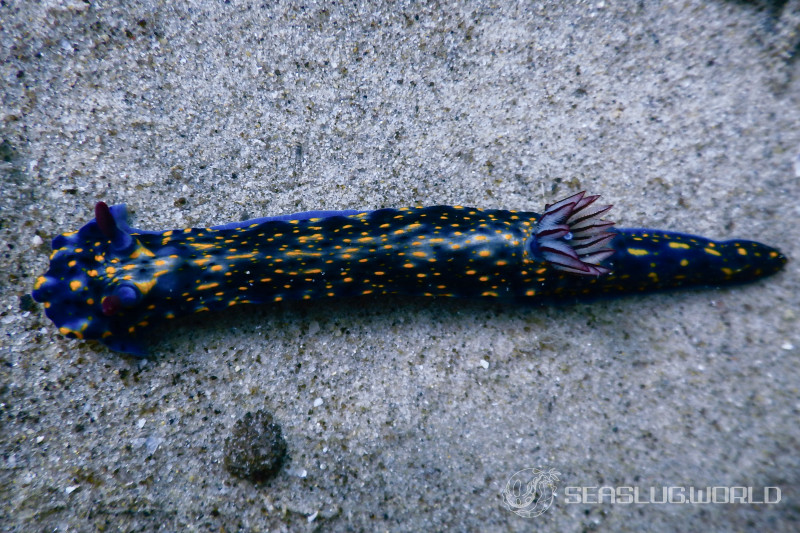
- Location
- La Balsa Park, The Sunshine Coast, Queensland, Australia
- Date
- 2017/09/09
- Length
- 70mm
- Depth
- 5.0m
- Water temperature
- 20.0℃
Description
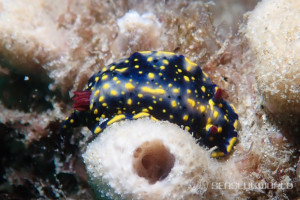
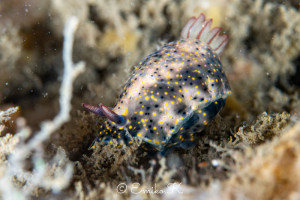
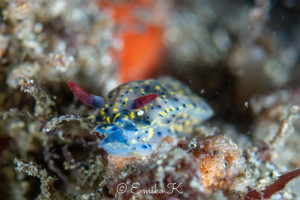
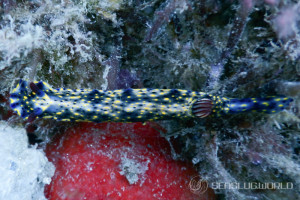
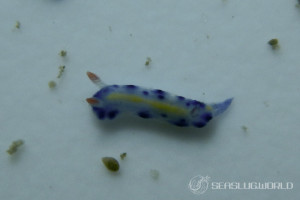
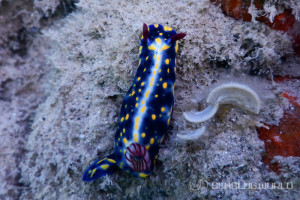
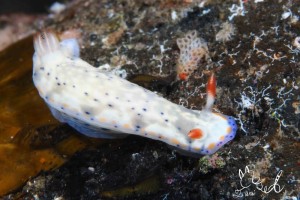
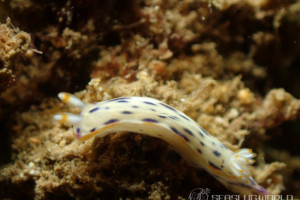
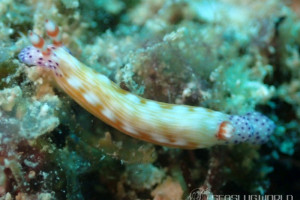
An elongate chromodorid reaching about 50 mm in body length. Ground colour is translucent white overlaid with numerous small yellow to orange spots scattered densely over the dorsum. The dorsal ground varies among individuals from pale bluish-grey to a darker grey-brown, the latter giving rise to the specific name obscura. The mantle margin has no conspicuous colour band, the edge being essentially the same colour as the body.The rhinophores are bright orange to red-orange and lamellate, while the gill consists of 8-10 translucent white to pale orange plumes, each rachis lined with a fine orange streak. Both rhinophores and gill retract fully into pockets in the mantle.
Distribution
Widespread in the Indo-West Pacific. Records extend from southern Japan and the East and South China Seas through the Philippines, Indonesia and northern/eastern Australia to the Red Sea. The species was originally described from material collected during Stimpson's North Pacific Exploring Expedition (1853-1856), with the type locality in the western Pacific. It inhabits shallow to moderately deep coral reefs and rocky reefs.Etymology
The specific epithet obscura is the feminine of Latin obscurus, meaning "dark" or "obscure", in reference to the somewhat dark grey-brown ground colour of the type specimens.Remarks
Originally described in 1855 by Stimpson as Goniodoris obscura. In the same paper Stimpson erected the new genus Hypselodoris Stimpson, 1855, with the present species as its type by monotypy. The species is therefore now combined as Hypselodoris obscura, the parentheses in the author citation reflecting that generic transfer.The species has long been confused externally with Hypselodoris infucata (Rüppell & Leuckart, 1831). Subsequent molecular and species-delimitation studies treat the two within the wider H. infucata - obscura - saintvincentius complex and show that they represent distinct lineages with non-overlapping ranges: H. infucata is centred on the Mediterranean and Red Sea, while H. obscura is essentially restricted to the western Pacific. The species is sponge-feeding, with Dysidea reported as one of its main prey genera.
References
- Hypselodoris obscura — type species, Stimpson W. (1855). Descriptions of some new marine Invertebrata. Proceedings of the Academy of Natural Sciences of Philadelphia. 7(10): 385-394.
- Hypselodoris obscura (Stimpson, 1855), Gosliner T.M. & Johnson R.F. (1999). Phylogeny of Hypselodoris (Nudibranchia: Chromodorididae) with a review of the monophyletic clade of Indo-Pacific species, including descriptions of twelve new species. Zoological Journal of the Linnean Society. 125: 1-114. https://doi.org/10.1111/j.1096-3642.1999.tb00585.x
- Hypselodoris obscura, Johnson R.F. & Gosliner T.M. (2012). Traditional taxonomic groupings mask evolutionary history: a molecular phylogeny and new classification of the chromodorid nudibranchs. PLoS ONE 7(4): e33479.
A Kindle field guide by the site author
Kimoto N. (2026). Sea Slugs of Japan & the Indo-Pacific, 2nd Edition.
Kindle Edition
View on Amazon PR (Amazon Associates)Seasonality
Shooting Locations
Loading shooting locations...
Photos of Hypselodoris obscura


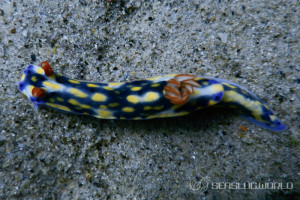
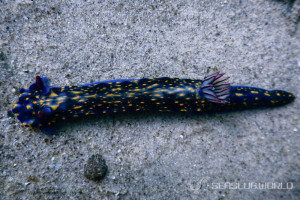
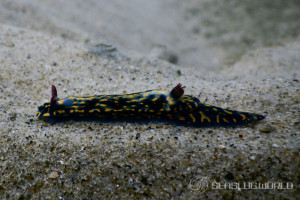
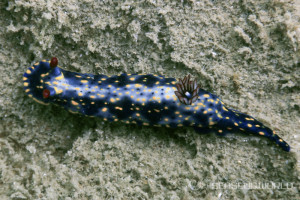
Same Genus Nudibranchs

Academic Database
Sea slug observation data is available in international marine biodiversity databases.