Hypselodoris violabranchia Gosliner & R. F. Johnson, 1999
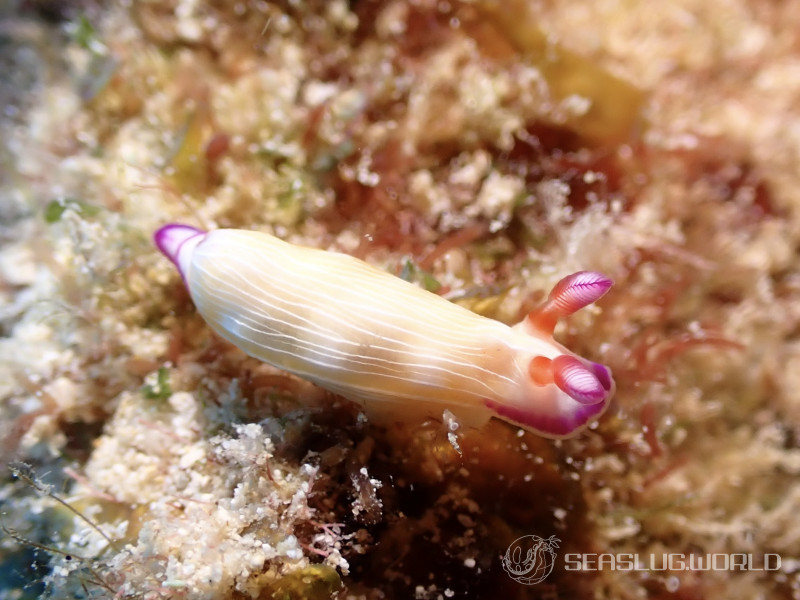
- Location
- Horseshoe Reef, O'ahu, Hawaii, United States
- Date
- 2022/12/14
- Length
- 12mm
- Depth
- 13.0m
- Water temperature
- 23.0℃
Description
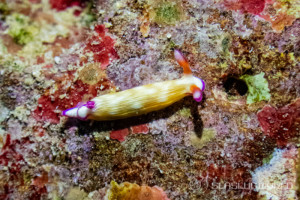
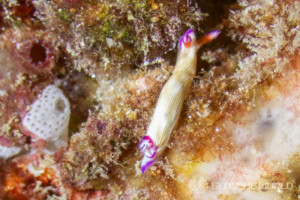
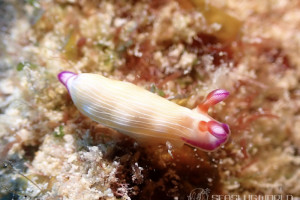
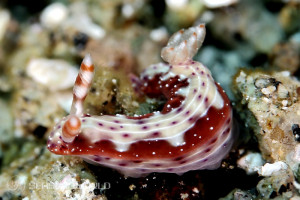
A small Hypselodoris, 10-14 mm in length. The general body colour is salmon pink with white areas bordered with purple on the head, posterior portion of the mantle and foot. There are 15-20 opaque white longitudinal lines on the notum, with scattered opaque white patches between the lines. The rhinophores are white with a basal orange band and a medial purple line. An area of translucence is found posterior to the rhinophores, through which the eyes are visible. The eight simply pinnate white gills have purple on the outer side of the rachis.There are 6-7 large posterior mantle glands and four small anterolateral glands on either side of the body; lateral and anterior glands are absent. The radular formula in one specimen is 77×45.0.45. The jaw rodlets are elongate and undivided with well developed lateral flanges. The inner lateral teeth are bifid with three inner denticles and 2-4 denticles on the outside of the cusps; all of the denticles are elongate and sharply pointed. The middle lateral teeth have five elongate denticles on the outer side of the sharply pointed bifid cusps. The outer lateral teeth are more rounded with fewer denticles. The reproductive system is triaulic; the prostate narrows into the moderately long ejaculatory portion, which terminates in a slightly enlarged bulbous penis. The minute, elongate pyriform receptaculum seminis has a short duct attached to the upper portion of the vaginal duct, below the base of the spherical bursa copulatrix.
Distribution
Endemic to the central Pacific, known only from Kauai and Maui in the Hawaiian Islands. Type locality: Ahukini Reef, Kauai Channel, Kauai, Hawaiian Islands (11 m depth).Etymology
Verbatim from the original description (Gosliner, Johnson & Andersson, 1999, Zoological Journal of the Linnean Society 125: p.78):This species is named violabranchia for its purplish gill rachises.
Remarks
Described in a 1999 revision. Closely related to H. insulana, H. andersoni, H. maculosa and H. alboterminata. H. violabranchia shares with H. insulana a pinkish body with longitudinal opaque white lines and a purple margin, but in H. violabranchia the purple margin is discontinuous and only present anteriorly and posteriorly. The rhinophores of H. violabranchia have a single basal red band, while those of H. insulana, H. andersoni and H. alboterminata have two red bands. The rachis of the gills is violet in H. violabranchia, while in the other three species it is red-orange. H. violabranchia is also closely related to H. alboterminata, but has opaque white longitudinal lines rather than the maroon ones of H. alboterminata. The radula of H. violabranchia has far more elongate denticles than do the other related species.References
- Hypselodoris violabranchia sp. nov., Gosliner T.M. & Johnson R.F. (1999). Phylogeny of Hypselodoris (Nudibranchia: Chromodorididae) with a review of the monophyletic clade of Indo-Pacific species, including descriptions of twelve new species. Zoological Journal of the Linnean Society. 125: 1-114. https://doi.org/10.1111/j.1096-3642.1999.tb00585.x
- Hypselodoris violabranchia, Johnson R.F. & Gosliner T.M. (2012). Traditional taxonomic groupings mask evolutionary history: a molecular phylogeny and new classification of the chromodorid nudibranchs. PLoS ONE 7(4): e33479.
A Kindle field guide by the site author
Kimoto N. (2026). Sea Slugs of Japan & the Indo-Pacific, 2nd Edition.
Kindle Edition
View on Amazon PR (Amazon Associates)Seasonality
Shooting Locations
Loading shooting locations...
Photos of Hypselodoris violabranchia


Same Genus Nudibranchs

Similar Colors Nudibranchs

Academic Database
Sea slug observation data is available in international marine biodiversity databases.