Hypselodoris dollfusi (Pruvot-Fol, 1933)
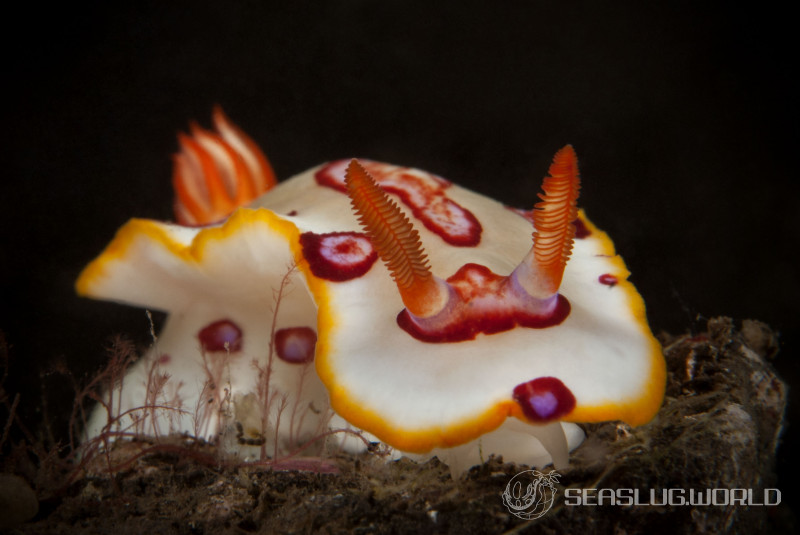
- Location
- Pulau Bali, Indonesia
- Date
- 2006/01/22
- Length
- 50mm
- Depth
- 45.0m
- Water temperature
- 27.0℃
Description
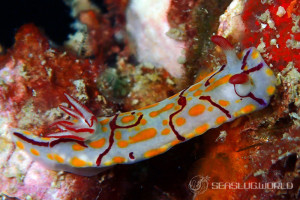
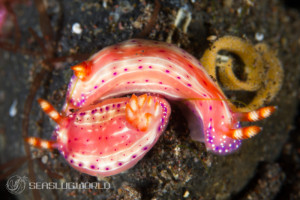
Body length 45-50 mm. The body is opaque white overall, with a bright yellow to orange marginal band along the mantle edge. The notum bears deep pink-purple rings of varying sizes, each surrounding a circle of lavender. In some specimens the centre of the ring has a bluish tinge. Similarly coloured rings are also present around the branchial pit and at the base of the rhinophores. Pink rings are arranged along the notal margin (one each at the anterior and posterior ends and several midlaterally between rhinophores and gill), with 9 to 21 rings on the notum, 4 to 6 on the hyponotum, and one at the posterior tip of the foot. The rhinophores and gill are red; the perfoliate rhinophores bear 27 lamellae, and the gill consists of ten unipinnate leaflets in a partially erect branchial plume.Approximately 22 large posterior mantle glands are present, with 12 to 18 anterolateral glands on each side of the head. Lateral glands are absent.
Distribution
Type locality: Gulf of Suez, Egypt. Also recorded from Khor Fakkan (Gulf of Oman), United Arab Emirates. After the 1919 Dollfus Expedition collected the original specimen, the species went unrecorded for decades until redescribed by Gosliner & Behrens 2000.Etymology
The specific epithet dollfusi honours Robert-Philippe Dollfus, the French zoologist who led the 1919 Egyptian expedition that collected the holotype.Remarks
This species forms a clade with Hypselodoris fucata Gosliner & Johnson, 1999, Hypselodoris kaname Baba, 1994, Hypselodoris koumacensis Rudman, 1995, and Hypselodoris paulinae Gosliner & Johnson, 1999. Within this clade, Hypselodoris dollfusi most closely resembles Hypselodoris paulinae externally, but is distinguished by having pink rings rather than red blotches and by lacking the purple submarginal line on the side of the foot present in Hypselodoris paulinae. Hypselodoris dollfusi is the only known member of the genus to bear circular rings on the notum.References
- Glossodoris dollfusi n.sp., Pruvot-Fol A. (1933). Mission Robert Ph. Dollfus en Égypte. Opisthobranchiata. Mémoires presentés à l'Institut d'Égypte. 21: 89-159, pls 1-4.
- Hypselodoris dollfusi (Pruvot-Fol, 1933) comb. nov., Gosliner T.M. & Behrens D.W. (2000). Two new species of Chromodorididae (Mollusca: Nudibranchia) from the tropical Indo-Pacific, with a redescription of Hypselodoris dollfusi (Pruvot-Fol, 1933). Proceedings of the California Academy of Sciences. 52(10): 111-124.
- Hypselodoris dollfusi, Johnson R.F. & Gosliner T.M. (2012). Traditional taxonomic groupings mask evolutionary history: a molecular phylogeny and new classification of the chromodorid nudibranchs. PLoS ONE 7(4): e33479.
- Hypselodoris dollfusi, Terrence Gosliner, Ángel Valdés and David Behrens. (2018). Nudibranch and Sea Slug Identification Indo-Pacific 2nd Edition. New World Pubns Inc.
Featured in this book
Terrence Gosliner, Ángel Valdés and David Behrens. (2018). Nudibranch and Sea Slug Identification Indo-Pacific 2nd Edition. New World Pubns Inc.
New World Publications
This species, Hypselodoris dollfusi, is included in the book.
View on Amazon PR (Amazon Associates)Seasonality
Shooting Locations
Loading shooting locations...
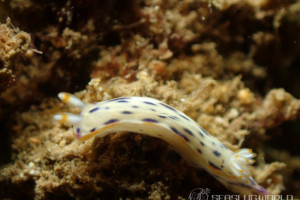
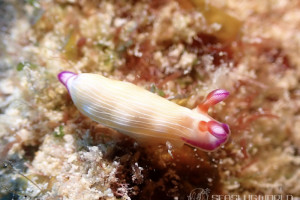
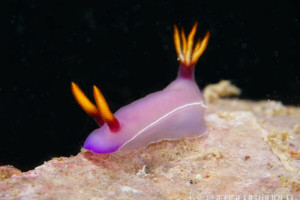
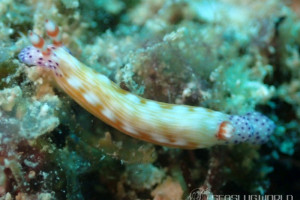
Photos of Hypselodoris dollfusi

Same Genus Nudibranchs

Similar Colors Nudibranchs
Academic Database
Sea slug observation data is available in international marine biodiversity databases.