Coryphellina aurora Ekimova, Deart, Antokhina, Mikhlina & Schepetov, 2022
Coryphellina aurora
No field photograph submitted for this species yet
Have you photographed this species?Description
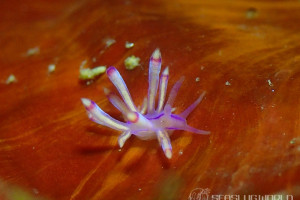
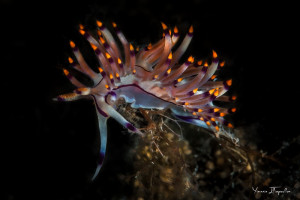
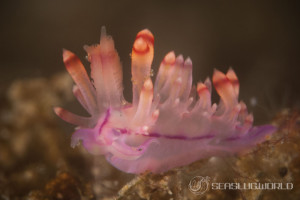
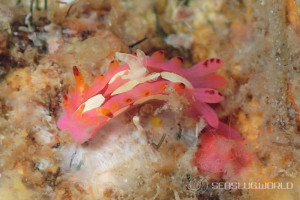
The largest member of the species complex, reaching about 27 mm in length (preserved). Background color translucent violet to lilac. Foot slender with long anterior corners. Rhinophores densely papillated, 1.2-1.5 times shorter than the oral tentacles, intensive pink with orange papillae and translucent tips. Oral tentacles translucent violet, more intensive toward the tip, covered by sparse white opalescent powder, with white tips. Cerata cylindrical, pointed distally, with brownish digestive gland diverticula filling only about one-quarter to one-fifth of the ceratal volume; arranged in up to nine distinct groups per side, with up to 23 cerata in the first group and seven in the second — by far the highest counts in the species complex. Each ceras is pink to lilac, with strong violet-red subapical rings underlain by sparse white opalescent speckling, and orange tips. The dorsal pink line is short and indistinct, present only on the head between the rhinophores; the dorsolateral lines are entirely absent.Distribution
The type locality is Hon Nok, in the outer part of Nha Trang Bay, Central Vietnam, at 25 m depth on rock. At present, the species is recorded only from this type locality.Etymology
The specific epithet aurora is Latin for "dawn", referring to the beautiful pinkish coloration of the species, which recalls the colors of the sunrise along the Vietnamese coast.Remarks
Within the family Flabellinidae, this species is uniquely identified by its translucent violet-to-lilac body, intensive pink rhinophores, and — most distinctively — the near-complete absence of the dorsal and dorsolateral pigmental lines characteristic of the rest of the species complex (only a short, indistinct dorsal line on the head remains). The exceptionally high number of ceratal groups and cerata per group is a further morphological hallmark. Specimens with similar coloration recorded from the Philippines may belong to this species, suggesting a possibly wider tropical Indo-West Pacific distribution.References
- Flabellina sp. 2, Terrence Gosliner, Ángel Valdés and David Behrens. (2018). Nudibranch and Sea Slug Identification Indo-Pacific 2nd Edition. New World Pubns Inc.
- Coryphellina aurora sp. nov., Ekimova I., Deart Y., Antokhina T., Mikhlina A. & Schepetov D. (2022). Stripes Matter: Integrative Systematics of Coryphellina rubrolineata Species Complex (Gastropoda: Nudibranchia) from Vietnam. Diversity. 14(4): 294. https://doi.org/10.3390/d14040294
Featured in this book
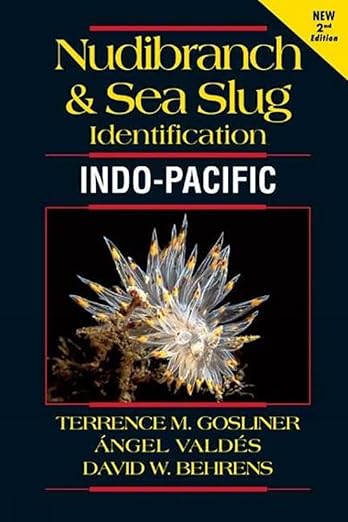
Terrence Gosliner, Ángel Valdés and David Behrens. (2018). Nudibranch and Sea Slug Identification Indo-Pacific 2nd Edition. New World Pubns Inc.
New World Publications
This species, Coryphellina aurora, is included in the book.
View on Amazon PR (Amazon Associates)Seasonality
Shooting Locations
Loading shooting locations...
Photos of Coryphellina aurora

Same Genus Nudibranchs



Similar Colors Nudibranchs
Academic Database
Sea slug observation data is available in international marine biodiversity databases.