Coryphellina rubrolineata O'Donoghue, 1929
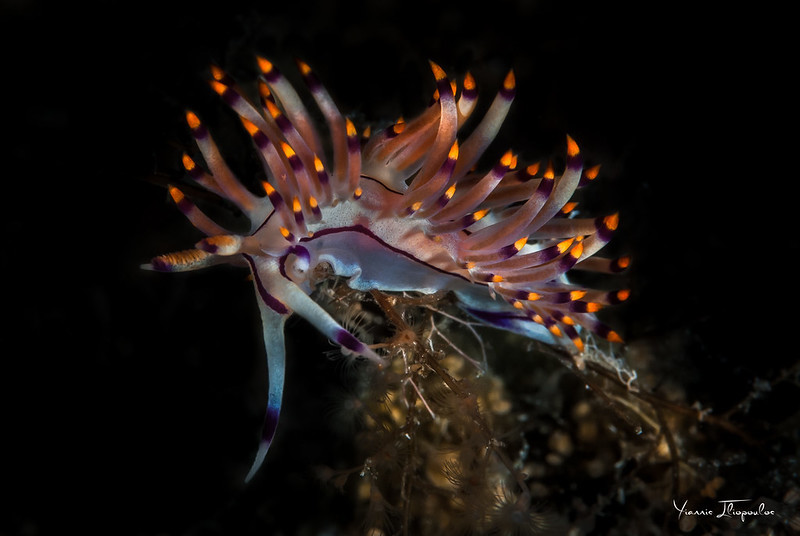
- Location
- Greece
- Date
- 2019/08/28
- Length
- ??mm
- Depth
- ??m
- Water temperature
- ??℃
Description
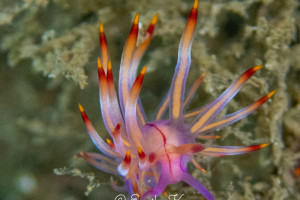
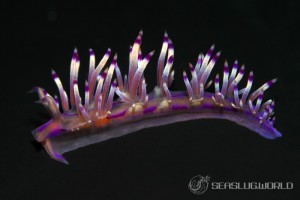
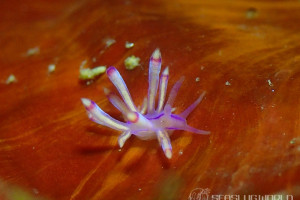
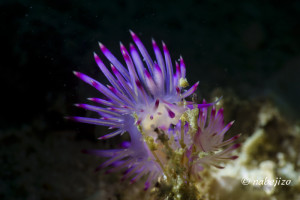
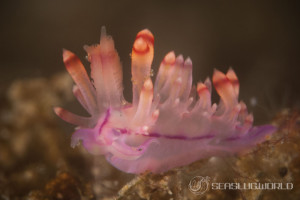
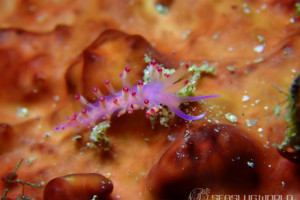
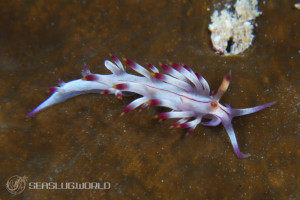
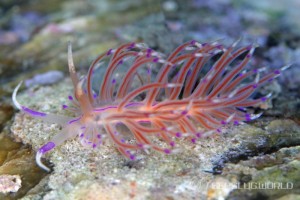
A small to medium-sized aeolid reaching about 12 mm in extended length. Background color translucent to milky-white, with a variable amount of opaque white opalescent powder on the dorsum and lateral sides. Three continuous purple (sometimes red-purple) longitudinal lines run along the dorsal midline and the two dorsolateral sides, from head to tail, and are the diagnostic feature of the species. Purple pigment may also appear on the distal third of the oral tentacles, at the tips of the rhinophores, on the anterior foot corners, and on the cerata. Rhinophores are densely papillated, with the front surface the same color as the body and the rear surface opaque white to pale yellow; they are roughly half to one-third the length of the oral tentacles. Oral tentacles are long and cylindrical, with lilac subapical rings and prominent white opalescent powder near the tips. Cerata are translucent to opaque white at the base, with red, purple or orange subapical pigmentation and orange pigment in the cnidosac area; they are arranged in 5-7 distinct groups, with up to 8-12 cerata in the first group.Distribution
The type locality is the Suez region of the Red Sea. Recent integrative work, including a molecular redescription based on Red and Arabian Sea material, indicates that the "true" Coryphellina rubrolineata is restricted to the Red Sea and the Arabian Sea, with a Lessepsian population in the eastern Mediterranean. Records from the Indo-West Pacific that were long attributed to this species in fact represent a complex of closely related but distinct species, and are no longer treated as C. rubrolineata.Etymology
The specific epithet rubrolineata combines the Latin ruber (red) and lineatus (lined), referring to the three reddish-purple longitudinal lines that run along the dorsum and lateral sides.Remarks
Within the family Flabellinidae, the genus Coryphellina is diagnosed by densely papillated rhinophores and a bilobed proximal seminal receptacle. The three longitudinal lines are shared with several related Indo-West Pacific species, but in C. rubrolineata all three lines are continuous from head to tail, and dense white opalescent powder is present on the distal parts of both the rhinophores and the oral tentacles — a combination that distinguishes it from the other members of the species complex.References
- Coryphellina rubrolineata gen. et sp. nov., O'Donoghue C.H. (1929). Report on the Opisthobranchia. The Zoological Results of the Cambridge Expedition to the Suez Canal, 1924. Transactions of the Zoological Society of London. 22(6): 713-841.
- Flabellina rubrolineata (O'Donoghue, 1929), Gosliner, T. M.; Willan, R. C. (1991). Review of the Flabellinidae (Nudibranchia: Aeolidacea) from the tropical Indo-Pacific, with the descriptions of five new species. The Veliger. 34(2): 97-133.
- 高岡生物研究会. (2002). 日本海のウミウシ. 第2版.
- Coryphellina rubrolineata, Korshunova T., Martynov A., Bakken T., Evertsen J., Fletcher K., Mudianta I.W., Saito H., Lundin K., Schrödl M. & Picton B. (2017). Polyphyly of the traditional family Flabellinidae affects a major group of Nudibranchia: aeolidacean taxonomic reassessment with descriptions of several new families, genera, and species (Mollusca, Gastropoda). ZooKeys. 717: 1-139. https://doi.org/10.3897/zookeys.717.21885
- Flabellina rubrolineata, Ekimova, Irina A., Tatiana I. Antokhina, and Dimitry M. Schepetov. 2020. “Molecular Data and Updated Morphological Description of Flabellina Rubrolineata (Nudibranchia: Flabellinidae) from the Red and Arabian Seas.” Ruthenica, Russian Malacological Journal 30(4): 183–94.
- Coryphellina rubrolineata, Ekimova I., Deart Y., Antokhina T., Mikhlina A. & Schepetov D. (2022). Stripes Matter: Integrative Systematics of Coryphellina rubrolineata Species Complex (Gastropoda: Nudibranchia) from Vietnam. Diversity. 14(4): 294. https://doi.org/10.3390/d14040294
A Kindle field guide by the site author
Kimoto N. (2026). Sea Slugs of Japan & the Indo-Pacific, 2nd Edition.
Kindle Edition
View on Amazon PR (Amazon Associates)Seasonality
Shooting Locations
Loading shooting locations...
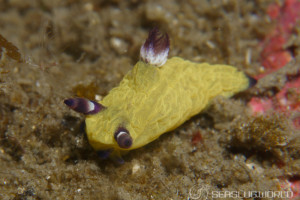
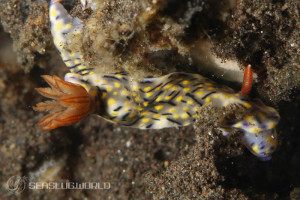
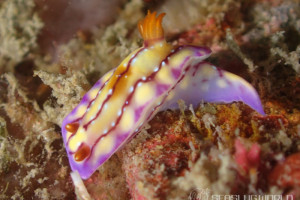
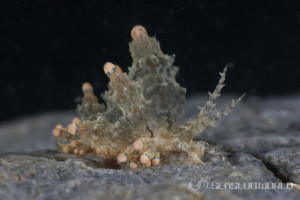
Photos of Coryphellina rubrolineata

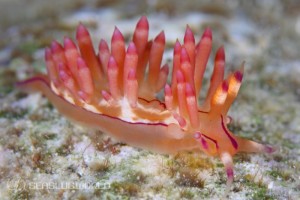
Same Genus Nudibranchs



Similar Colors Nudibranchs
Academic Database
Sea slug observation data is available in international marine biodiversity databases.