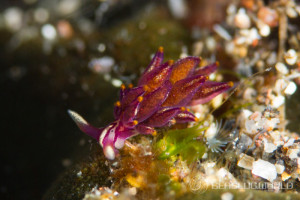
Tyrannodoris nikolasi (Pola, Padula, Gosliner & Cervera, 2014)
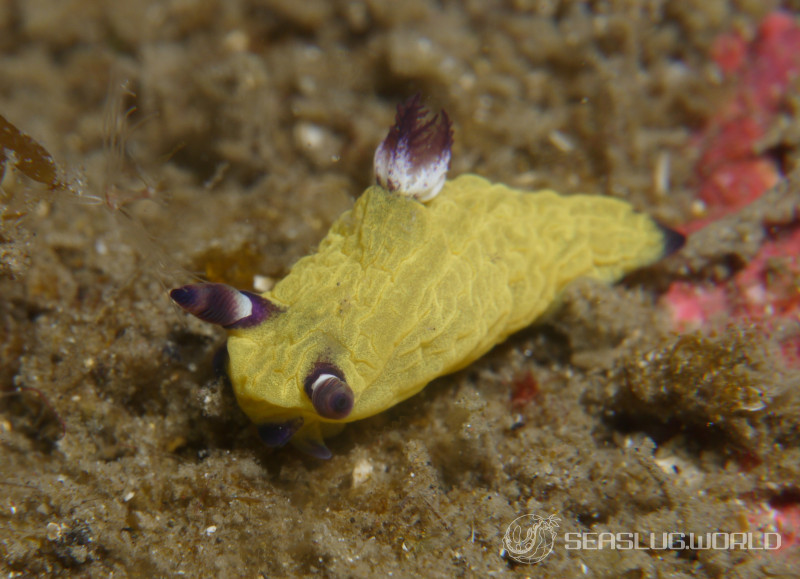
- Location
- Shirosaki, Tago, Futou, Dougashima, Shizuoka, Japan
- Date
- 2017/03/24
- Length
- 18mm
- Depth
- 22.0m
- Water temperature
- 16.1℃
Description
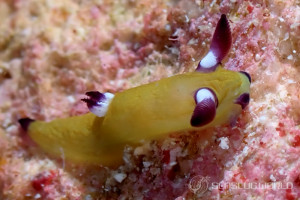
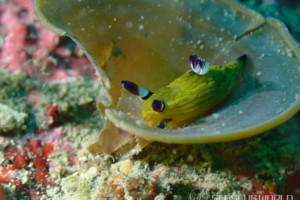
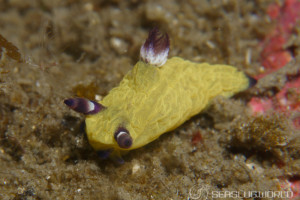
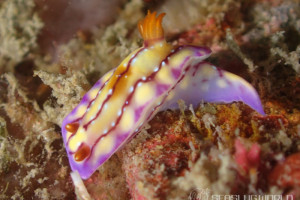
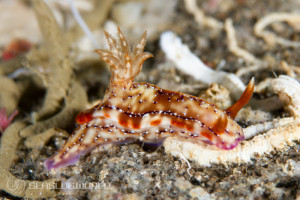
Body elongate and limaciform with a long pointed tail. Living animals 15 mm in length (6 mm preserved). The body is black to dark blue, with yellow to orange longitudinal lines or rows of dots on the dorsum. Gills and rhinophores are dark basally and pale-tipped (dark blue/violet at the distal region in some specimens). The radular formula is 32 × 2(3).1.1.1.2(3) for both Vanuatu and Malaysia specimens. The rachidian tooth is rectangular, broad with a slightly arched upper edge and three well-developed denticles, the central one being slightly longer. The inner lateral tooth is very curved, having two well-developed cusps; the inner cusp is bifid. All three cusps are long and slender. There are only two outer lateral teeth, both lacking cusps or denticulation.Distribution
Type locality: Vanuatu, Espiritu Santo Island (10 m). Also recorded by Pola et al. 2014 from Jubilee Shoal, South China Sea, Malaysia. Photographic records exist from Dampier (Western Australia), Japan and Singapore, but those specimens have not been examined and may represent a different species.Etymology
Verbatim from the original description (Pola, Padula, Gosliner & Cervera, 2014, p.614):This species is dedicated to Nikolas Butvill-Camacho, first son of Yolanda Camacho-García, great friend to all the authors of this paper and who participated in the expedition Santo 2006 to Vanuatu, collecting and photographing this species.
Remarks
Originally described as Roboastra nikolasi by Pola, Padula, Gosliner & a 2014 revision Cladistics 30:607-634; subsequently transferred to Tyrannodoris on the basis of phylogenetic analyses. Specimens previously figured by Gosliner et al. 2008 as Roboastra sp. are referable to this species. The original Remarks state that "Roboastra nikolasi sp. nov. cannot be confused with" other congeners (p.616).References
- Roboastra nikolasi, Terrence Gosliner, Ángel Valdés and David Behrens. (2015). Nudibranch and Sea Slug Identification Indo-Pacific. New World Pubns Inc.
- ニコラスリュウグウウミウシ(新称), 中野理枝. (2018). 日本のウミウシ. 文一総合出版.
- Roboastra nikolasi, Terrence Gosliner, Ángel Valdés and David Behrens. (2018). Nudibranch and Sea Slug Identification Indo-Pacific 2nd Edition. New World Pubns Inc.
Featured in this book
Terrence Gosliner, Ángel Valdés and David Behrens. (2018). Nudibranch and Sea Slug Identification Indo-Pacific 2nd Edition. New World Pubns Inc.
New World Publications
This species, Tyrannodoris nikolasi, is included in the book.
View on Amazon PR (Amazon Associates)Seasonality
Shooting Locations
Loading shooting locations...
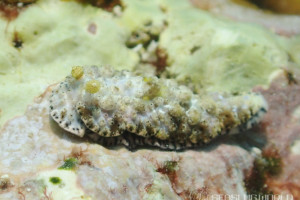
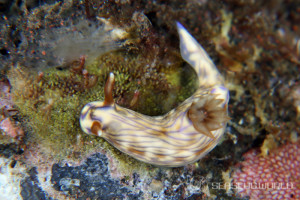
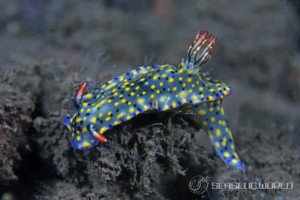
Photos of Tyrannodoris nikolasi

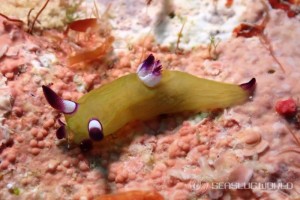

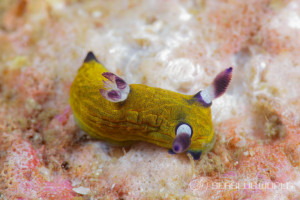

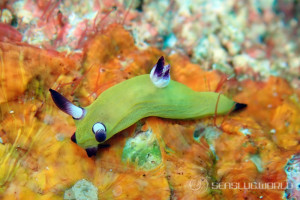
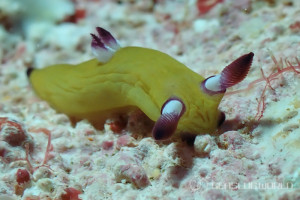


Same Genus Nudibranchs

Similar Colors Nudibranchs
Academic Database
Sea slug observation data is available in international marine biodiversity databases.