Goniobranchus roboi (Gosliner & Behrens, 1998)
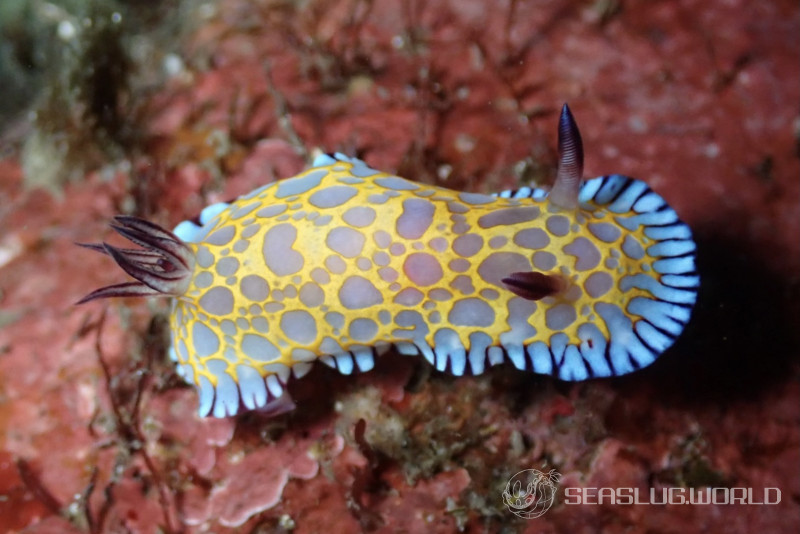
Description
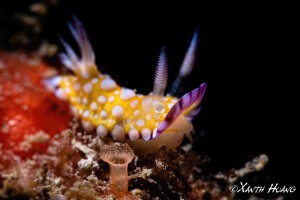
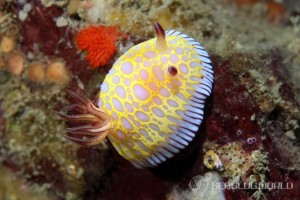
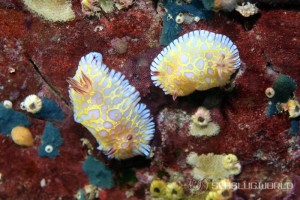
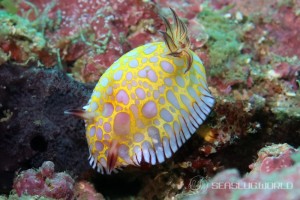
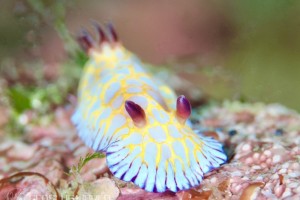
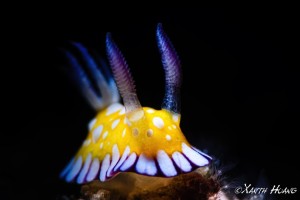
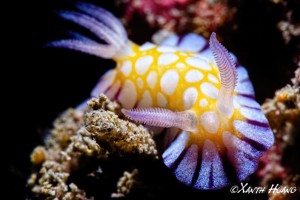
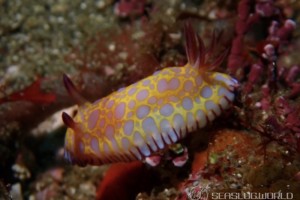
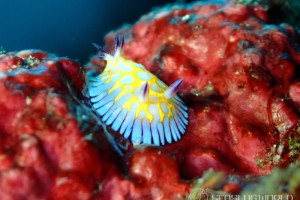
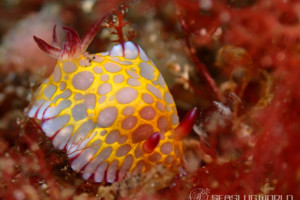
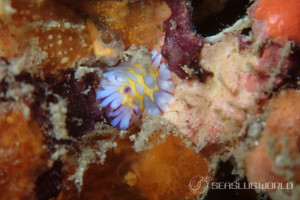
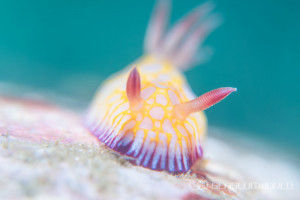
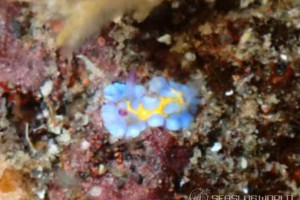
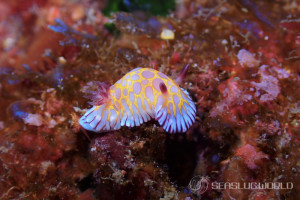
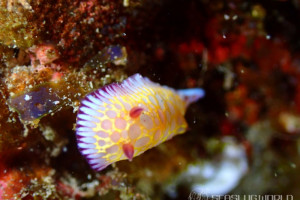
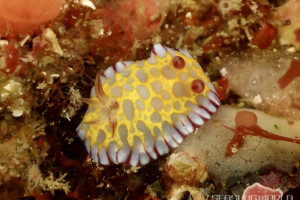
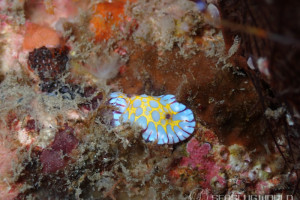
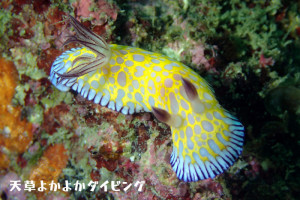
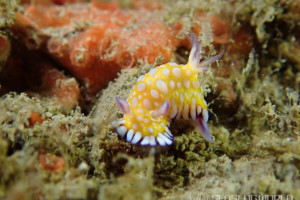
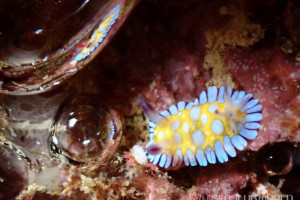
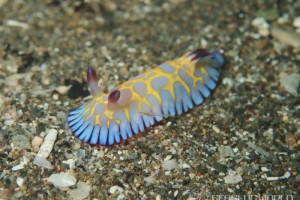
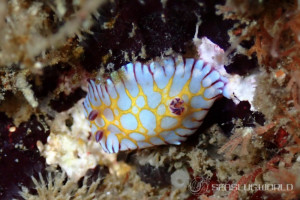
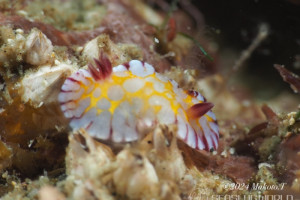
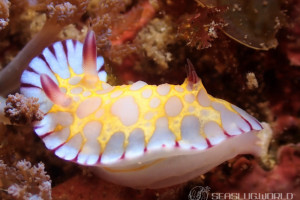
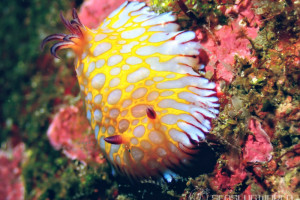
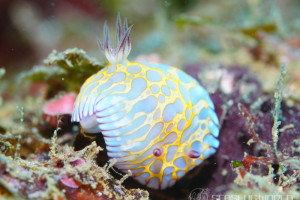
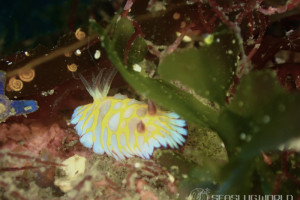
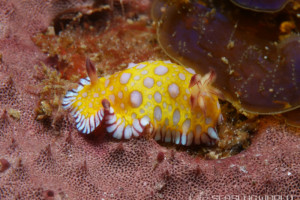
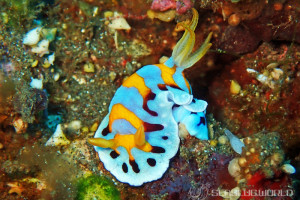
A medium-sized chromodorid, 17–50 mm long. Easily distinguished by the magnificent, bright blue blocks of colour which appear in series separated by black areas of pigment. The blue blocks are squarish or rectangular in shape with edges that are rounded to varying degree. The dorsal yellowish-orange surface is interrupted in many areas where circles or irregular patches of blue to lavender are visible. Usually a large patch is present behind each rhinophore, and dark brown or wine-coloured blotches may cover the dorsal surface. The areas bordering the rhinophore and gill sheaths are orange and may bear spots of bright blue, lavender, black or wine. The lamellae and rachis of the rhinophores and the longitudinal edges of the gill plumes are dark blue to black; in one specimen the gill plumes are entirely blue-black. The foot bears the same pattern as the mantle margin, blue with black stripes radiating from near the median line. There are 5–6 elongate, unipinnate gills and the rhinophores bear 19–22 lamellae. As in G. hintuanensis, G. roboi raises and lowers its anterior end when actively crawling (R. Bolland, pers. comm.).Distribution
Type locality: Horseshoe Cliffs, 1 km NW of Onna Village, Okinawa, Ryukyu Islands, Japan, 26°30′N, 127°50.9′E (Holotype CASIZ 079346, collected 31 August 1991 at 47 m depth by Robert F. Bolland). Known from Lord Howe Island, New South Wales, Australia (Coleman 1989); Murion Island, Western Australia (Debelius 1996, as Hypselodoris vibrata); and Okinawa, Ryukyu Islands, Japan (present study). Found at relatively deep reef habitats (37–50 m).Etymology
The species is named for Robert Bolland, friend and enthusiastic nudibranch biologist. The first two letters of his first and last names produce "robo," synonymous with RoboCop — a fictitious personality equally as daring and adventurous as their friend Bob Bolland.Remarks
Originally described as Chromodoris roboi; transferred to Goniobranchus in a molecular revision based on molecular phylogeny. Not a member of the Chromodoris quadricolor complex. The most similar species in colour pattern are G. vibratus (Pease, 1860) — with white pustules on a yellow-orange notum and a white marginal region with triangular dark blue interruptions — and G. aureopurpureus (Collingwood, 1881) — with a white body bearing dark blue mantle margin intrusions and orange spots. G. roboi has long been confused with G. vibratus (Debelius 1996, fig. 239 misidentified). Diagnostic differences: G. roboi has only 5–6 gills which do not vibrate, while G. vibratus has 8–10 vibratile gills (Kay & Young 1969); G. roboi has a vestigial rachidian tooth, apparently absent in G. vibratus; the radula of G. roboi bears 8–11 denticles on middle laterals (vs. up to 4 in G. vibratus).References
- Chromodoris roboi sp. nov., Gosliner, T. M.; Behrens, D. W. (1998). Five new species of Chromodoris (Molluscs: Nudibranchia: Chromodorididae) from the tropical Indo-Pacific Ocean. Proceedings of the California Academy of Sciences. 4(50): 139-165., available online at http://www.biodiversitylibrary.org/page/15659747 page(s): 145-150
- ボブサンウミウシ(仮称), 益田一. (1999). 海洋生物ガイドブック. 東海大学出版会.
- ボブサンウミウシ, 鈴木敬宇. (2000). ウミウシガイドブック〈2〉. TBSブリタニカ.
- クロモドリス・ロボイ, 殿塚孝昌. (2003). ウミウシガイドブック〈3〉. TBSブリタニカ.
- Goniobranchus roboi, Johnson R.F. & Gosliner T.M. (2012). Traditional taxonomic groupings mask evolutionary history: a molecular phylogeny and new classification of the chromodorid nudibranchs. PLoS ONE 7(4): e33479.
A Kindle field guide by the site author
Kimoto N. (2026). Sea Slugs of Japan & the Indo-Pacific, 2nd Edition.
Kindle Edition
View on Amazon PR (Amazon Associates)Seasonality
Shooting Locations
Loading shooting locations...
Photos of Goniobranchus roboi
Tag:




















Same Genus Nudibranchs
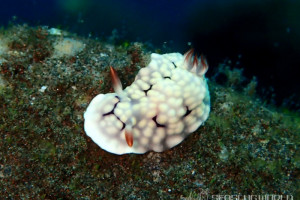
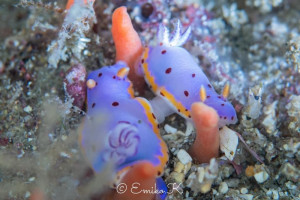

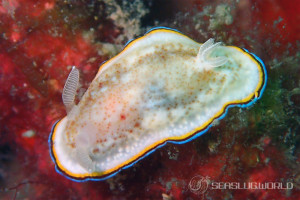
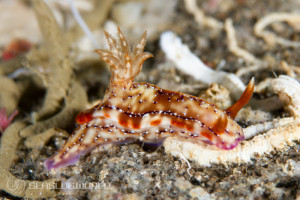
Similar Colors Nudibranchs
Academic Database
Sea slug observation data is available in international marine biodiversity databases.