Hypselodoris krakatoa Gosliner & R. F. Johnson, 1999
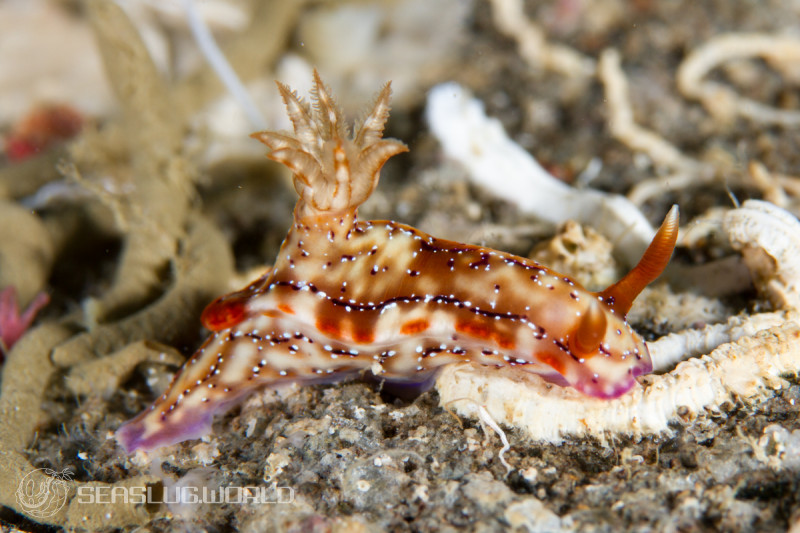
- Location
- DIVE7000, Anilao, Philippines
- Date
- 2016/04/18
- Length
- 15mm
- Depth
- 6.0m
- Water temperature
- 29.2℃
Description
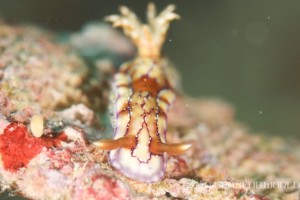
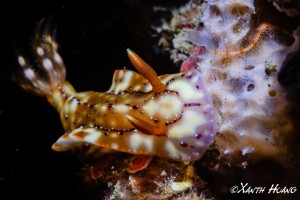
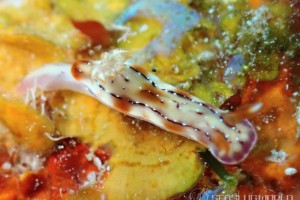
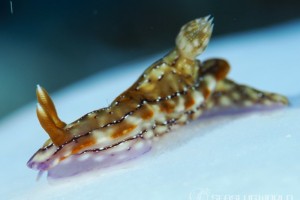
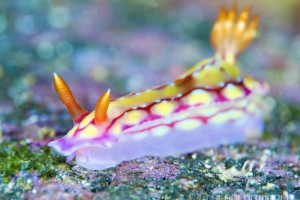
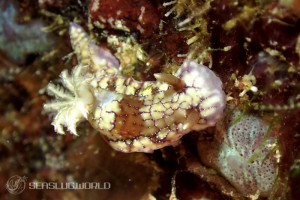
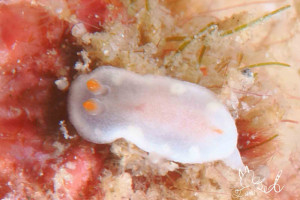
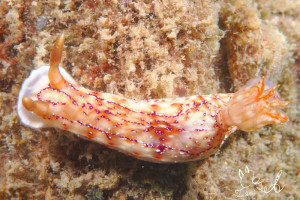
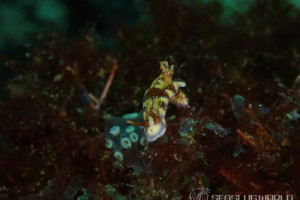
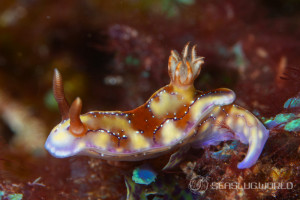
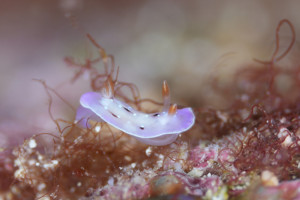
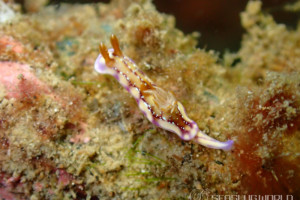
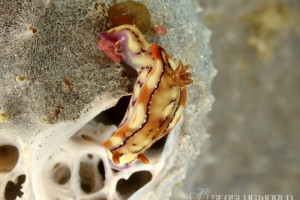
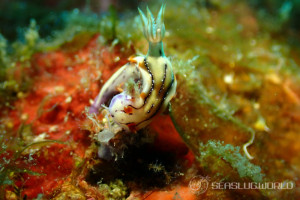
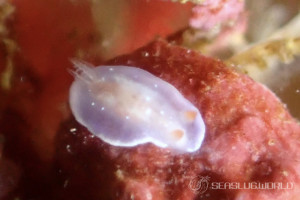
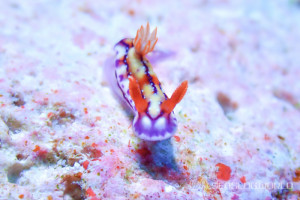
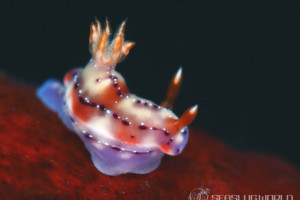
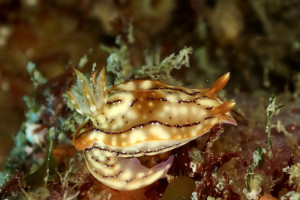
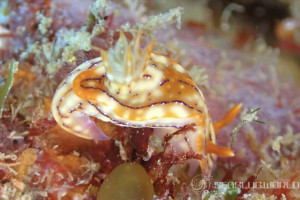
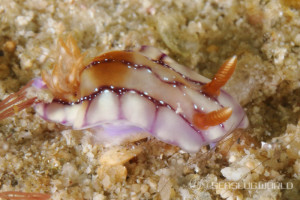
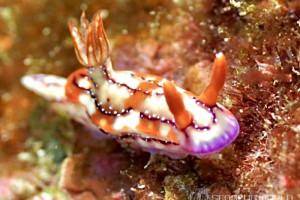
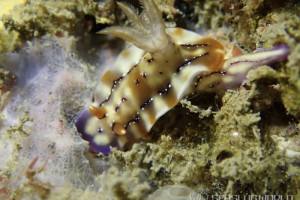
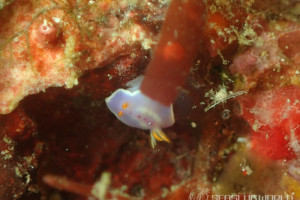
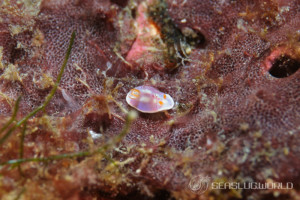
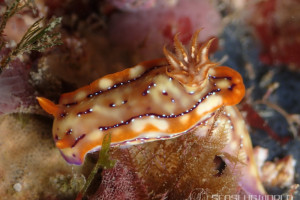
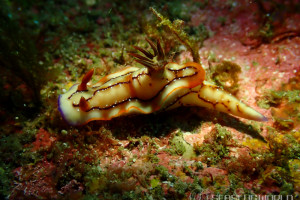
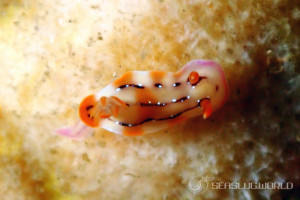
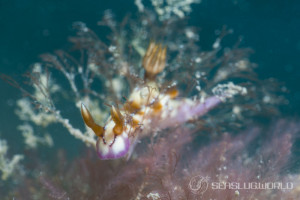
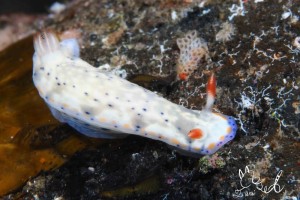
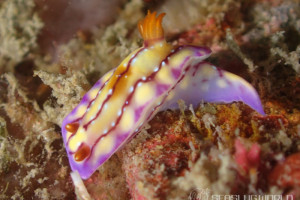
A medium to fairly large Hypselodoris, 10-55 mm long. The body is elongate and high in profile, with the posterior gill region distinctly higher than the rest of the mantle, recalling the volcano-like shape that gave the species its name. The head is spatulate. The mantle has a very complex pattern: the body is light yellowish brown overlaid by darker brown patches that form a distinctive irregular figure-eight pattern over the surface of the notum. The arrangement and density of these patches varies greatly. Two parallel black lines run anterior to the rhinophores and join posterior to the gills, overlaid by scattered opaque white or light blue spots. Between these lines runs a complete or interrupted black line bearing opaque whitish spots. Other isolated black lines or black and opaque white spots may occur on the dorsum, sides of the body and foot. The mantle margin around the head and foot is light purple. The well-separated rhinophores are uniformly rusty-brown with opaque white apical spots. Behind the rhinophores are two patches of lighter, more translucent pigment through which the eyes are visible. Each of the seven simply pinnate gills is yellowish brown with a rust-red rachis.The congested posterior glands are larger than the sparse, evenly-spaced lateral, anterolateral and anterior glands. The anterior glands are closer together than the lateral or anterolateral glands. Radular formulae in three specimens are 51×66.0.66, 30×35.0.35 and 46×60.0.60, lacking rachidian teeth. The jaw rodlets are moderately elongate, circular in cross-section and lack lateral flanges. The inner lateral teeth have 1-7 denticles on the inner side of the bifid cusps; outer denticles are absent. The remaining lateral teeth, including the middle laterals, lack denticles except the bifid cusps. The five or six outermost teeth bear 2-5 denticles on the outer side of the bifid cusps. The penial sac is narrow and elongate. The receptaculum seminis is elongate and pyriform, with a short duct attached to the vaginal duct below the base of the ovoid bursa copulatrix.
Distribution
Found uncommonly on subtidal reefs from Okinawa, the Philippines, Indonesia and Papua New Guinea, at 4-56 m depth. Type locality: off the southern point of Culebra (Bonito) Island, Batangas, Luzon, Philippines (25 m depth).Etymology
Verbatim from the original description (Gosliner, Johnson & Andersson, 1999, Zoological Journal of the Linnean Society 125: p.45):The name krakatoa comes from the volcano in Indonesia which exploded on August 26, 1883, and refers to the volcano-like shape of the gill sheath which is well elevated from the rest of the notum.
Remarks
Described in a 1999 revision. The sister species is H. reidi; both are distinguished by an elevated, conical branchial sheath. H. krakatoa has black lines and black and white spots, which are absent in H. reidi. The gills and rhinophores of H. reidi are the same colour as the general body, while those of H. krakatoa have red pigment. The mantle glands of H. krakatoa are closer together anteriorly while those of H. reidi are sparsely situated. The inner lateral teeth of H. krakatoa have many inner denticles, while only a single inner denticle is present in H. reidi. The penis of H. krakatoa is narrow while it is slightly bulbous in H. reidi. The receptaculum seminis of H. krakatoa is more elongate than that of H. reidi.References
- Hypselodoris krakatoa sp. nov., Gosliner T.M. & Johnson R.F. (1999). Phylogeny of Hypselodoris (Nudibranchia: Chromodorididae) with a review of the monophyletic clade of Indo-Pacific species, including descriptions of twelve new species. Zoological Journal of the Linnean Society. 125: 1-114. https://doi.org/10.1111/j.1096-3642.1999.tb00585.x
- アンジンサイウミウシ(仮称), 益田一. (1999). 海洋生物ガイドブック. 東海大学出版会.
- アンジンサイウミウシ, 益田一. (1999). 海洋生物ガイドブック. 第2刷. 東海大学出版会.
- ヒュプセロドーリス・クラカトア, 中野理枝. (2004). 本州のウミウシ. ラトルズ.
- ヒュプセロドーリス・クラカトア, 小野篤司 & 加藤昌一. (2009). ウミウシ. 誠文堂新光社.
- Hypselodoris krakatoa, Johnson R.F. & Gosliner T.M. (2012). Traditional taxonomic groupings mask evolutionary history: a molecular phylogeny and new classification of the chromodorid nudibranchs. PLoS ONE 7(4): e33479.
- Hypselodoris krakatoa, Terrence Gosliner, Ángel Valdés and David Behrens. (2015). Nudibranch and Sea Slug Identification Indo-Pacific. New World Pubns Inc.
- クラカトアウミウシ(新称), 中野理枝. (2018). 日本のウミウシ. 文一総合出版.
Featured in this book
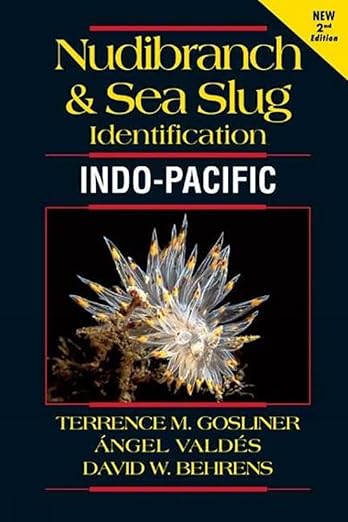
Terrence Gosliner, Ángel Valdés and David Behrens. (2018). Nudibranch and Sea Slug Identification Indo-Pacific 2nd Edition. New World Pubns Inc.
New World Publications
This species, Hypselodoris krakatoa, is included in the book.
View on Amazon PR (Amazon Associates)Seasonality
Shooting Locations
Loading shooting locations...
Photos of Hypselodoris krakatoa
Tag:























Same Genus Nudibranchs

Academic Database
Sea slug observation data is available in international marine biodiversity databases.