Terry Gosliner and the Slug Lab — Who Names Today's Indo-Pacific Sea Slugs
Dr. Terrence M. Gosliner is the Senior Curator of Invertebrate Zoology at the California Academy of Sciences (CAS) and the leading taxonomist of Indo-Pacific sea slugs. Since describing his first new species as a high schooler in 1975, he has built the "Slug Lab" at CAS, a multi-generational research group that has named hundreds of new species over half a century. Of 1,178 species cataloged on this site, 220 carry Gosliner as one of the naming authors.
Open any Indo-Pacific sea slug field guide and "Gosliner" is on nearly every page: as author, co-author, or identifier. He is the central figure in sea slug taxonomy as it is being practised right now. This article looks at Gosliner and the Slug Lab through their body of work and how the research carries across generations.
Profile: Senior Curator and the Slug Lab
Senior Curator of Invertebrate Zoology and Geology at the California Academy of Sciences (CAS). The opisthobranch research group Gosliner leads at CAS calls itself the "Slug Lab" (sluglab.wordpress.com).
Notable books:
- Nudibranchs of Southern Africa (Gosliner, 1987): the comprehensive guide for South African / Mozambican opisthobranchs of the 1980s
- Indo-Pacific Nudibranchs and Sea Slugs (Gosliner, Behrens & Valdés, 2008): the large reference monograph that defined the Indo-Pacific opisthobranch standard for the 2000s
- Nudibranch and Sea Slug Identification — Indo-Pacific (Gosliner, Valdés & Behrens, 1st ed. 2015 / 2nd ed. 2018): the current Indo-Pacific identification standard, anchored in Slug Lab field collection and description work
- Numerous co-authored review papers
Half a century of activity, 1975 to 2026
The defining feature of Gosliner's career is that it is still in motion.
- 1975: first new species (Hallaxa chani, with Gary Williams, based on a specimen collected as a high schooler)
- 1978: PhD (University of New Hampshire)
- 1982: joins CAS as Assistant Curator
- 1987: Nudibranchs of Southern Africa
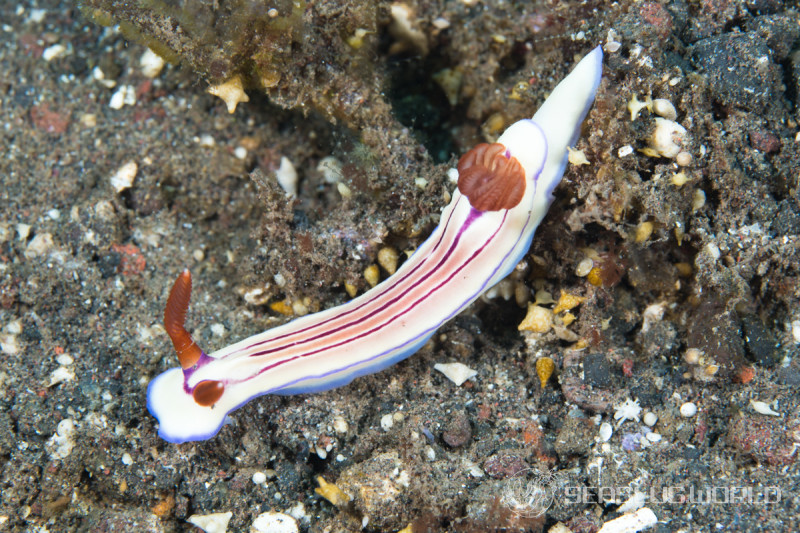
- 1999: Hypselodoris systematic review (Gosliner & Johnson)
- 2008: Indo-Pacific Nudibranchs and Sea Slugs
- 2026: most recent Gosliner-associated record on this site
A career that began in his high-school years has continued without interruption, pulling in graduate students, younger researchers, and international collaborators along the way.
1987, Nudibranchs of Southern Africa
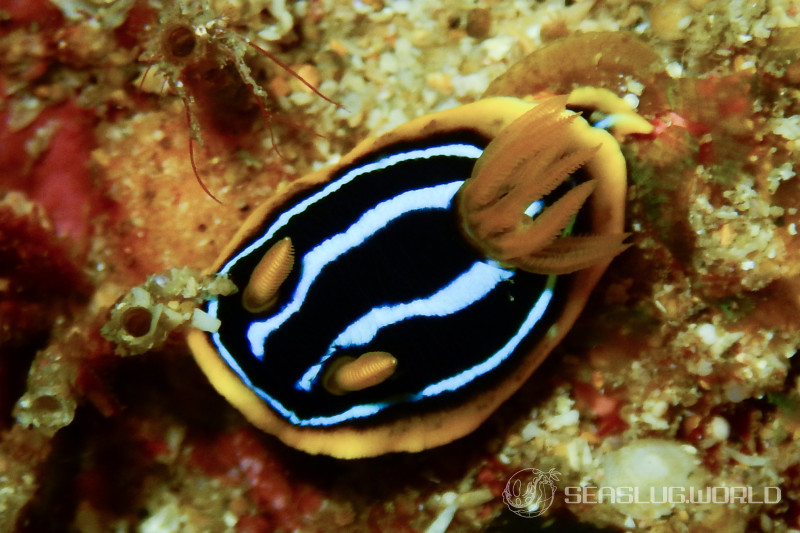
Gosliner's defining early book is Nudibranchs of Southern Africa, published in 1987. Built primarily from holdings at the South African Museum (now Iziko South African Museum), it covers the opisthobranchs of the South African and Mozambican coasts.
This is a sole-author work, written before Gosliner had organised the Slug Lab into a production team, and it grounds the rest of his career.
2008, Indo-Pacific Nudibranchs and Sea Slugs
The 2008 monograph co-authored by Gosliner, Behrens, and Valdés covers the opisthobranchs of the Indo-Pacific (Philippines, Indonesia, Papua New Guinea, and adjacent waters), pairing photographs with classification text and notes on distribution, colour variation, and resemblance to congeners.
At the time of publication this was the world reference for Indo-Pacific opisthobranchs; serious sea slug enthusiasts in Japan and elsewhere kept a copy on the shelf. It represents the 2000s state of the art for the region.
2015 / 2018, Nudibranch and Sea Slug Identification — Indo-Pacific
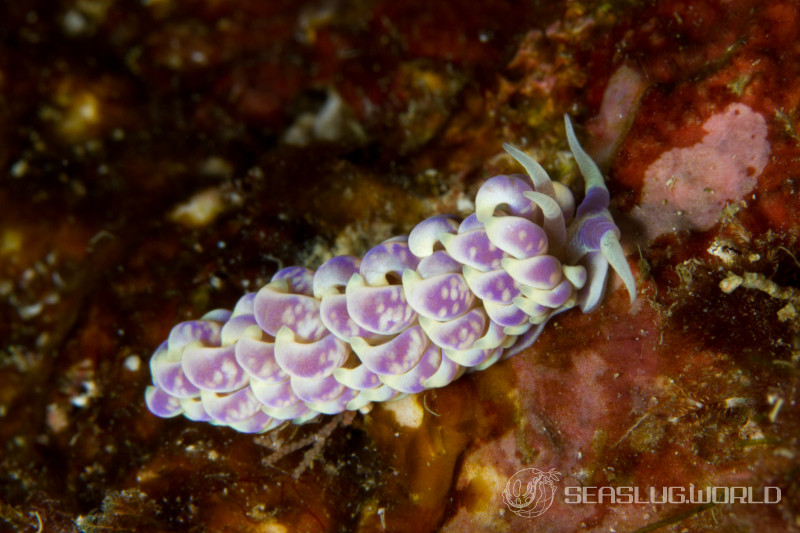
Seven years after the 2008 monograph, Gosliner teamed up with Valdés and Behrens again to publish Nudibranch and Sea Slug Identification — Indo-Pacific (New World Publications) in 2015, with a 2nd edition in 2018.
What sets this book apart is that most of the species shown were collected and later described by the Slug Lab and its international collaborators. It is not a picture-only field guide: each species sits on top of specimen, molecular, and morphological data. Rather than a universally settled standard, it is closer to the world the Slug Lab is building, presented outward as the reference.
From the 2008 monograph the classification framework and species coverage were expanded substantially, and the volume runs to around 450 pages. It is not a pocket guide but the kind of book you keep on a shelf or pack along to a trip when you're willing to carry the weight. Even so, it is the first reference divers, enthusiasts, and researchers reach for when identifying Indo-Pacific sea slugs.
World Sea Slug Day (October 29)
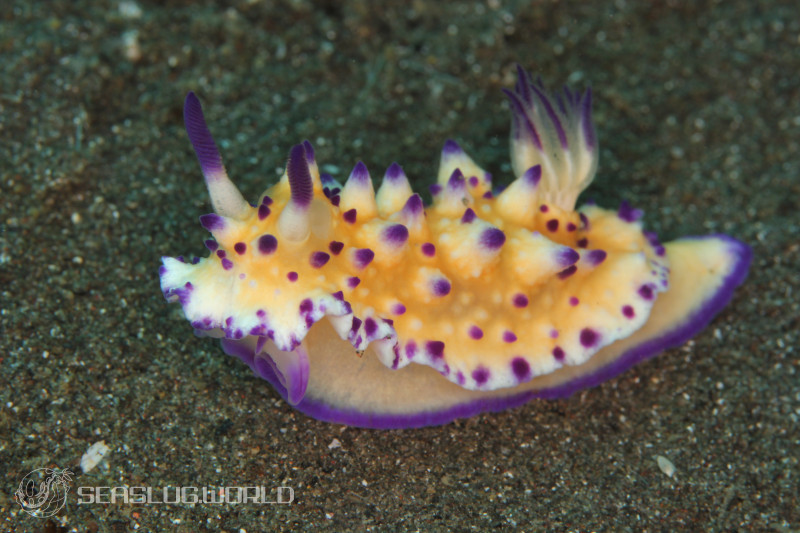
Gosliner's reach extends past the academic world. World Sea Slug Day, observed every October 29 by divers, photographers, and citizen scientists posting sea slug images on social media, falls on Gosliner's birthday. The tradition traces back to 2015, when CAS echinoderm specialist Chris Mah declared "October 29 = Sea Slug Day" on his Echinoblog, fixing the date the community now uses every year.
That a single researcher's birthday has settled into a global social-media event reflects how his work reaches past the lab and into a broader community of enthusiasts.
The Slug Lab as a training pipeline
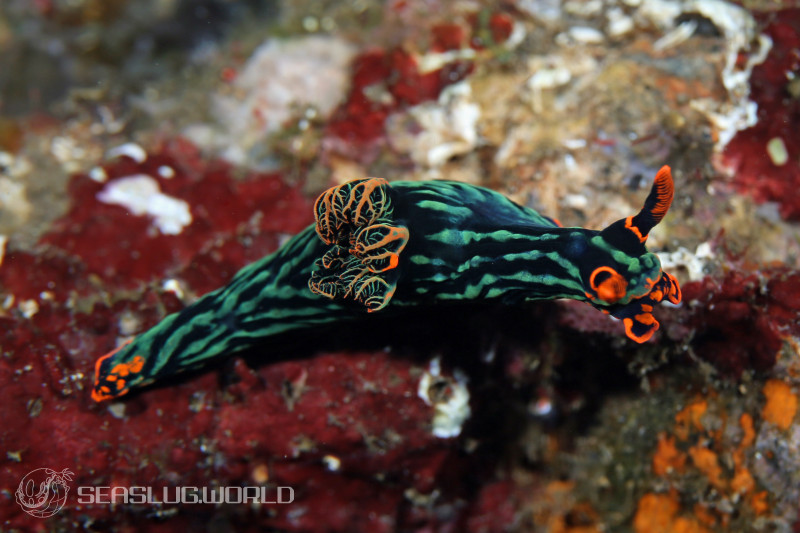
The Slug Lab is the opisthobranch research group Gosliner founded at CAS, and in practice it works as a multi-generation training pipeline. The typical path: a master's at San Francisco State University (SFSU) under Gosliner, a PhD at a partner university in Spain, Costa Rica, the U.S., or elsewhere, a post-doc back at CAS, and then a PI position somewhere in the world.
Looking at the named alumni on the lab site, the modern roster of Indo-Pacific opisthobranch taxonomy is largely Slug Lab-derived.
The Spain axis, the lab's biggest international node:
- Marta Pola: PhD at Universidad Autónoma de Madrid (UAM), post-doc at CAS, now back at UAM as PI; trains the next generation in Spain (including Paz-Sedano, below)
- Leila Carmona: PhD at Universidad de Cádiz (Spain); Slug Lab graduate
U.S. and elsewhere:
- Benoit Dayrat (originally France, now Penn State)
- Monica Medina (now Penn State)
- Yolanda Camacho (PhD U. Costa Rica)
- Rebecca Johnson (M.S. SFSU, PhD UCSC, post-doc CAS, now CAS staff; co-author of the 1999 Hypselodoris monograph)
- Shireen Fahey (M.S. SFSU, PhD U. Queensland)
Recent Slug Lab graduates appearing in this site's author column:
- Sam Donohoo: genus Avaldesia (Donohoo & Gosliner, 2024) and others
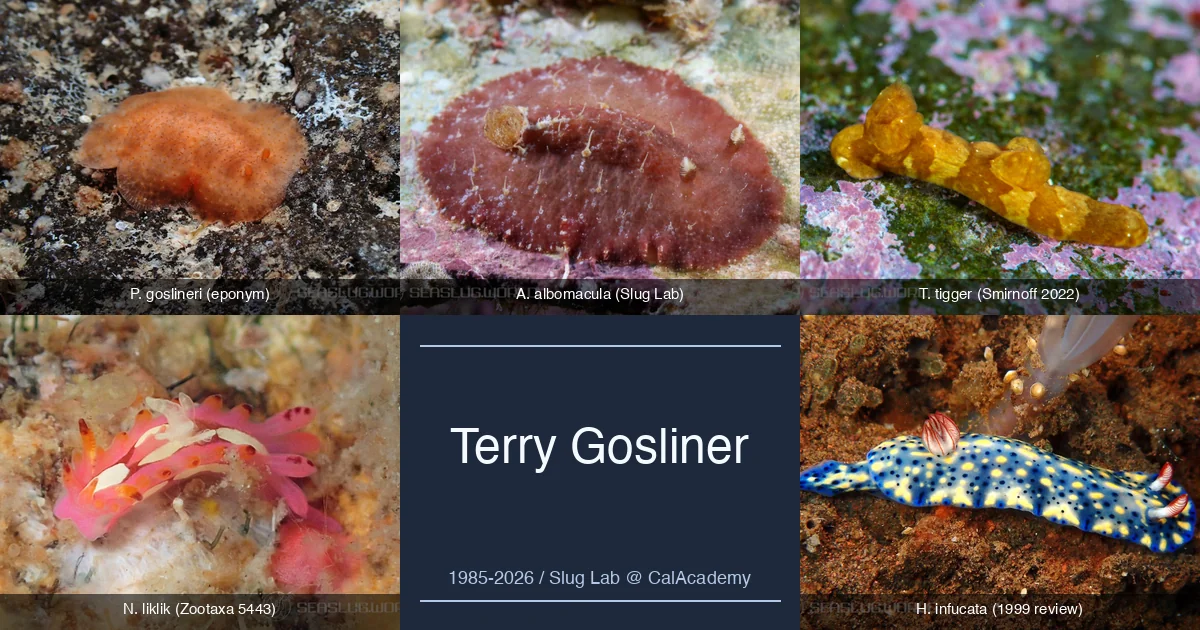
- Dimitri Smirnoff: new Trapania descriptions (Smirnoff, Donohoo & Gosliner, 2022, with 8 registered on this site) and others
- Jamie Chan: Thordisa group (Chan & Gosliner, 2007) and others
These alumni keep their connection to the Slug Lab after they go home and continue to co-author with Gosliner. The 2022 Murphydoris paper, for example, has Paz-Sedano (Pola's PhD student) + Smirnoff (Slug Lab) + Candás (Spain) + Gosliner + Pola on it, so a generation of Slug Lab "grand-students" (alumni's students) is already on the author lists.
Of the 1,178 species registered on this site with binomial scientific names, 220 carry Gosliner as author. That number reads more accurately as the cumulative output of researchers who have passed through the Slug Lab over nearly half a century than as Gosliner's personal tally. The current state of Indo-Pacific opisthobranch taxonomy is run not by Gosliner alone but by the training pipeline he built.
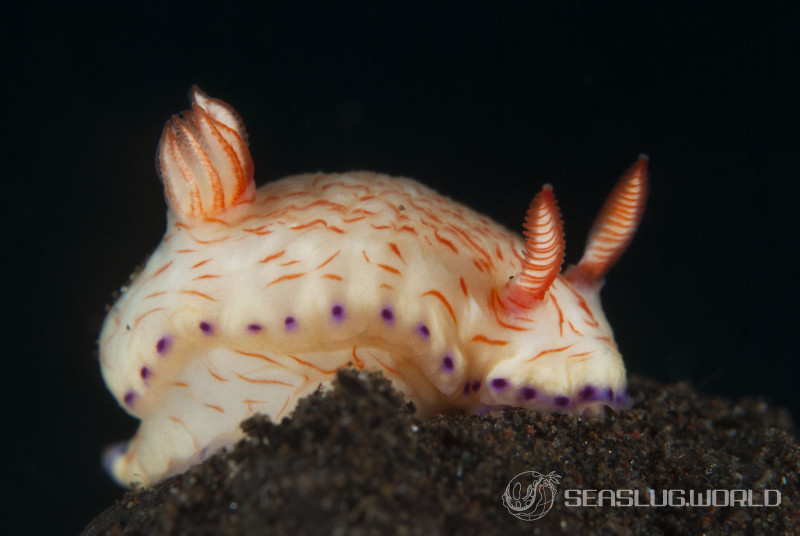
2021-2024, restructuring the Goniodorididae in four years
The scale of what the Slug Lab and its international network produce shows most clearly in the continuous Goniodorididae revision running from 2021. Genus after genus in this family of dorid nudibranchs has been reworked with molecular and morphological data, with a substantial batch of new species added each round.
- 2021: 3 new Ceratodoris (Paz-Sedano & Pola)
- 2022: 9 new Trapania (Smirnoff, Donohoo & Gosliner) + 4 new Murphydoris (Paz-Sedano, Smirnoff, Candás, Gosliner & Pola)
- 2023: 3 new Goniodoridella (Paz-Sedano, Ekimova, Smirnoff, Gosliner & Pola) + 6 new Pelagella (Paz-Sedano, Smirnoff, Gosliner & Pola)
- 2024: a multi-genus paper adding 3 Naisdoris + Trapania franae + Ceratodoris trypomandyas + Murphydoris polkadotsa (Paz-Sedano, Cobb, Gosliner & Pola, Zootaxa 5443). The same year saw the synthesis paper Paz-Sedano, Moles, Smirnoff, Gosliner & Pola 2024 in Molecular Phylogenetics and Evolution (192: 107990), pulling four years of Goniodorididae work into one combined phylogenetic framework
Counted at the paper level, that is more than 30 new species across four years, spanning seven genera of a single family. The pace requires multiple continuous co-author teams (Slug Lab graduates + Pola's UAM cohort + various international collaborators) and decades of accumulated specimen material to sustain. Few other groups in the field can produce at this volume.
Reading the author lists in sequence, you see Slug Lab graduates (Smirnoff, Donohoo), the Spain axis around Pola (Paz-Sedano, Candás), and Russian (Ekimova) and British (Cobb) collaborators all stepping in. The Slug Lab and its alumni network are operating at the scale of restructuring an entire family in four years.
Closing
Gosliner's work appears on bookstore shelves as the authority on Indo-Pacific dive guides, and on this site's species pages as "Gosliner, 2008" or "Donohoo & Gosliner, 2024". It keeps growing.
A career that began more than half a century ago, as a high-school student, has built itself into an active lab that keeps producing through generational turnover. Slug Lab graduates carry on their own work, and the Latin names attached to Indo-Pacific sea slugs over the next decade or two will, in substantial part, pass through the Slug Lab.
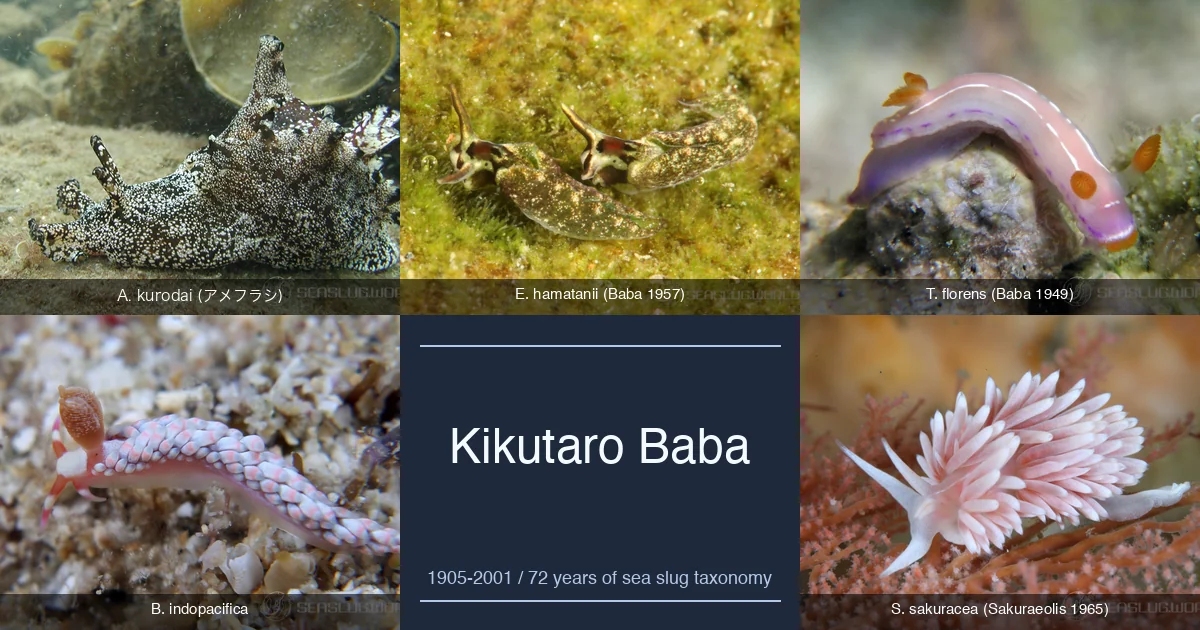
For a related read, see our biography of Dr. Kikutaro Baba, who built the framework of Japanese opisthobranch taxonomy across the prewar and postwar decades. Together the two pieces sketch the network of researchers running from mid-20th-century Japan to present-day CalAcademy.
Enjoyed this post? You can tip the author directly —
Tip this post