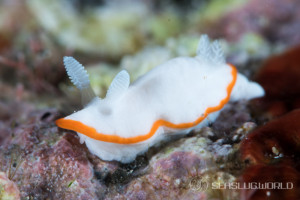
Goniobranchus daphne (Angas, 1864)
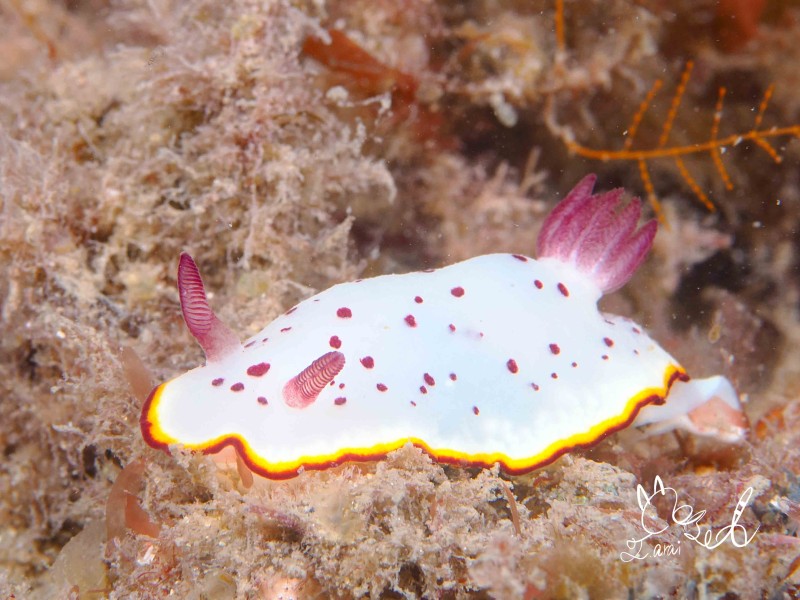
- Location
- Flypoint, Nelson Bay, New South Wales, Australia
- Date
- 2026/04/28
- Length
- 15mm
- Depth
- 8.0m
- Water temperature
- 20.0℃
Description
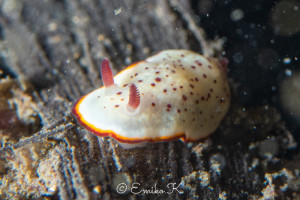
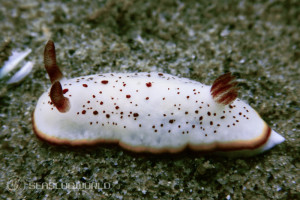
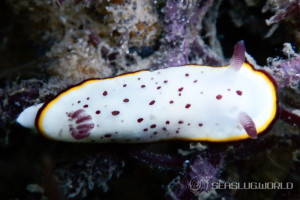
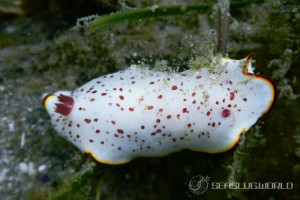
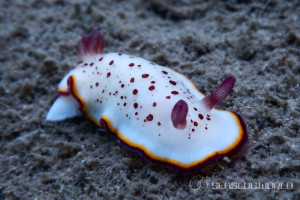
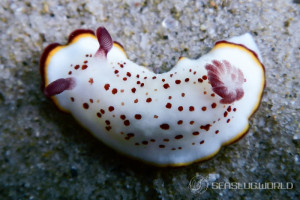
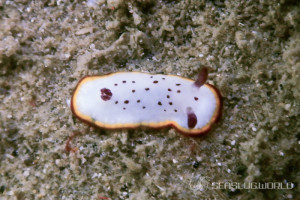
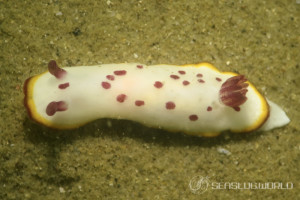
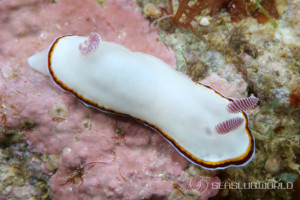
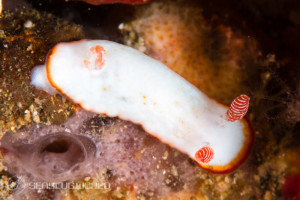
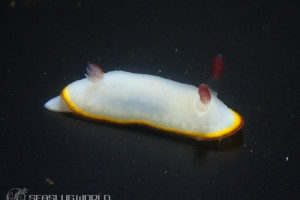
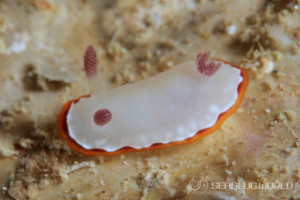
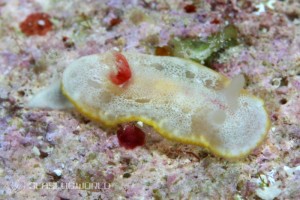
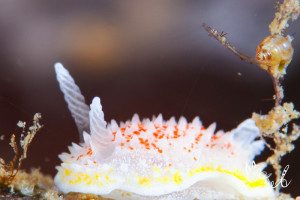
A slender chromodorid reaching about 51 mm in body length and 8 mm in width. The body is somewhat flattened and white, oval to elongate. The mantle leaves a relatively broad portion of the posterior foot uncovered, that posterior foot bordered with scarlet. Numerous small scarlet spots are scattered over the mantle. The gills are 10, pinnate and scarlet. The rhinophores are also scarlet. Angas's type was 51 mm long and 8 mm wide, collected under stones at Wooloomooloo Bay.Distribution
South-eastern Australia (Tasman Sea). Type locality: Wooloomooloo Bay (within Port-Jackson Harbour), New South Wales, based on a specimen collected by Angas.Etymology
Named for Daphne, the Greek mythological nymph transformed into a laurel tree, presumably alluding to the bright scarlet margin evoking young laurel leaves. Angas does not state an explicit etymology.Remarks
Originally placed by Angas in Goniodoris. Angas distinguished the species from G. crossei by (1) the absence of a double-band marginal pattern (only the scarlet line, not the gold zone), (2) fewer and smaller scarlet spots, and (3) the foot being uniformly white. Later transferred to Goniobranchus; the parentheses in the author citation reflect this generic transfer.References
- Goniodoris daphne Angas n. sp., Angas G.F. (1864). Description d'espèces nouvelles appartenant à plusieurs genres de Mollusques Nudibranches des environs de Port-Jackson (Nouvelle-Galles du Sud), accompagnée de dessins faits d'après nature. Journal de Conchyliologie, 12(1): 43-70, pl. IV.
- Glossodoris daphne (Angas), Allan J.K. (1947). Nudibranchia from the Clarence River Heads, north coast, New South Wales. Records of the Australian Museum, 21(8): 433-463, pls. xli-xliii and map. https://doi.org/10.3853/j.0067-1975.21.1947.561
- Goniobranchus daphne, Johnson R.F. & Gosliner T.M. (2012). Traditional taxonomic groupings mask evolutionary history: a molecular phylogeny and new classification of the chromodorid nudibranchs. PLoS ONE 7(4): e33479.
- Goniobranchus daphne, Soong G.Y., Bonomo L.J., Reimer J.D. & Gosliner T.M. (2022). Battle of the bands: systematics and phylogeny of the white Goniobranchus nudibranchs with marginal bands (Nudibranchia, Chromodorididae). ZooKeys. 1083: 169-210. https://doi.org/10.3897/zookeys.1083.72939
A Kindle field guide by the site author
Kimoto N. (2026). Sea Slugs of Japan & the Indo-Pacific, 2nd Edition.
Kindle Edition
View on Amazon PR (Amazon Associates)Seasonality
Shooting Locations
Loading shooting locations...
Photos of Goniobranchus daphne



Same Genus Nudibranchs

Similar Colors Nudibranchs

Academic Database
Sea slug observation data is available in international marine biodiversity databases.