Doto greenamyeri Shipman & Gosliner, 2015
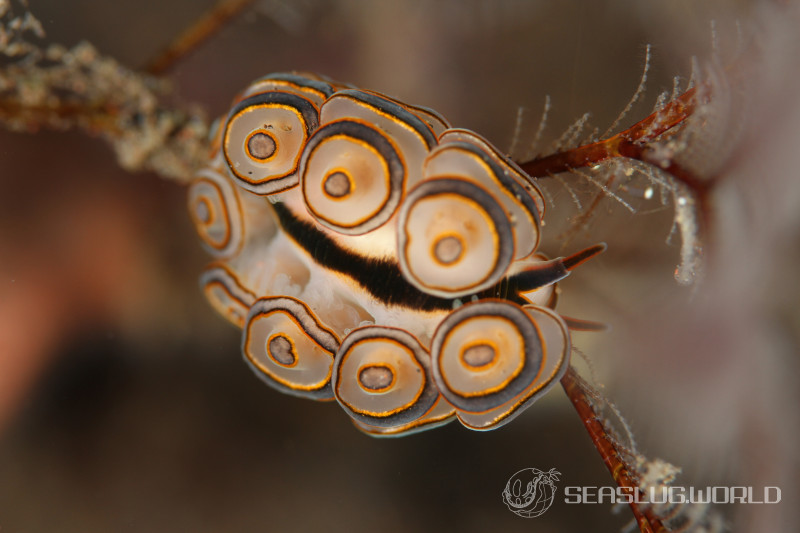
- Location
- Petti San, Tulamben, Pulau Bali, Indonesia
- Date
- 2013/11/20
- Length
- ??mm
- Depth
- 20.0m
- Water temperature
- ??℃
Description
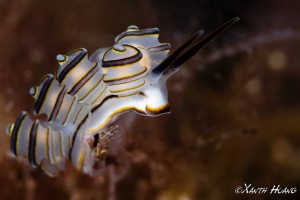
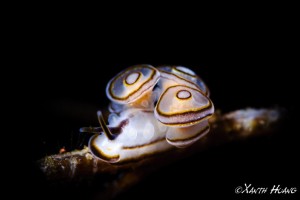
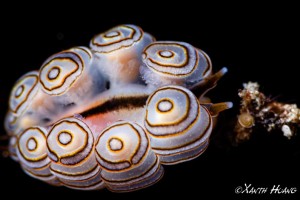
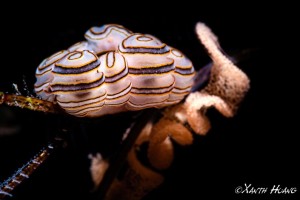
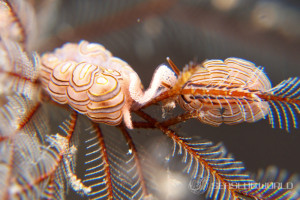
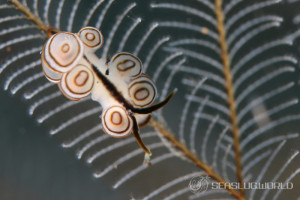
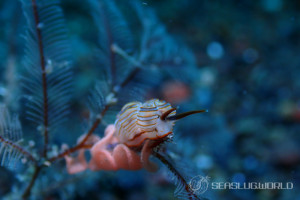
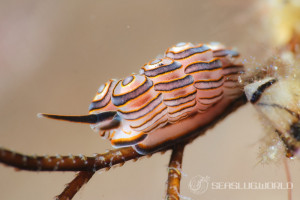
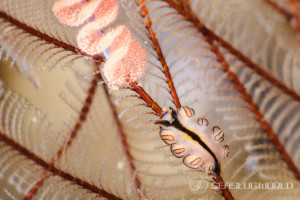
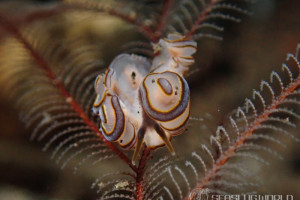
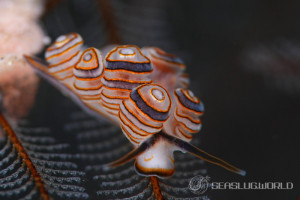
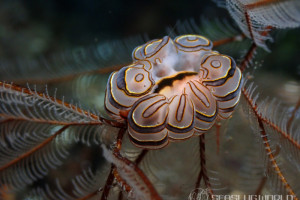
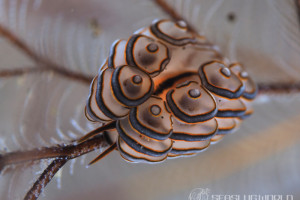
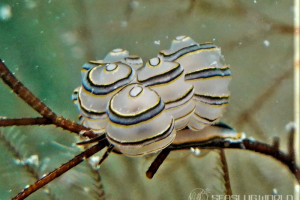
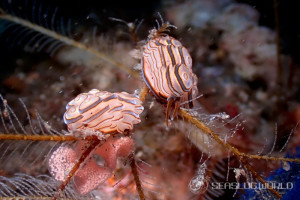
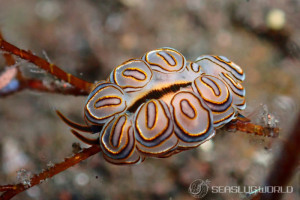
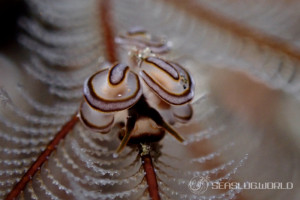
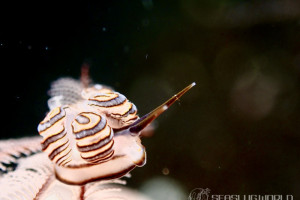
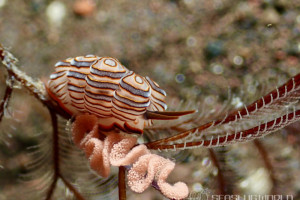
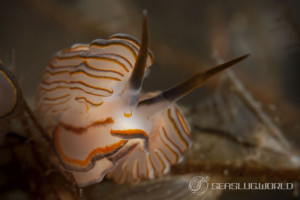
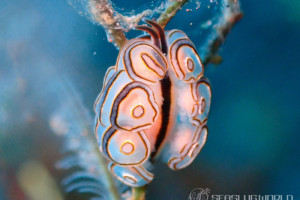
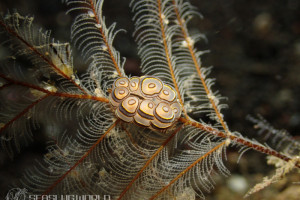
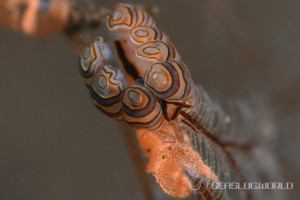
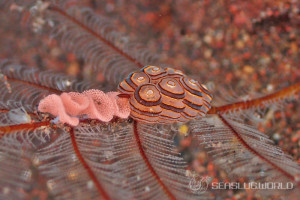
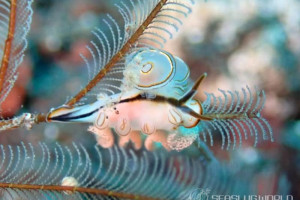
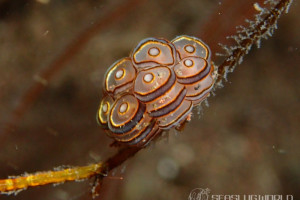
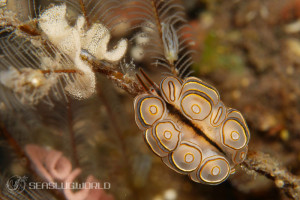
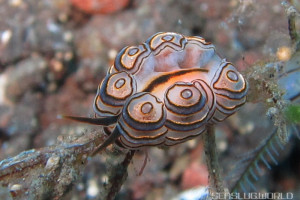
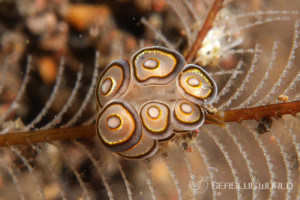
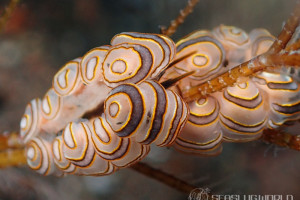
A small short-bodied dotid reaching 15 mm in length (preserved specimen ~7 mm). The notum bears 4–5 pairs of broad cerata that almost completely obscure the dorsum. Each ceras displays 3–5 stacked concentric rings, either solid gray to black-brown or outlined in gray to black-brown, giving the cerata the appearance of a honey-dipper or a stack of pancakes — a feature unique among Indo-Pacific Doto. A conspicuous fine gold-orange ring surrounds each concentric ring and the nipple-like terminal tubercle. On the lower medial face of each ceras are two dark gray semi-U-shaped bands enclosing a small circular opening, and a ruffled pseudobranch occupies the lateral and dorsal sides of the basal figure-eight. The rhinophores are dark brown, edged in gold-orange, with a gray tip; the narrow rhinophoral sheath is white at its base and bears a black band above. Two upward-directed gold loops sit on the head, in line with and below the rhinophores. The oral veil is auriform, edged in fine opaque white, followed dorsally by a black-brown band and a gold-orange band. A thick gold-orange longitudinal band runs along the lateral surface of the body, and a very thick black-brown band runs along the entire dorsum, connecting to the black pigment behind the rhinophores; this dorsal band is sometimes outlined in gold.The species exhibits several color morphs. A dark morph has dark gray body, rhinophores, and cerata with prominent gold-orange concentric rings. A light morph lacks the gray to black-brown stacked rings entirely and possesses only fine gold-orange concentric rings. The radular formula is 38 × 0.1.0; each tooth forms a pointed arch with 8–9 ventral denticles and 4–5 denticles on either side of a pointed medial cusp.
Distribution
Papua New Guinea (Milne Bay Province, Samarai Island in Kwato Channel, 20 m depth) and Indonesia. Feeds on an unidentified plumularid hydroid.Etymology
Verbatim from the original description (Shipman & Gosliner, 2015):Named after friend and avid videographer, John Greenamyer, who first photographed this species in Papua New Guinea (Gosliner et al. 2008).
Remarks
Originally figured as Doto sp. 9 in a 2008 reference work. In the molecular phylogeny presented by Shipman & Gosliner 2015, D. greenamyeri is sister to the rest of the short-bodied Indo-Pacific clade. The distinctive concentric-ring pattern of the cerata immediately distinguishes this species from all other Indo-Pacific Doto; this character alone is sufficient for identification. Because the species belongs to the short-bodied Doto clade, it was retained in Doto and not transferred to the new genus Kabeiro.References
- Doto greenamyeri, Terrence Gosliner, Ángel Valdés and David Behrens. (2015). Nudibranch and Sea Slug Identification Indo-Pacific. New World Pubns Inc.
- Doto greenamyeri n. sp., Shipman C. & Gosliner T.M. (2015). Molecular and morphological systematics of Doto Oken, 1851 (Gastropoda: Heterobranchia), with descriptions of five new species and a new genus. Zootaxa. 3973(1): 1-49. https://doi.org/10.11646/zootaxa.3973.1.1
- ドーナツマツカサウミウシ(新称), 中野理枝. (2018). 日本のウミウシ. 文一総合出版.
Featured in this book
Terrence Gosliner, Ángel Valdés and David Behrens. (2018). Nudibranch and Sea Slug Identification Indo-Pacific 2nd Edition. New World Pubns Inc.
New World Publications
This species, Doto greenamyeri, is included in the book.
View on Amazon PR (Amazon Associates)Seasonality
Shooting Locations
Loading shooting locations...
Photos of Doto greenamyeri
Tag:


















Same Genus Nudibranchs


Similar Colors Nudibranchs
Academic Database
Sea slug observation data is available in international marine biodiversity databases.