Phyllodesmium magnum Rudman, 1991
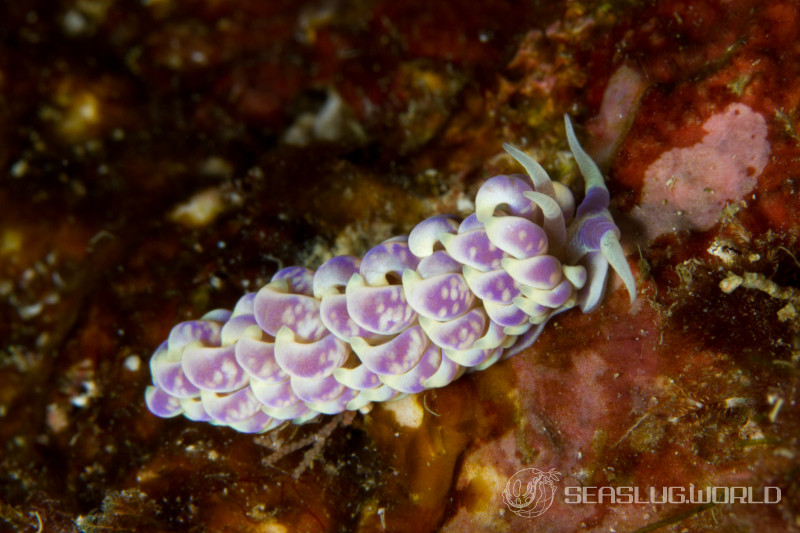
- Location
- Horse Shoes, Okinawa Island (Onna and Yomitan area), Okinawa, Japan
- Date
- 2015/02/11
- Length
- 40mm
- Depth
- 12.0m
- Water temperature
- 20.9℃
Description
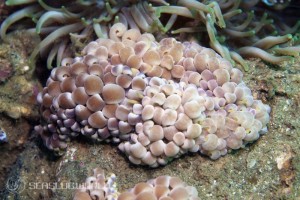
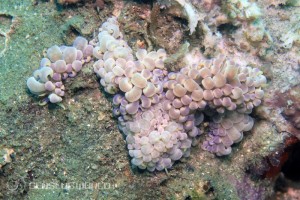
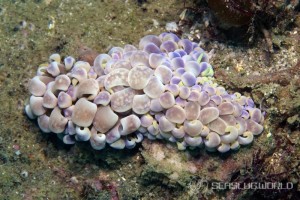
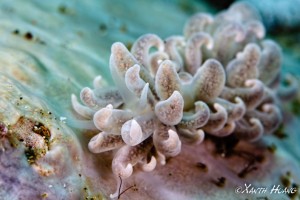
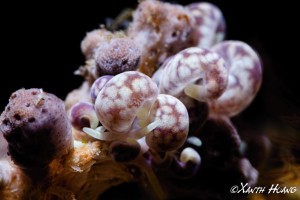
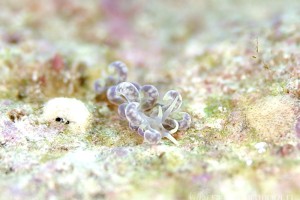
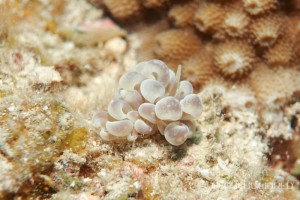
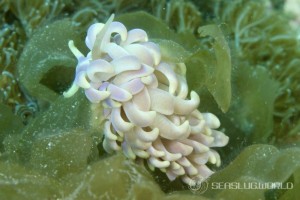
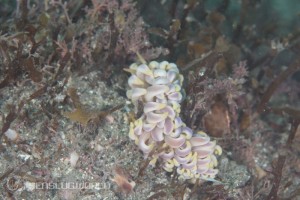
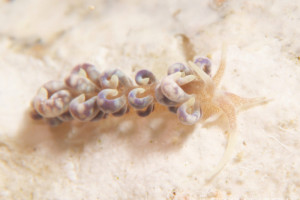
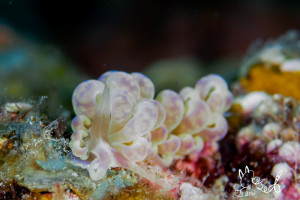
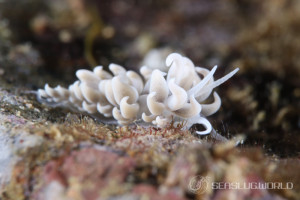
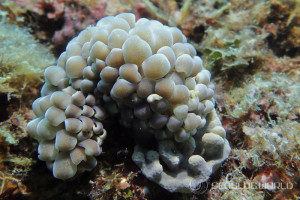
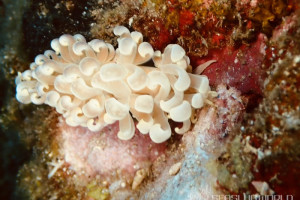
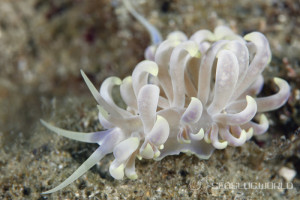
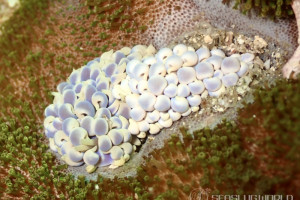
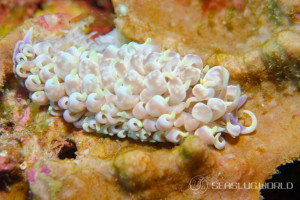
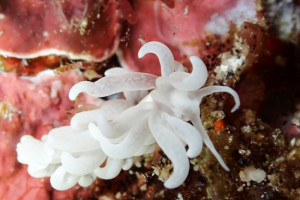
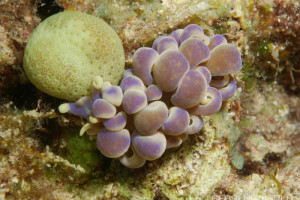
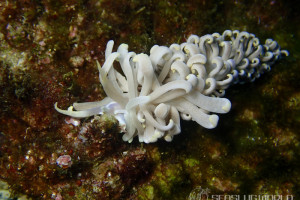
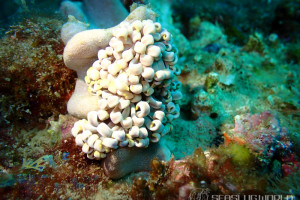
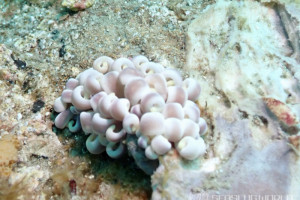
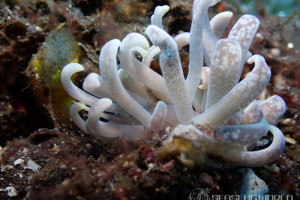
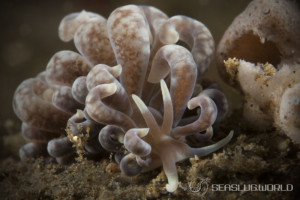
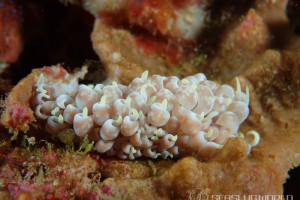
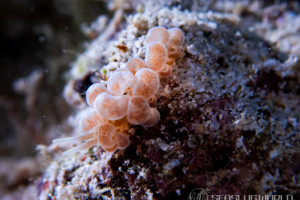
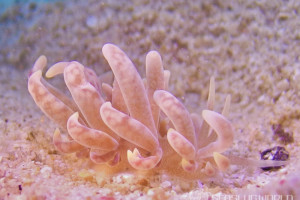
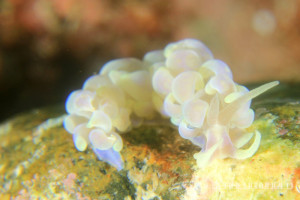
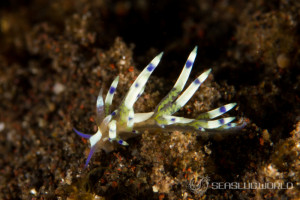
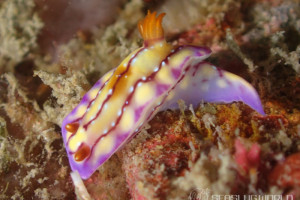
A very large aeolid, growing to over 110 mm and reportedly up to 130 mm (Orr, 1981). The body is elongate with a relatively broad anterior tapering to a slender posterior "tail". Oral tentacles are long and tapering; rhinophores are smooth and similarly shaped but only about half the length of the oral tentacles. Cerata are large and flattened, with a short cylindrical base and a bluntly pointed tip, slightly enrolled and mounted on distinctive dorsal ridges. The body colour is translucent white, but the countless microscopic brown symbiotic zooxanthellae embedded in the tissues give it a brownish tinge; in refractive light the body and ceratal walls glow a beautiful bluish lilac. Areas of opaque milky yellow pigment occur on the anterior edge of the head, the upper third of the rhinophores, the ceratal tips, and the foot borders. The foot is relatively broad, about twice the body width.Distribution
Type locality is the Noumea Aquarium, New Caledonia (October 1988, holotype 110 mm long alive). Originally recorded from Hong Kong, the Marshall Islands, New Caledonia, and north-western Australia (Dampier Archipelago); subsequent records extend across the Indo-West Pacific to East Africa, the Red Sea, Thailand, Indonesia, Papua New Guinea, the Philippines, Japan, and Guam.Etymology
The specific epithet magnum is Latin for great or large, referring to the species' large body size (verbatim from the original description).Remarks
A solar-powered aeolid: the species harbours symbiotic zooxanthellae in cells of the digestive gland, arranged in terminal "garden" chambers across the unshaded dorsal surface of the cerata. In large cerata, the zooxanthellae are concentrated on the outer half of the dorsal surface where the chambers are exposed to light. The species feeds on the soft coral genus Sinularia (Western Australian specimens are exceptionally well camouflaged on the colonies, and a large sclerite resembling Sinularia skeletal elements was recovered from the gut of a Hong Kong specimen). Closely related in size and radular morphology to Phyllodesmium longicirrum (also a zooxanthellate species), but Phyllodesmium magnum has fewer, larger, more flattened cerata.References
- キッカミノウミウシ(新称), 小野篤司. (2004). 沖縄のウミウシ. ラトルズ.
A Kindle field guide by the site author
Kimoto N. (2026). Sea Slugs of Japan & the Indo-Pacific, 2nd Edition.
Kindle Edition
View on Amazon PR (Amazon Associates)Seasonality
Shooting Locations
Loading shooting locations...
Photos of Phyllodesmium magnum
Tag:
























Same Genus Nudibranchs

Similar Colors Nudibranchs



Academic Database
Sea slug observation data is available in international marine biodiversity databases.