Hypselodoris cerisae Gosliner & R. F. Johnson, 2018
Description
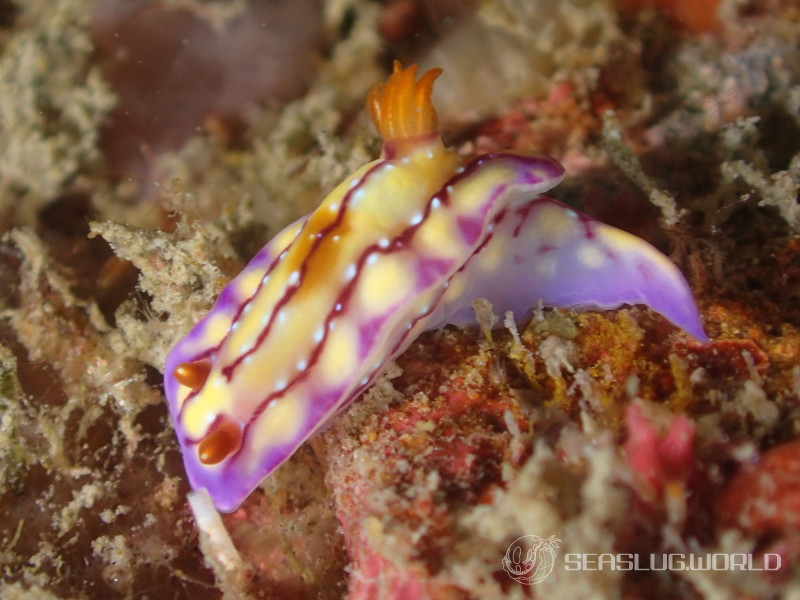
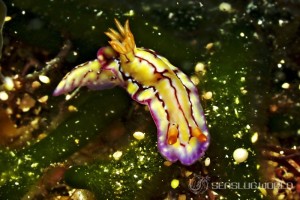
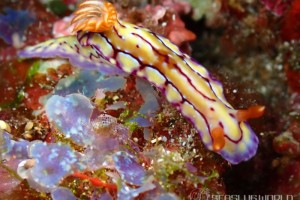
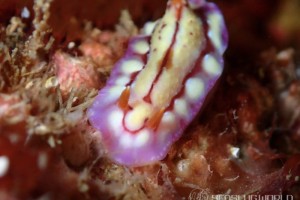
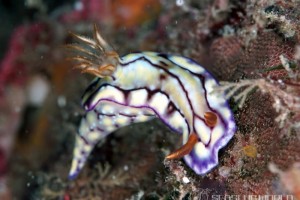
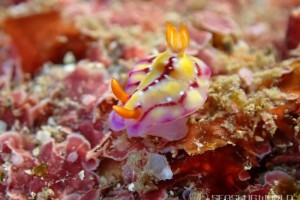
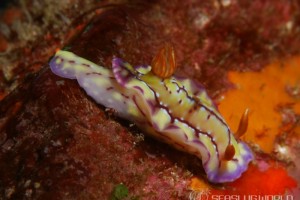
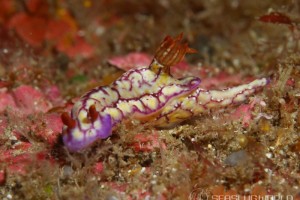
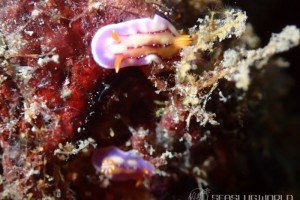
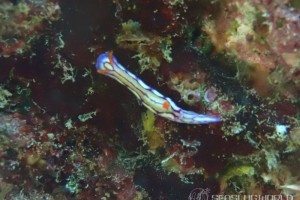
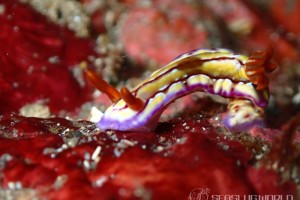
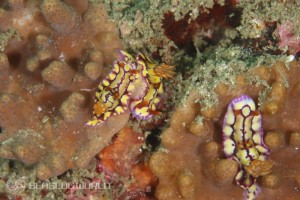
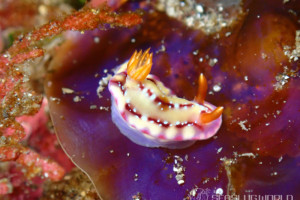
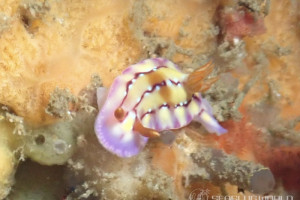
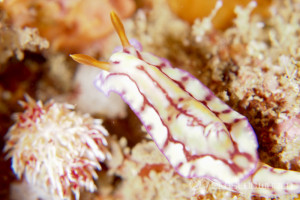
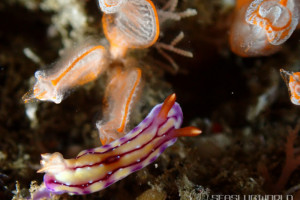
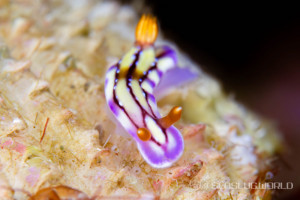
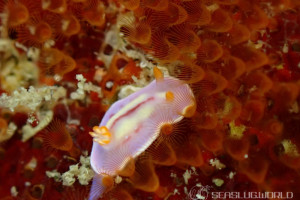
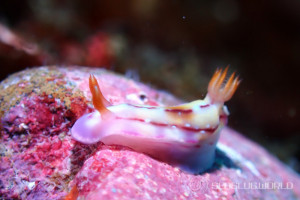
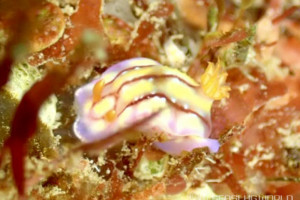
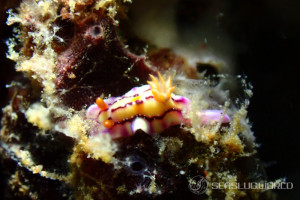
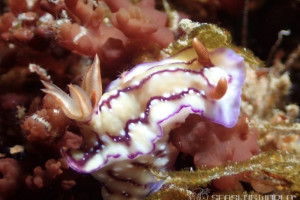
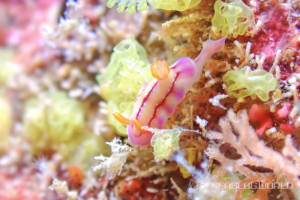
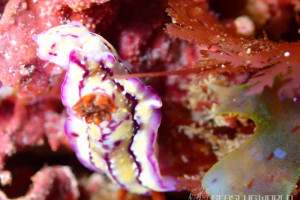
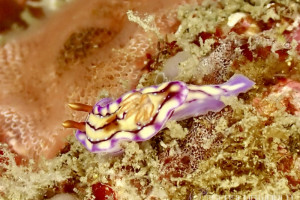
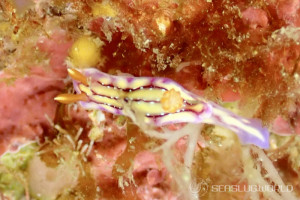
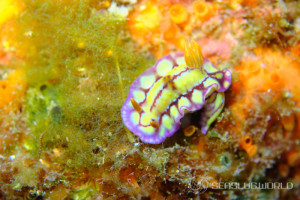
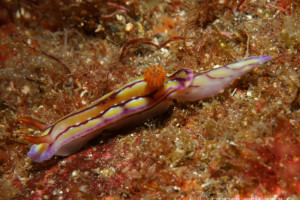
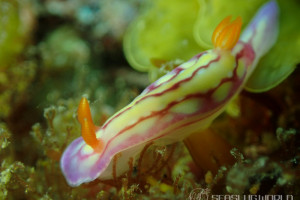
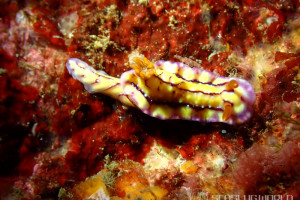
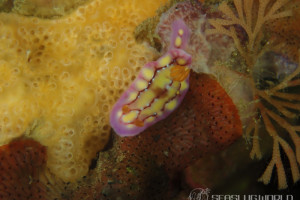
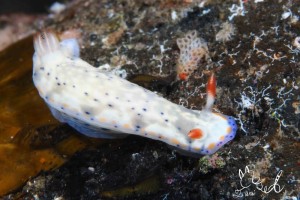
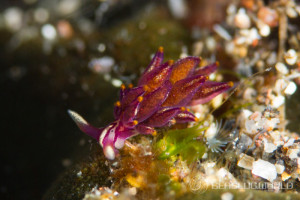
Living animals reach 20-35 mm in length. The colour pattern is complex with a golden honey ground colour. The notum is ornamented with purple along the anterior, lateral and posterior margins. Irregular dark brown to black longitudinal lines run along the notum, with a few opaque white spots along the sides of the dark lines. The gill pocket is well elevated above the notum. Seven to nine narrow, thin, unipinnate gill branches arise from the notum; the upper outer surface of the gill branches is red-orange, while the base is opaque white internally and externally. Rhinophores are uniformly bright red-orange except for an opaque white apex, with about 21 small lamellae. The foot edge bears a purple marginal band.Distribution
Known from Japan (Hachijo Island), Taiwan and Malaysia.Etymology
Named for Cerise Chen, who first found this species in Taiwan and collected the holotype. She has a keen interest in octocoral biology as well as in marine biodiversity more broadly.Remarks
Hypselodoris cerisae resembles Hypselodoris krakatoa in colour pattern but differs in several consistent respects. In H. cerisae the body has more purple pigment, whereas in H. krakatoa the notum is suffused with patches of burnt orange. Both species have prominent purple pigment along the anterior margin of the mantle, but in H. cerisae the posterior end is also purple, while in H. krakatoa it is orange. The body of H. cerisae appears lower and wider than that of H. krakatoa. There are 7-9 gill branches in H. cerisae and only 6-7 in H. krakatoa. In the molecular phylogeny H. cerisae is sister to a clade that includes Hypselodoris jacksoni, Hypselodoris reidi and Hypselodoris iba. The type locality is Long Dong, Taipei County, Taiwan, 10 m depth.References
- ヒュプセロドーリス・クラカトア, 中野理枝. (2004). 本州のウミウシ. ラトルズ.
- Hypselodoris sp 6, Helmut Debelius, Rudie H. Kuiter. (2007). Nudibranchs of the World.
- ヒュプセロドーリス・クラカトア, 小野篤司 & 加藤昌一. (2009). ウミウシ. 誠文堂新光社.
- イロウミウシ科の 1 種, 中野理枝 & 小谷光. (2016). 高知県大月町樫西海域及び一切海域から記録された後鰓類. Kuroshio Biosphere. 12: 21-43.
- クラカトアウミウシ(新称), 中野理枝. (2018). 日本のウミウシ. 文一総合出版.
- Hypselodoris cerisae, Terrence Gosliner, Ángel Valdés and David Behrens. (2018). Nudibranch and Sea Slug Identification Indo-Pacific 2nd Edition. New World Pubns Inc.
- Hypselodoris cerisae sp. nov., Epstein H.E., Hallas J.M., Johnson R.F., Lopez A. & Gosliner T.M. (2019). Reading between the lines: revealing cryptic species diversity and colour patterns in Hypselodoris nudibranchs (Mollusca: Heterobranchia: Chromodorididae). Zoological Journal of the Linnean Society. 186(1): 116-189. https://doi.org/10.1093/zoolinnean/zly048
- セリスイロウミウシ(新称), 中野理枝. (2019). フィールド図鑑 日本のウミウシ. 文一総合出版.
- ヤマトクラカトアウミウシ(新称), 中野理枝. (2019). 日本のウミウシ. 第二版. 文一総合出版.
- セリスイロウミウシ, 小野篤司 & 加藤昌一. (2020). 新版 ウミウシ. 誠文堂新光社.
Featured in this book
Terrence Gosliner, Ángel Valdés and David Behrens. (2018). Nudibranch and Sea Slug Identification Indo-Pacific 2nd Edition. New World Pubns Inc.
New World Publications
This species, Hypselodoris cerisae, is included in the book.
View on Amazon PR (Amazon Associates)Seasonality
Shooting Locations
Loading shooting locations...
Photos of Hypselodoris cerisae
Tag:




















Same Genus Nudibranchs

Similar Colors Nudibranchs
Academic Database
Sea slug observation data is available in international marine biodiversity databases.