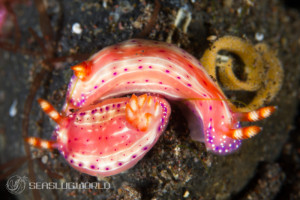
Hypselodoris reidi Gosliner & R. F. Johnson, 1999
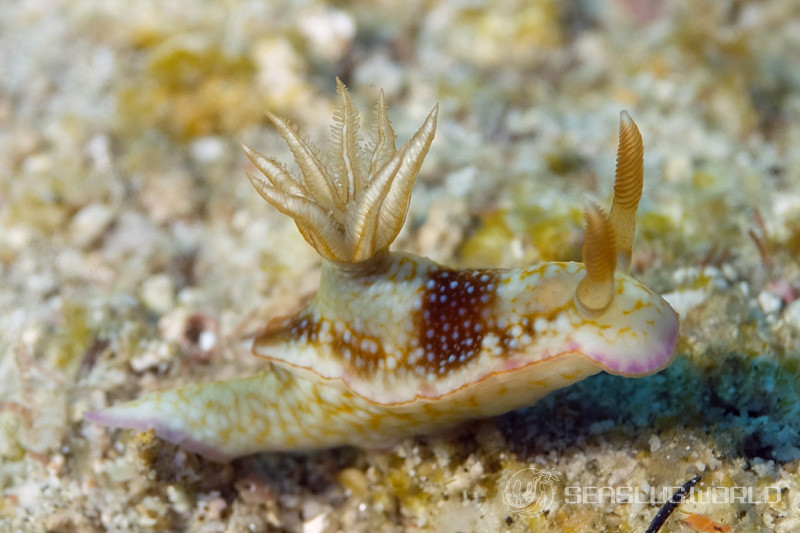
- Location
- Arthur's Rock, Anilao, Philippines
- Date
- Length
- 50mm
- Depth
- 8.0m
- Water temperature
- 26.0℃
Description
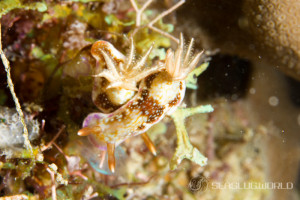
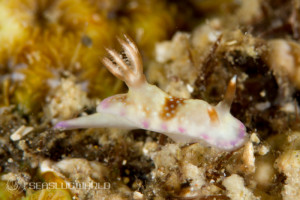
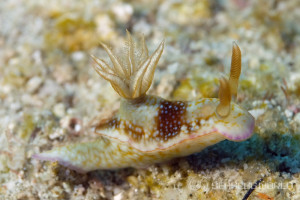
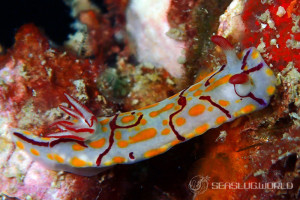
A medium-sized Hypselodoris reaching approximately 50 mm in length. The colour is white with a network of yellowish pigment which leaves white spots uncovered by yellow. Anterior and posterior to the gills the network is darker brown. There is a thin pink marginal line on the mantle and foot. The rhinophores are yellow with a lighter apex. Behind the rhinophores are two patches of lighter, more translucent pigment through which the eyes are visible. The seven simply pinnate gills are yellow with white spots on the internal side of the rachis. The gill sheath is well elevated from the notum.The posterior glands are somewhat larger than the others; the remaining glands are sparsely and uniformly distributed around the mantle margin. The radular formula in the paratype is 57×65.0.65. The jaw rodlets are thin and elongate, undivided and without lateral flanges. The inner lateral teeth are bifid with a single small denticle on the inner side of the cusps. The middle laterals have a reduced second cusp and lack denticles. The three outer laterals show some trace of denticulation, with the outermost teeth bearing up to six denticles. The reproductive system is triaulic; the prostate narrows into the elongate, convoluted ejaculatory portion, which terminates in a widened, slightly bulbous, muscular penis. The minute but short pyriform receptaculum seminis has a short duct attached to the upper portion of the vaginal duct.
Distribution
Type locality: Bus Stop, Balayan Bay, Batangas, Luzon Island, Philippines (12 m depth).Etymology
Named for friend and underwater photographer Dave Reid, who first found the species.Remarks
Described in a 1999 revision. Sister species to H. krakatoa; both are distinguished by an elevated, conical branchial sheath. H. reidi lacks the black lines and black and white spots of H. krakatoa; the gills and rhinophores of H. reidi are the same colour as the general body, while those of H. krakatoa have red pigment. The mantle glands of H. reidi are sparsely situated, while those of H. krakatoa are closer together anteriorly. The inner lateral teeth of H. reidi have only a single inner denticle, while those of H. krakatoa have many. The penis of H. reidi is slightly bulbous, while in H. krakatoa it is narrow. H. reidi is unique among the clade in retaining markings of the general body colour on the inner side of the gill rachis.References
- Hypselodoris reidi sp. nov., Gosliner T.M. & Johnson R.F. (1999). Phylogeny of Hypselodoris (Nudibranchia: Chromodorididae) with a review of the monophyletic clade of Indo-Pacific species, including descriptions of twelve new species. Zoological Journal of the Linnean Society. 125: 1-114. https://doi.org/10.1111/j.1096-3642.1999.tb00585.x
- Hypselodoris reidi, Johnson R.F. & Gosliner T.M. (2012). Traditional taxonomic groupings mask evolutionary history: a molecular phylogeny and new classification of the chromodorid nudibranchs. PLoS ONE 7(4): e33479.
A Kindle field guide by the site author
Kimoto N. (2026). Sea Slugs of Japan & the Indo-Pacific, 2nd Edition.
Kindle Edition
View on Amazon PR (Amazon Associates)Seasonality
Shooting Locations
Loading shooting locations...
Photos of Hypselodoris reidi
Tag:




Same Genus Nudibranchs

Academic Database
Sea slug observation data is available in international marine biodiversity databases.