Hypselodoris flavomarginata Rudman, 1995
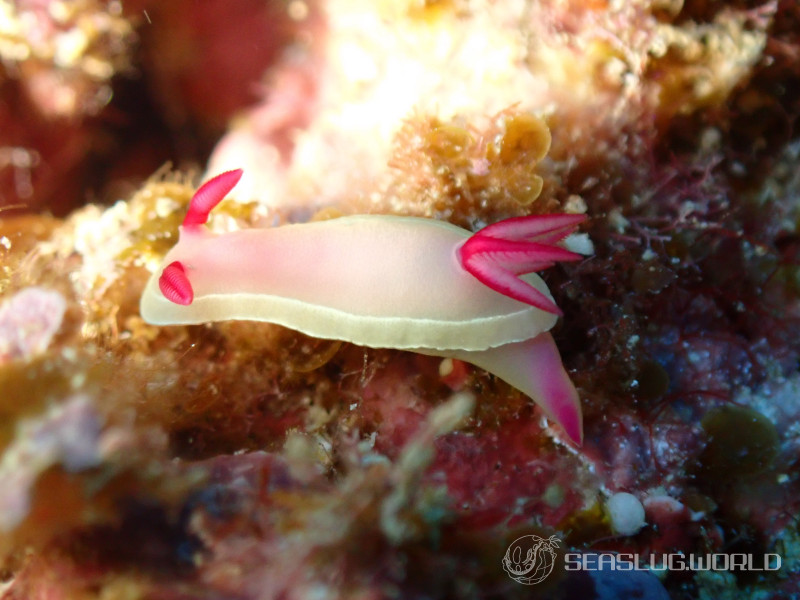
- Location
- Passe exterieure Boulari, New Caledonia Island, New Caledonia
- Date
- 2020/01/04
- Length
- 20mm
- Depth
- 17.0m
- Water temperature
- 25.0℃
Description
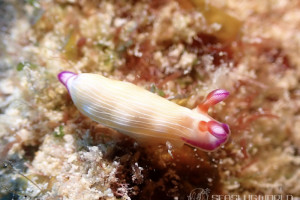
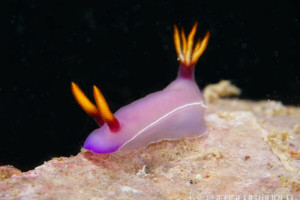
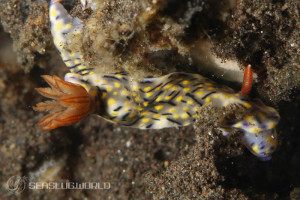
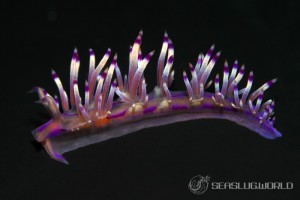
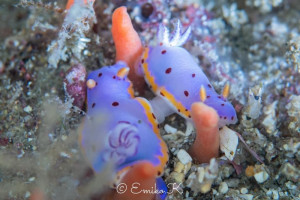
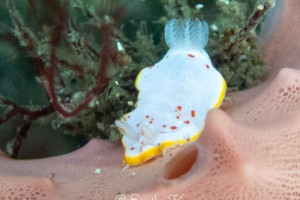
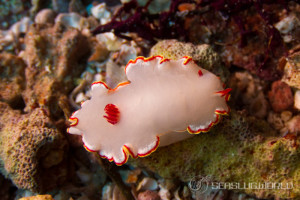
A small to medium chromodorid, 14–25 mm long alive (holotype 15 mm alive; largest paratype 25 mm preserved). The mantle is bright pink with a broad yellow or cream band at the edge; between the yellow border and the pink there is a thin opaque white line. The rhinophore stalk is purple-red, the club has a translucent white core, but the anterior and posterior edges and the lamellae are translucent purplish-red. The simple gills are translucent clear but edged in purplish-red. The underside is creamy white except for the visible posterior part of the foot, which is the same pink as the mantle. The mantle is elongately ovate, with the posterior part of the foot exposed when the animal crawls. In profile the body is relatively high, the highest point being the gill pocket about two-thirds of the way down the body. The five simple gills form a circle around the anus and are held vertically. A row of small single mantle glands lies right at the mantle edge. Radular formula 44.0.44 × 73 in a 25 mm specimen.Distribution
Type locality: Grande Coude, Bourail, W Coast, New Caledonia, 15 m. Type series additionally from 5 Mile Channel and Banc Gail in the SW Lagoon (30–35 m). A specimen previously figured as Noumea romeri in an earlier guide was reidentified to this species in the original description.Etymology
The specific epithet flavomarginata combines Latin flavus ("yellow") and marginatus ("bordered"), in reference to the yellow band along the mantle. The etymology paragraph in the original description carries a typographic slip ("flavomaculata"), but the species heading, figure captions and rest of the paper all use the available name flavomarginata.Remarks
The buccal armature and reproductive system are typical of the genus Hypselodoris. The colour pattern is highly characteristic — pink with a broad outer cream or yellow border and a narrow inner line of opaque white. Similar colour is found in Thorunna speciosus, but the internal anatomy is quite different.References
- Hypselodoris flavomarginata n.sp., Rudman, W. B. (1995). The Chromodorididae (Opisthobranchia: Mollusca) of the Indo-West Pacific: further species from New Caledonia and the Noumea romeri colour group. Molluscan Research. 16(1): 1-43. https://doi.org/10.1080/13235818.1995.10673663
- Hypselodoris flavomarginata Rudman, 1995, Gosliner T.M. & Johnson R.F. (1999). Phylogeny of Hypselodoris (Nudibranchia: Chromodorididae) with a review of the monophyletic clade of Indo-Pacific species, including descriptions of twelve new species. Zoological Journal of the Linnean Society. 125: 1-114. https://doi.org/10.1111/j.1096-3642.1999.tb00585.x
- Hypselodoris flavomarginata, Johnson R.F. & Gosliner T.M. (2012). Traditional taxonomic groupings mask evolutionary history: a molecular phylogeny and new classification of the chromodorid nudibranchs. PLoS ONE 7(4): e33479.
A Kindle field guide by the site author
Kimoto N. (2026). Sea Slugs of Japan & the Indo-Pacific, 2nd Edition.
Kindle Edition
View on Amazon PR (Amazon Associates)Seasonality
Shooting Locations
Loading shooting locations...
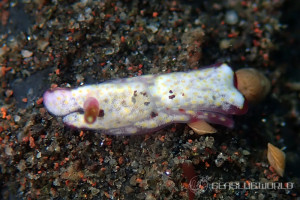
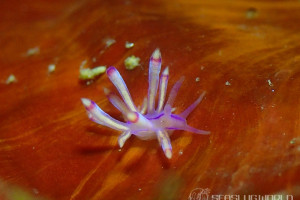
Photos of Hypselodoris flavomarginata


Same Genus Nudibranchs
Similar Colors Nudibranchs


Academic Database
Sea slug observation data is available in international marine biodiversity databases.