Babakina festiva (Roller, 1972)
Babakina festiva
No field photograph submitted for this species yet
Have you photographed this species?Description
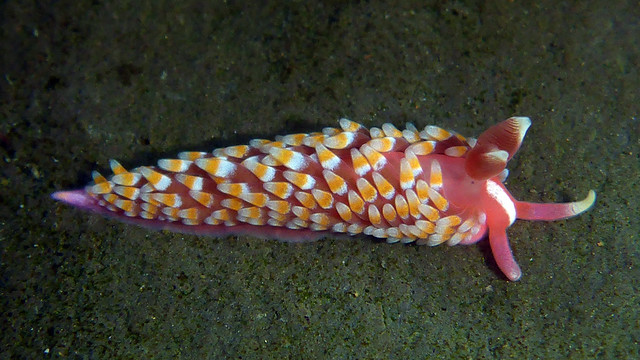
A strikingly colored aeolid, 20-28 mm long. The head region and sides of the foot are pinkish-red, with lighter pink around the cardiac elevation. About 22 oblique rows of 2-3 fusiform cerata line each side of the body. The rhinophores are unusual: their proximal third is fused into a common stalk, while the upper portion bears a bulbous, perfoliate club of about 35 leaves overlaid with yellow-orange pigment. The cerata are vividly banded - pinkish-red in the proximal half, then a broad opaque white band, then a narrow cadmium yellow-orange ring, with a translucent greyish tip.Distribution
Southern California coast, USA, from Malibu Reef to La Jolla. The type locality is White's Point, Palos Verdes Peninsula, Los Angeles County, California, collected intertidally beneath rocks.Etymology
From Latin festivus (festive), feminine form festiva. Roller did not give an explicit etymology in the original description.Remarks
A 1972 paper originally erected a new genus and new family for this species. The original genus name Babaina proved to be a junior homonym of Babaina Odhner, 1968, and a 1973 paper introduced Babakina as a replacement name. The genus honours the Japanese malacologist Kikutaro Baba, with Roller acknowledging "his more than 40 years of dedicated work with Opisthobranchia and his many kindnesses to the author."For decades, Indo-West Pacific specimens (including those from Honshu, Japan, mentioned in the original paper) were also referred to Babakina festiva. Gosliner, Gonzáles-Duarte & Cervera 2007 revised the genus and split off the Indo-Pacific population as a separate species, Babakina indopacifica, restricting Babakina festiva to the northeastern Pacific coast of California. The same revision elevated Babakinidae to family rank, with Babakina as its sole genus.
References
- Babaina festiva Roller, gen. nov., spec. nov., Roller R.A. (1972). Three new species of eolid nudibranchs from the west coast of North America. The Veliger. 14(4): 416-423.
- 高岡生物研究会. (2002). 日本海のウミウシ. 第2版.
A Kindle field guide by the site author
Kimoto N. (2026). Sea Slugs of Japan & the Indo-Pacific, 2nd Edition.
Kindle Edition
View on Amazon PR (Amazon Associates)Seasonality
Shooting Locations
Loading shooting locations...
Same Genus Nudibranchs

Academic Database
Sea slug observation data is available in international marine biodiversity databases.