Hypselodoris zebrina (Alder & Hancock, 1864)
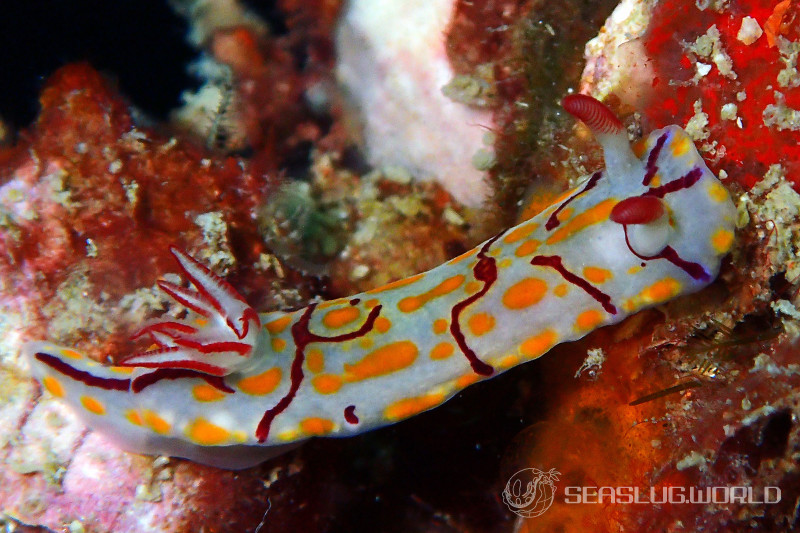
- Location
- Train Wreck, Koh Wean, Phuket, Thailand
- Date
- 2019/02/20
- Length
- 20mm
- Depth
- 17.0m
- Water temperature
- 30.0℃
Description
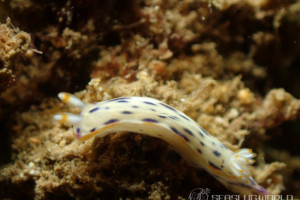
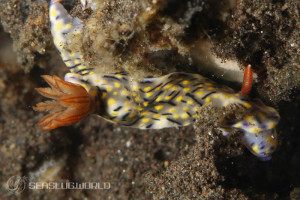
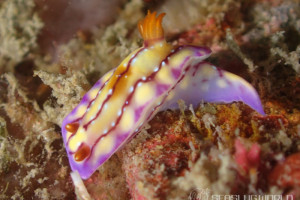
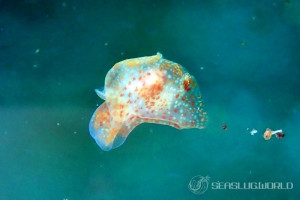
A small chromodorid; the type specimen measures about seven-tenths of an inch (ca. 1.8 cm), and Alder & Hancock note that "from its diminutive size, [it] may probably have been young." The body is elongated, slender, rounded in front, and tapering to a point behind; white, with red and yellow markings. The mantle is broadly rounded, and produced considerably beyond the head in front; nearly parallel at the sides, narrow and rounded posteriorly. It is white, with a waved crimson stripe down the centre of the back, and transverse stripes of the same colour (of unequal lengths) at the sides and round the ends. There are largish yellow spots down each side of the central stripe and between the transverse ones near the margin; a crimson stripe also runs from the cloak along a ridge to the tail. The dorsal tentacles are longish, clavate, with the laminated part crimson, the margin of the orifices a little raised. There are no oral tentacles; the head is rounded in front and indistinctly angulated at the sides. The branchial plumes are nine, small, simply pinnate, crimson, forming nearly a complete cup; the two posterior plumes smaller than the rest. The foot is large, broadly truncated in front, and extended to a blunt point behind. Only one specimen was preserved, which from its diminutive size was probably a juvenile.Distribution
Type locality: Waltair, near Vizagapatam, Coromandel coast, Madras Presidency, India (now Visakhapatnam, Andhra Pradesh). Based on a single (presumably juvenile) specimen collected by Walter Elliot in 1853–1854. After the original description the species was not re-encountered for approximately 150 years; it was re-observed around 2002 and has since been recorded sporadically across the Indo-West Pacific. The species remains very rare.Etymology
The specific epithet zebrina is a Latinised adjective meaning "zebra-like", in reference to the crimson longitudinal and transverse stripes on the white ground colour of the mantle.Remarks
In the original description Alder & Hancock placed the species in Chromodoris Alder & Hancock, 1855. The species was later transferred to Hypselodoris Stimpson, 1855 (the parentheses in the author citation reflect this generic transfer). Because the species went unseen for about 150 years after its description, its taxonomic placement remained uncertain for a long time; the recent rediscoveries have confirmed it as a valid species.References
- Chromodoris zebrina n. sp., Alder J. & Hancock A. (1864). Notice of a collection of nudibranchiate Mollusca made in India by Walter Elliot Esq., with descriptions of several new genera and species. Transactions of the Zoological Society of London. 5(3): 113-147.
- Hypselodoris zebrina, Johnson R.F. & Gosliner T.M. (2012). Traditional taxonomic groupings mask evolutionary history: a molecular phylogeny and new classification of the chromodorid nudibranchs. PLoS ONE 7(4): e33479.
- Hypselodoris zebrina, Terrence Gosliner, Ángel Valdés and David Behrens. (2018). Nudibranch and Sea Slug Identification Indo-Pacific 2nd Edition. New World Pubns Inc.
Featured in this book
Terrence Gosliner, Ángel Valdés and David Behrens. (2018). Nudibranch and Sea Slug Identification Indo-Pacific 2nd Edition. New World Pubns Inc.
New World Publications
This species, Hypselodoris zebrina, is included in the book.
View on Amazon PR (Amazon Associates)Seasonality
Shooting Locations
Loading shooting locations...
Photos of Hypselodoris zebrina

Same Genus Nudibranchs

Similar Colors Nudibranchs

Academic Database
Sea slug observation data is available in international marine biodiversity databases.