Hypselodoris zephyra Gosliner & R. F. Johnson, 1999
- Location
- Seraya, Tulamben, Pulau Bali, Indonesia
- Date
- 2015/11/15
- Length
- 12mm
- Depth
- 3.0m
- Water temperature
- 30.0℃
Description
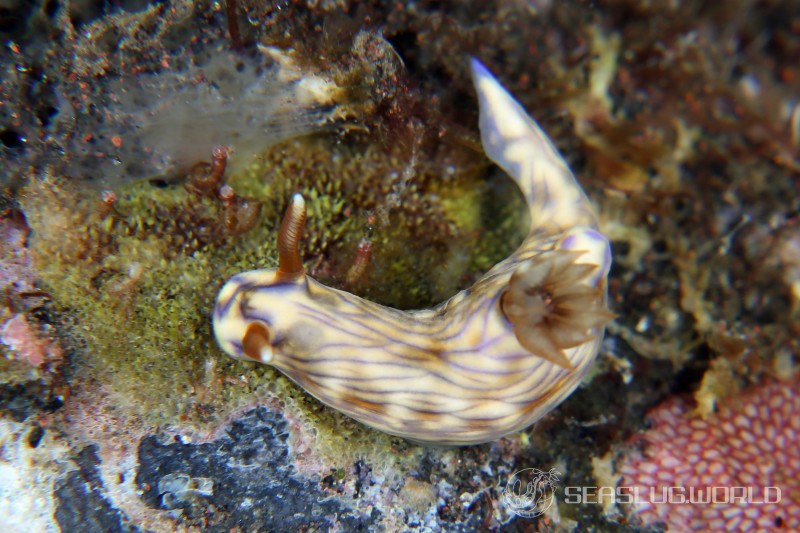
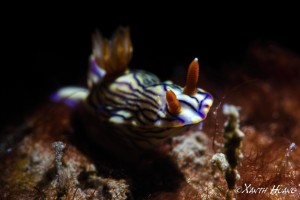
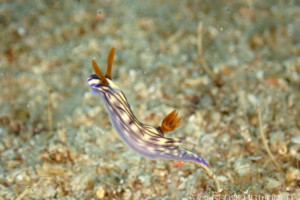
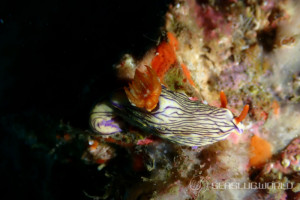
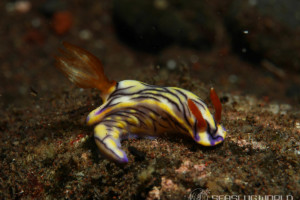
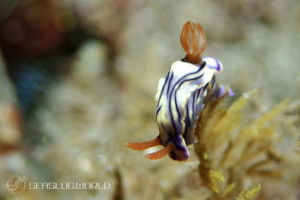
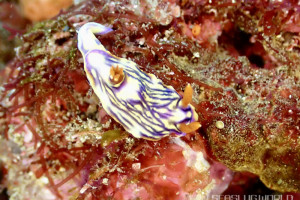
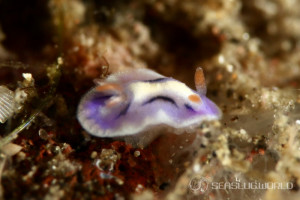
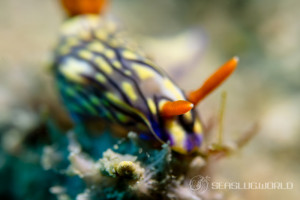
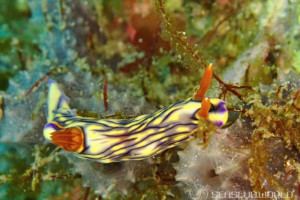
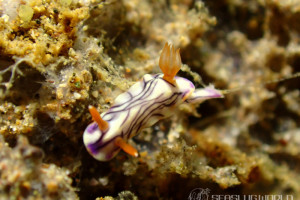
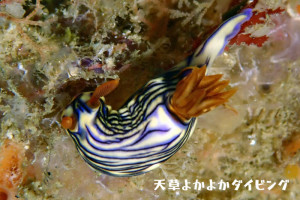
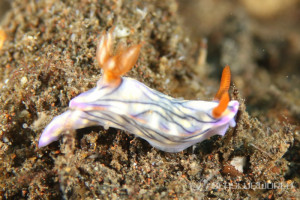
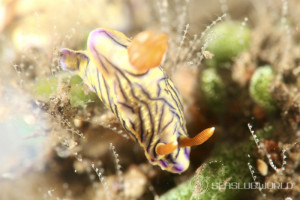
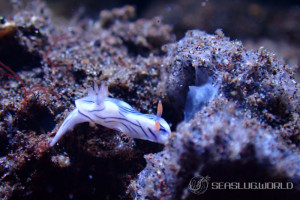
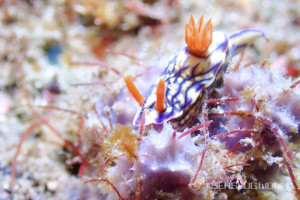
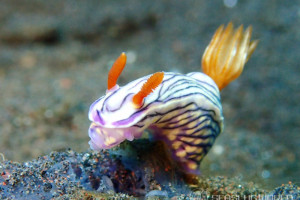
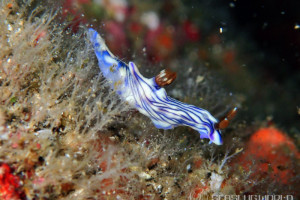
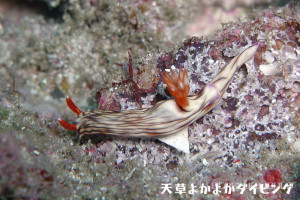
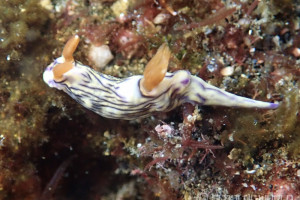
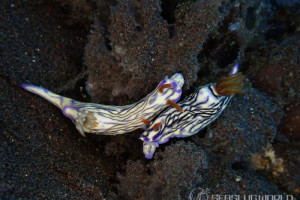
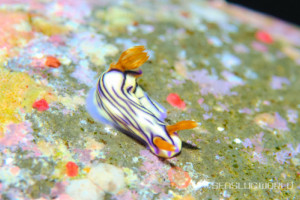
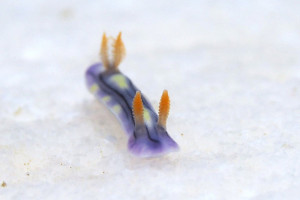
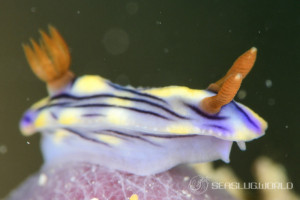
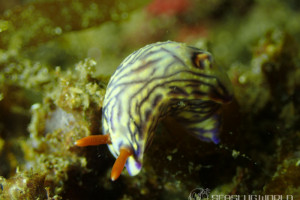
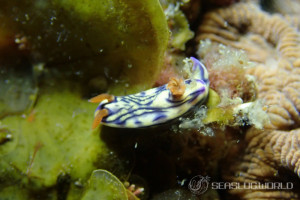
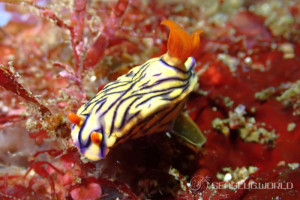
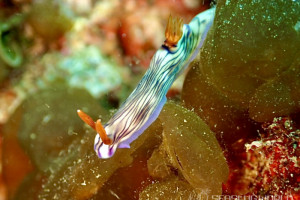
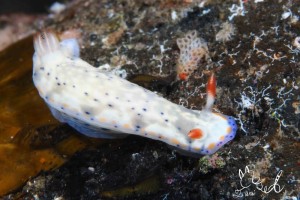
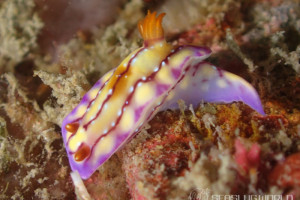
A small to medium-sized Hypselodoris, 6-25 mm in length. The animal is elongate, with the mantle margin forming a very small rim overhanging the side of the foot. The general body colour is white. The mantle is marked by a series of black lines running parallel to each other and to the body axis. At least two or three pairs of lines on either side of the mantle midline converge to make an hourglass-like pattern, with the lines diverging again around the rhinophores and the gills. One black line almost completely encircles the mantle, but is interrupted once at the posterior edge and twice anteriorly. Yellow patches are scattered throughout the black lines; these patches and lines are absent from the area immediately surrounding the gills and the rhinophores. There are a few grey to purple patches on the mantle, most noticeably on the posterior edge, to the outside of the rhinophores and at the front of the head region. The foot has a thick purple line around the margin and a distinctive black line down the middle of the dorsum. The rhinophores are dark orange with white tips, and behind them is an area of translucence through which the eyes are visible. The 6-7 simply pinnate gills are the same dark orange as the rhinophores but darker along the rachis.There are five very large posterior glands and 9-10 smaller anterolateral and anterior glands. Lateral glands are entirely absent. The radular formula in two specimens is 47×56.0.56 and 41×48.0.48; a rachidian row is entirely absent. The jaw rodlets are elongate and undivided, without prominent lateral flanges. The inner lateral teeth are bicuspid with a single, prominent denticle on the inner side. The middle lateral teeth are all bifid without denticles. The outermost laterals have 3-6 denticles, and the adjacent two teeth have a single denticle. The triaulic reproductive system has a slightly enlarged, bulbous penis. The minute, elongate, pyriform receptaculum seminis has a short duct attached to the upper portion of the vaginal duct, below the base of the spherical bursa copulatrix.
Distribution
Widely distributed throughout the western and central Pacific from Australia, Indonesia, Papua New Guinea, the Philippines, eastwards to Fiji and the Society Islands, at 0-40 m depth. Type locality: Rasch Pass, Madang, Papua New Guinea (15 m depth).Etymology
Verbatim from the original description (Gosliner, Johnson & Andersson, 1999, Zoological Journal of the Linnean Society 125: p.79):The name zephyra comes from the Latin for a warm west wind, referring to its presence in the tropical western Pacific.
Remarks
Described in a 1999 revision. Externally similar to H. nigrostriata (Eliot, 1904), but in H. zephyra the lines are largely parallel while in H. nigrostriata the lines are intersecting; the yellow pigment of H. nigrostriata is more intense than in H. zephyra. H. zephyra has 2-5 enlarged posterior glands while H. nigrostriata has small glands uniformly distributed around the entire mantle margin (with the exception of a small midlateral gap); lateral glands are absent in H. zephyra. The three outer lateral radular teeth of H. zephyra are denticulate, while in H. nigrostriata they are smooth. H. nigrostriata and its sister species H. kanga have a narrow penial duct, while it is bulbous in H. zephyra. H. zephyra belongs to a clade with modified mantle glands that includes H. krakatoa, H. reidi and H. regina, all of which have a gill sheath that is elevated from the notum. In H. zephyra and H. regina the gill forms a more closed circle and the elevation of the gill sheath is not as pronounced as in H. krakatoa and H. reidi.References
- Hypselodoris zephyra sp. nov., Gosliner T.M. & Johnson R.F. (1999). Phylogeny of Hypselodoris (Nudibranchia: Chromodorididae) with a review of the monophyletic clade of Indo-Pacific species, including descriptions of twelve new species. Zoological Journal of the Linnean Society. 125: 1-114. https://doi.org/10.1111/j.1096-3642.1999.tb00585.x
- ヒプセロドーリス・ゼフィラ, 殿塚孝昌. (2003). ウミウシガイドブック〈3〉. TBSブリタニカ.
- Hypselodoris zephyra, Johnson R.F. & Gosliner T.M. (2012). Traditional taxonomic groupings mask evolutionary history: a molecular phylogeny and new classification of the chromodorid nudibranchs. PLoS ONE 7(4): e33479.
- ソヨカゼイロウミウシ(新称), 中野理枝 & 小谷光. (2016). 高知県大月町樫西海域及び一切海域から記録された後鰓類. Kuroshio Biosphere. 12: 21-43.
A Kindle field guide by the site author
Kimoto N. (2026). Sea Slugs of Japan & the Indo-Pacific, 2nd Edition.
Kindle Edition
View on Amazon PR (Amazon Associates)Seasonality
Shooting Locations
Loading shooting locations...
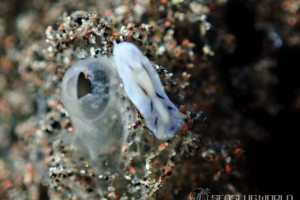
Photos of Hypselodoris zephyra
Tag:





















Same Genus Nudibranchs

Academic Database
Sea slug observation data is available in international marine biodiversity databases.