Chromodoris orientalis Rudman, 1983
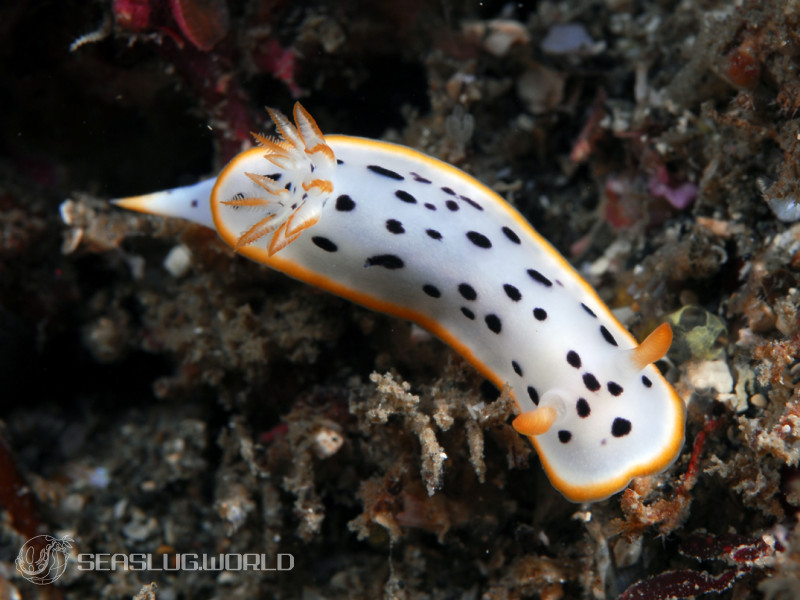
- Location
- Gontarouiwaoki, Hayama, Kanagawa, Japan
- Date
- 2006/09/28
- Length
- 20mm
- Depth
- 10.0m
- Water temperature
- 26.0℃
Description
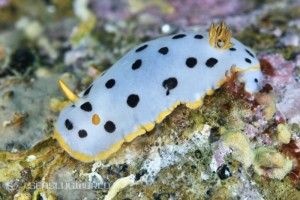
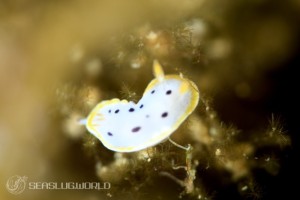
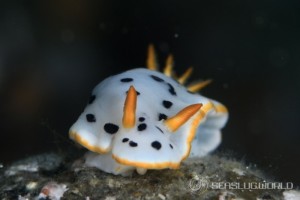
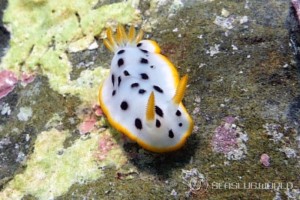
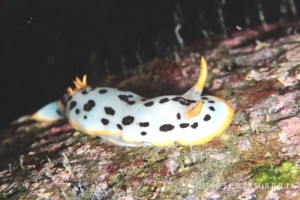
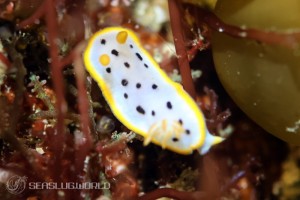
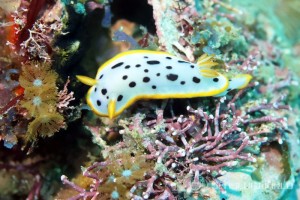
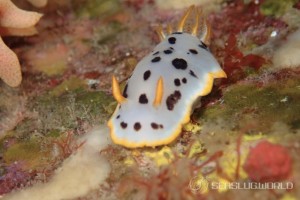
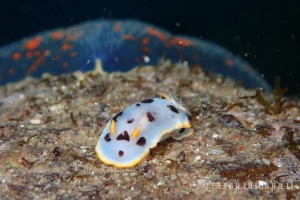
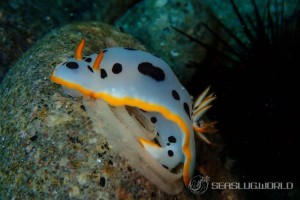
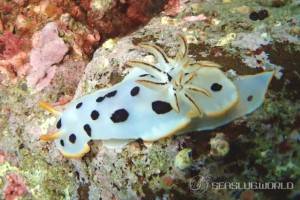
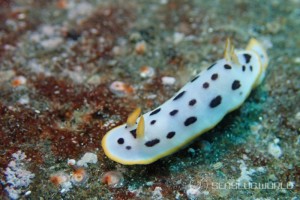
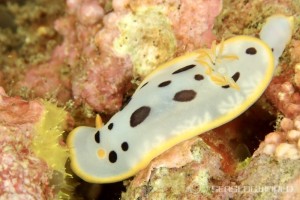
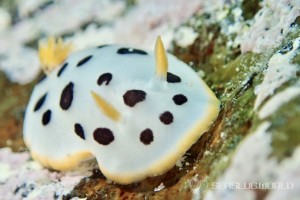
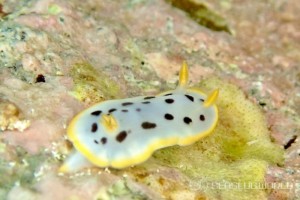
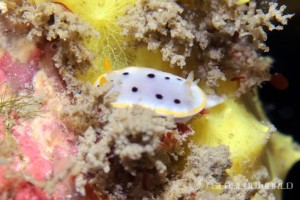
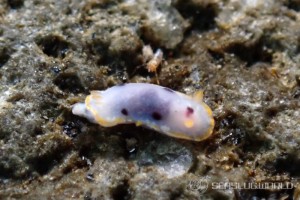
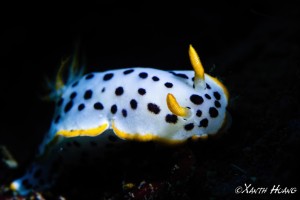
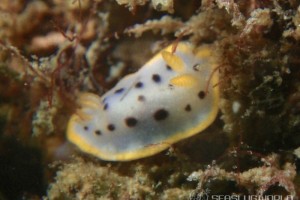
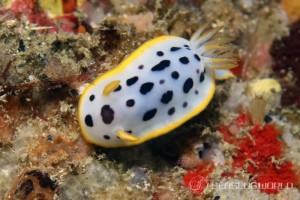
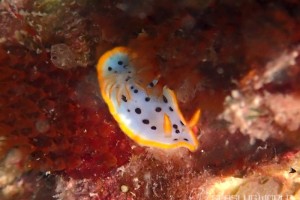
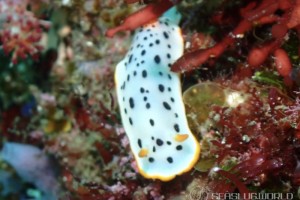
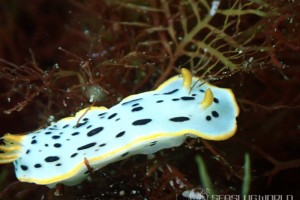
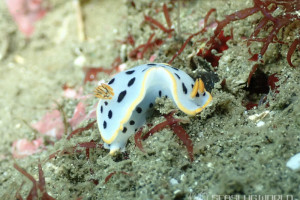
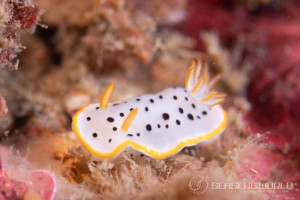
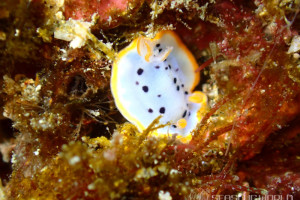
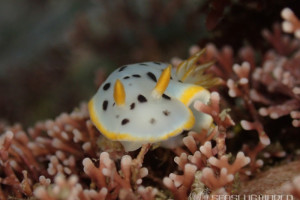
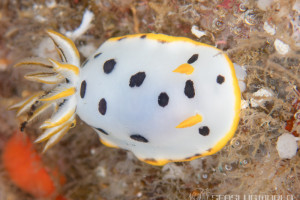
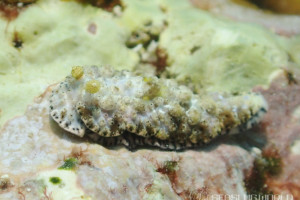
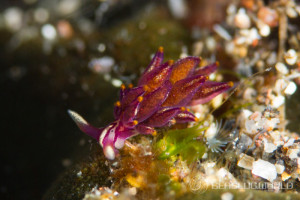
The preserved holotype is white with a few large dark brown ovoid spots down each side of the midline. The living animal is white with a few large black spots on the mantle arranged on either side of the midline. The mantle has an orange-yellow border. The foot also has an orange-yellow border, usually broken into a series of spots and dashes laterally but continuous at the posterior end. The rhinophores have a white stalk and an orange club; the gills are translucent white with orange edges. In some specimens there are a few black spots along the sides of the body, beneath the mantle. In larger specimens (up to 55 mm preserved, 50 mm alive), the mantle can have a darker tinge fading to white at the edge, with up to four irregular rows of black spots. Mantle elongately oval, somewhat tapering posteriorly, with a medium mantle overhang along the sides. Gills simple, arranged in a circle open posteriorly. Radular formula 36.0.36 × 50 (+5), with a slight median triangular thickening. Innermost tooth has three denticles on the inside base of the median cusp and four on the outside. Cusp length increases to a maximum at about Tooth 8; teeth 3-16 carry five denticles, increasing to a maximum of eight by Tooth 26. Jaw plates of bifid rodlets.Distribution
Type locality is Hong Kong. Specimens previously reported from Japan as the Tahitian C. pallescens are referable to C. orientalis. The species occurs in temperate to subtropical waters from Japan to China (East China Sea and South China Sea).Etymology
The species name orientalis is Latin for "of the east / eastern", referring to the East Asian distribution from Japan to China.Remarks
Japanese specimens were long misidentified as the Tahitian C. pallescens (now a junior synonym of C. aspersa). The two are separable on spot pattern (large black spots in 1-2 rows along the midline in orientalis; many small purple spots ringed in brown across the mantle in aspersa) and on radular morphology. The species was later transferred to Goniobranchus orientalis in a molecular revision of the Indo-Pacific Chromodorididae.References
- 白うみうし(新称), 藤田經信. (1893). 相州三浦三崎近傍ノ隱鰓うみうし科 (Cryptobranchiate Nudibranchiata)(第四十七號ノ續キ). 動物學雜誌. 5(53): 95-98.
- シロウミウシ, Baba K. (1949). Opisthobranchia of Sagami Bay collected by His Majesty the Emperor of Japan (相模湾産後鰓類図譜). Iwanami Shoten, Tokyo. 4+2+194+7 pp., pls. 1-50.
- Glossodoris pallescens (Bergh) Shiro-umiushi, Baba, K. 1957. A revised list of the species of Opisthobranchia from the northern part of Japan, with some additional descriptions. J. Fac. Sci., Hokkaido Univ.,ser. 6, Zool. 13(1-4):8-14.
- シラライロウミウシ Chromodoris tumuliferus, 益田一ほか. (1996). 海岸動物 (フィールド図鑑). 補訂版第2版. 東海大学出版会.
- シロウミウシ, 鈴木敬宇. (2000). ウミウシガイドブック〈2〉. TBSブリタニカ.
- 高岡生物研究会. (2002). 日本海のウミウシ. 第2版.
- シロウミウシ, 中野理枝. (2004). 本州のウミウシ. ラトルズ.
- シロウミウシ, 小野篤司 & 加藤昌一. (2009). ウミウシ. 誠文堂新光社.
- Chromodoris orientalis, Johnson R.F. & Gosliner T.M. (2012). Traditional taxonomic groupings mask evolutionary history: a molecular phylogeny and new classification of the chromodorid nudibranchs. PLoS ONE 7(4): e33479.
- Goniobranchus orientalis (Rudman, 1983), Terrence Gosliner, Ángel Valdés and David Behrens. (2015). Nudibranch and Sea Slug Identification Indo-Pacific. New World Pubns Inc.
- Chromodoris orientalis, Layton K.K., Gosliner T.M. & Wilson N.G. (2018). Flexible colour patterns obscure identification and mimicry in Indo-Pacific Chromodoris nudibranchs (Gastropoda: Chromodorididae). Molecular Phylogenetics and Evolution. 124: 27-36. https://doi.org/10.1016/j.ympev.2018.02.008
Featured in this book
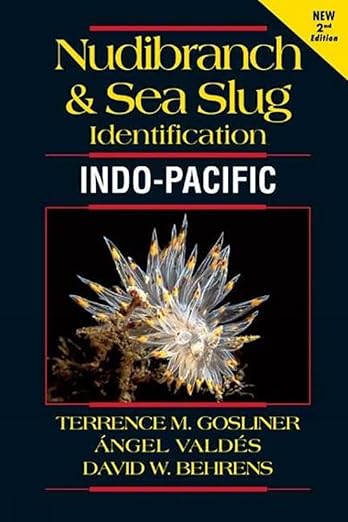
Terrence Gosliner, Ángel Valdés and David Behrens. (2018). Nudibranch and Sea Slug Identification Indo-Pacific 2nd Edition. New World Pubns Inc.
New World Publications
This species, Chromodoris orientalis, is included in the book.
View on Amazon PR (Amazon Associates)Seasonality
Shooting Locations
Loading shooting locations...
Photos of Chromodoris orientalis
Tag:










Same Genus Nudibranchs

Similar Colors Nudibranchs
Academic Database
Sea slug observation data is available in international marine biodiversity databases.