Phyllodesmium karenae Moore & Gosliner, 2009
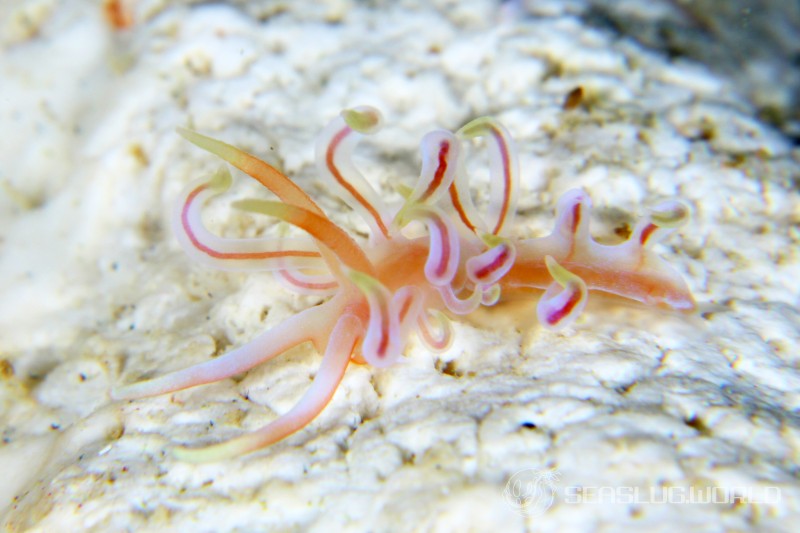
- Location
- Gorilla Chop, Okinawa Island (Motobu and Northern area), Okinawa, Japan
- Date
- 2023/09/05
- Length
- 10mm
- Depth
- 10.0m
- Water temperature
- 27.0℃
Description
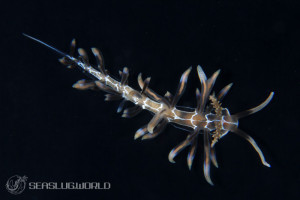
Phyllodesmium karenae is a small, delicate aeolid nudibranch. The living animal is elongate, with the edges of the foot extending just beyond the mantle. The body is predominantly transparent with a bluish hue, so that the viscera and gonad show through the mantle, and there are no opaque markings on the dorsum. The cerata are elongate, smooth and cylindrical, largest toward the middle of the back, with curled, prehensile-looking tips. Inside each ceras the digestive gland is straight and unbranched, a uniform brownish-purple, while the extreme tip is capped by yellow-cream epithelium. The cerata contain no zooxanthellae and lack a cnidosac and nematocysts. The rhinophores are smooth and about two-thirds the length of the oral tentacles, shading from brownish-purple to a yellow-cream tip; the oral tentacles are transparent to faintly bluish at the base with yellow-cream tips. The single preserved type specimen measured about 8 mm.Distribution
The type locality is Matotonggil Rock, Mabini, Batangas Province, southern Luzon Island, Philippines, at 0–17 m. At the time of its description the species was known from southern Luzon and from Indonesia, where it had been figured as Phyllodesmium sp. 7 by Gosliner, Behrens & Valdés (2008).Etymology
The specific epithet karenae honours the senior author Elizabeth Moore's mother, Karen, for her years of support and enthusiasm for the study of marine life.Remarks
Most members of the genus Phyllodesmium feed on octocorals (soft corals) and store symbiotic zooxanthellae in their cerata, functioning as “solar-powered” sea slugs that use the products of photosynthesis. P. karenae is unusual in lacking zooxanthellae, and its prey has not yet been observed; in phylogenetic analysis it falls near the base of the genus. It most closely resembles the transparent Phyllodesmium opalescens but differs in lacking opaque white markings on the dorsum. It has been found among sand and rocks.References
- Phyllodesmium karenae sp. nov., Moore E.J. & Gosliner T.M. (2009). Three new species of Phyllodesmium Ehrenberg (Gastropoda: Nudibranchia: Aeolidoidea), and a revised phylogenetic analysis. Zootaxa. 2201: 30-48. https://doi.org/10.11646/zootaxa.2201.1.6
- イシタニミノウミウシ(新称), 今川郁. (2026). 沖縄のウミウシ: DNA解析による最新の分類図鑑1089種. 誠文堂新光社.
A Kindle field guide by the site author
Kimoto N. (2026). Sea Slugs of Japan & the Indo-Pacific, 2nd Edition.
Kindle Edition
View on Amazon PR (Amazon Associates)Seasonality
Shooting Locations
Loading shooting locations...
Photos of Phyllodesmium karenae

Specimen & DNA
| Observation | Database | COI | 16S | H3 |
|---|---|---|---|---|
| #53975 | BOLD Systems | SSWBP029-25 |
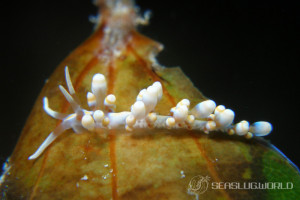
Same Genus Nudibranchs

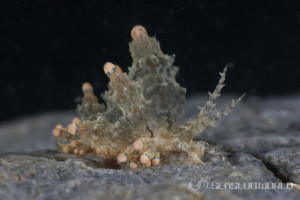
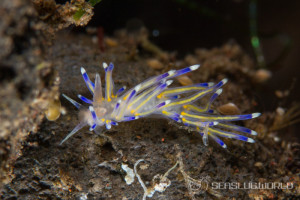
Similar Colors Nudibranchs
Academic Database
Sea slug observation data is available in international marine biodiversity databases.