Phyllodesmium opalescens Rudman, 1991
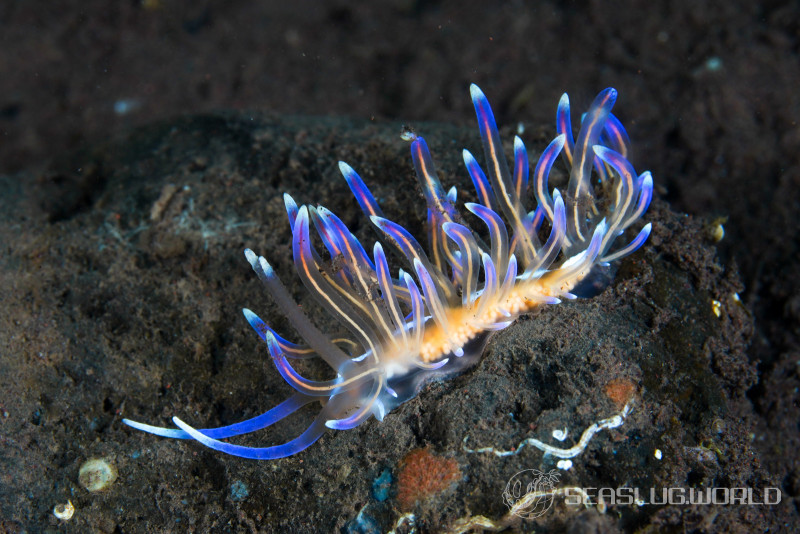
- Location
- Batu Niti, Tulamben, Pulau Bali, Indonesia
- Date
- 2020/02/25
- Length
- 40mm
- Depth
- 10.0m
- Water temperature
- 28.0℃
Description
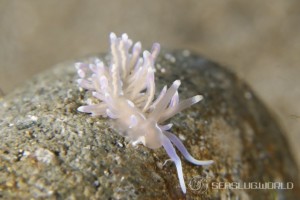
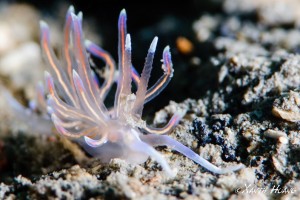
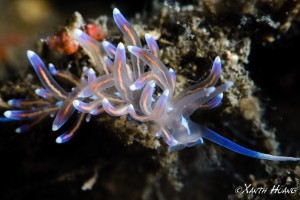
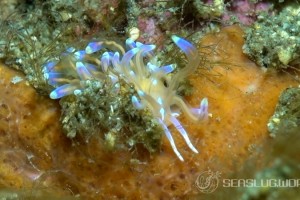
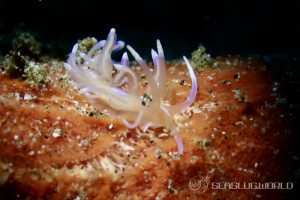
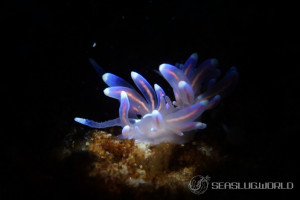
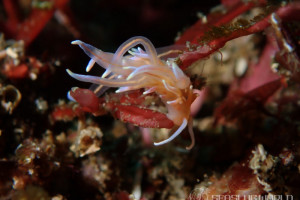
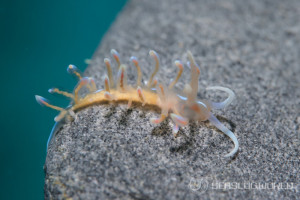
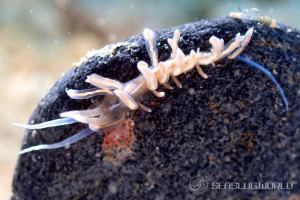
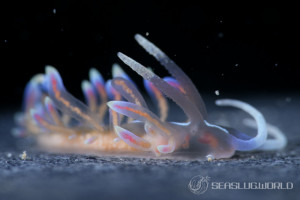
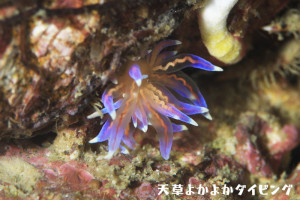
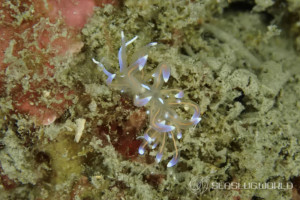
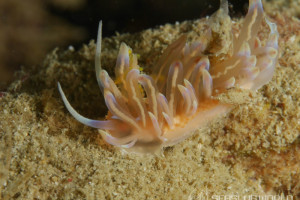
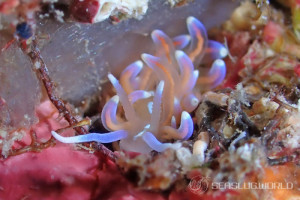
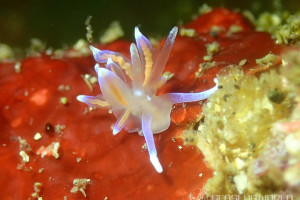
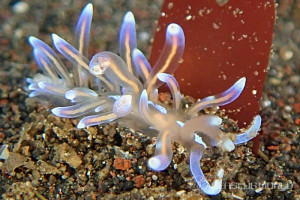
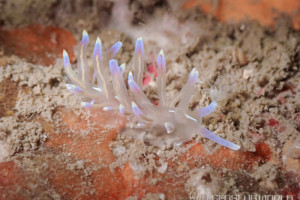
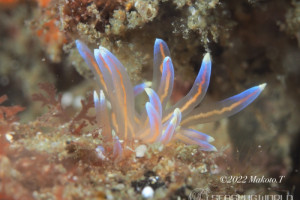
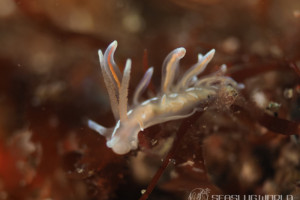
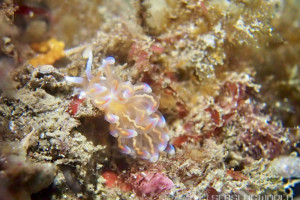
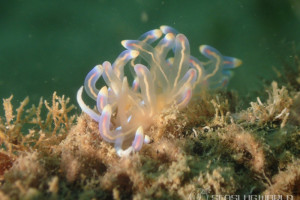
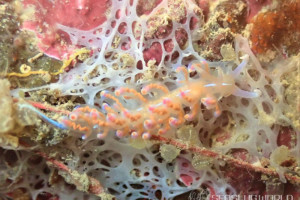
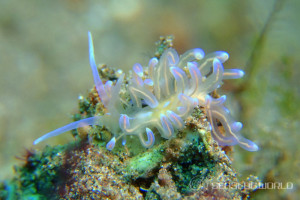
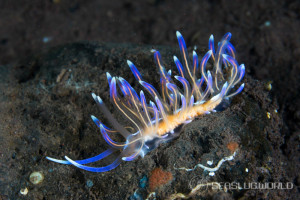
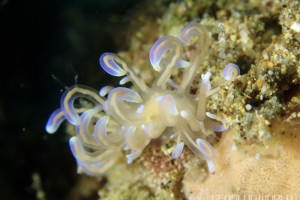
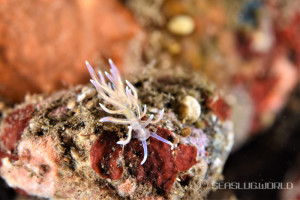
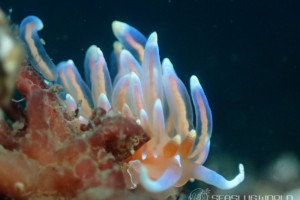
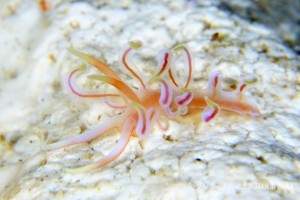
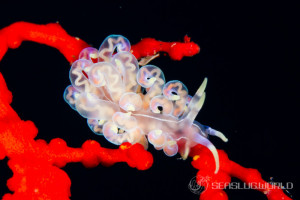
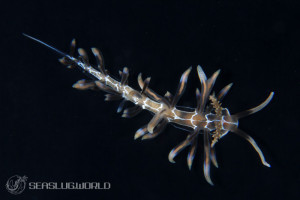
A small Phyllodesmium, with the holotype 13 mm preserved and live specimens 5-17 mm long. The body is relatively broad but elongate, with the posterior foot extending as a long tapering tail. Anterior foot wide with angular corners. Rhinophores are relatively short and smooth, with slight wrinkling near the tip; the long tapering oral tentacles arise some distance back from the head edge. Cerata are cylindrical and arranged in a regular series of arches and rows on each side. Body translucent and almost transparent, with an irregular white border along the leading edge of the foot. A series of opaque white (sometimes bluish) ovate to diamond-shaped patches runs down the dorsal midline — these are the "opalescent" markings that give the species its name; the first appears on the head between the oral tentacles and rhinophores, with further patches set between successive ceratal clusters. The distal third of each oral tentacle is opaque white or cream; the basal two-thirds is translucent with a bright bluish sheen. Rhinophores transparent with an apical milky-yellow cap and a sub-apical bluish band; the cerata are similarly coloured. The bluish glow is structural, produced by light-refracting particles in the epithelium and visible only in living animals.Distribution
Type locality is Gau Tau (north), Mirs Bay, Hong Kong (5-12 m depth, April 1983, collected by B. W. Darvell). The original description rests on collections from Hong Kong only (Kong Chau, Gau Tau, Bluff Head, Round Island, South Ninepin, Tolo Channel, Tap Mun, Long Harbour), all by B. W. Darvell. Subsequent records extend to the Philippines, Korea, and Japan.Etymology
The specific epithet opalescens is Latin for opalescent, referring to the opalescent markings down the dorsal midline of the body (verbatim from the original description).Remarks
A non-zooxanthellate species — unusually for the genus, it harbours no symbiotic zooxanthellae, with histological sections of the gut finding none, suggesting that Xenia (the typical Phyllodesmium prey) is unlikely to be its food source. The digestive gland is restricted to the cerata (as in Phyllodesmium horridum), with a narrow unbranched duct. The diet remains unknown despite long-term efforts by the collector Dr B. W. Darvell. The broken white dorsal midline pattern is shared with Phyllodesmium hyalinum and Phyllodesmium crypticum, but this species is recognisable by its colour pattern and by its radular morphology (broad teeth with a short pointed cusp and many fine long pointed denticles).References
- Phyllodesmium opalescens, Terrence Gosliner, Ángel Valdés and David Behrens. (2015). Nudibranch and Sea Slug Identification Indo-Pacific. New World Pubns Inc.
- オパールミノウミウシ(新称), 中野理枝. (2018). 日本のウミウシ. 文一総合出版.
Featured in this book

Terrence Gosliner, Ángel Valdés and David Behrens. (2018). Nudibranch and Sea Slug Identification Indo-Pacific 2nd Edition. New World Pubns Inc.
New World Publications
This species, Phyllodesmium opalescens, is included in the book.
View on Amazon PR (Amazon Associates)Seasonality
Shooting Locations
Loading shooting locations...
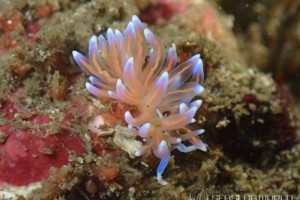
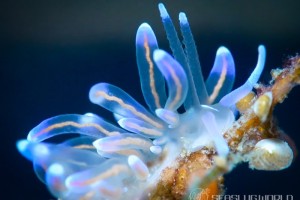
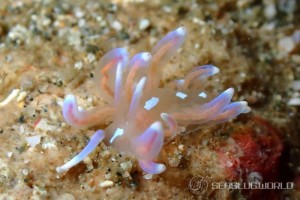
Photos of Phyllodesmium opalescens
Tag:



























Same Genus Nudibranchs

Academic Database
Sea slug observation data is available in international marine biodiversity databases.