Hypselodoris confetti Gosliner & R. F. Johnson, 2018
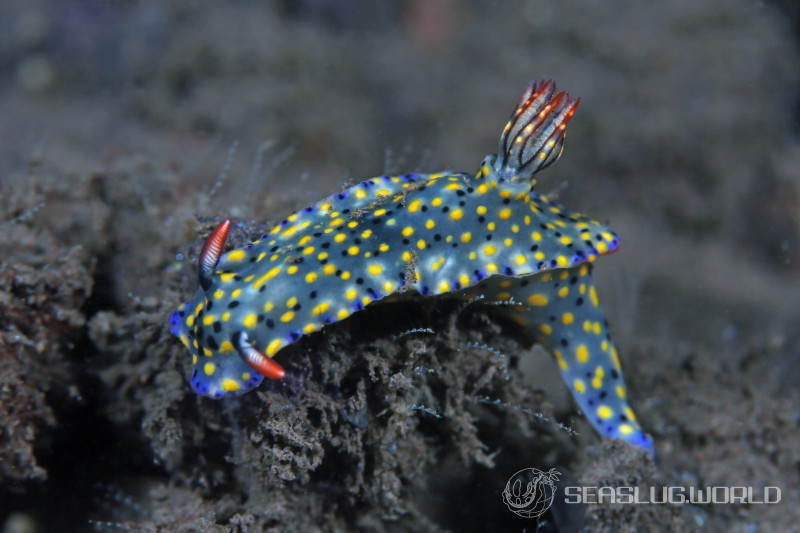
- Location
- Seraya, Tulamben, Pulau Bali, Indonesia
- Date
- 2015/03/06
- Length
- 30mm
- Depth
- 7.0m
- Water temperature
- 29.0℃
Description
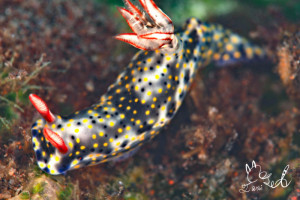
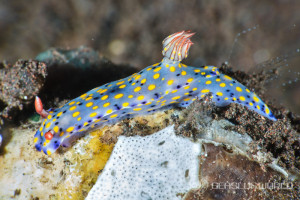
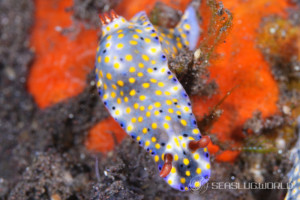
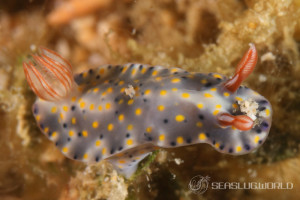
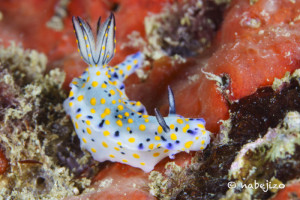
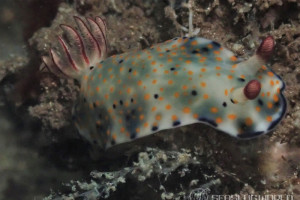
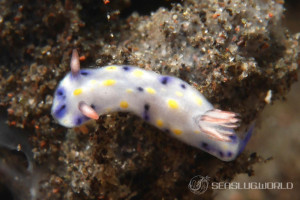
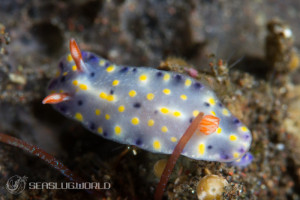
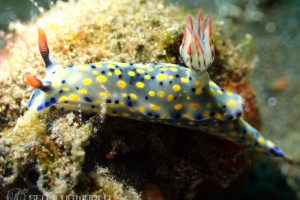
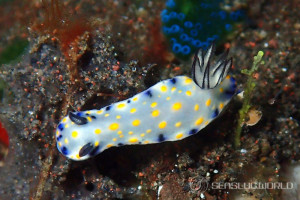
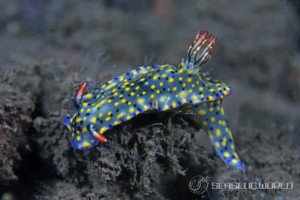
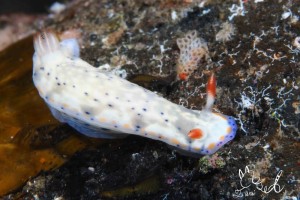
Living animals are moderately large, reaching 35 mm in length. The body is whitish to grey-blue. The notum is ornamented with large yellow spots and smaller dark blue to black spots scattered over the surface, with large blue areas near the mantle margin. Additional spots of the same colours occur on the sides of the body and foot. The gill pocket is slightly elevated. Seven to nine narrow, thin, unipinnate gill branches bear purple lines along the inner and outer edges, and the central portion of the outer face has three to five yellow spots. The base of the rhinophore is deep red-orange and the upper half of the rhinophore is bright red, with about 19 small lamellae.Distribution
Known from Papua New Guinea and the Philippines, and probably also from Hong Kong and Indonesia. Type locality: Siar Island, Madang, Papua New Guinea, 10 m depth.Etymology
Verbatim from the original description (Epstein, Hallas, Johnson, Lopez & Gosliner, 2019, Zoological Journal of the Linnean Society 186: p.133):Hypselodoris confetti comes from the Italian word confetti that means sweets, referring to the multicoloured sweets that were thrown to people at Italian carnivals. In the 19th century it was used to refer to brightly coloured pieces of paper tossed out during parades. This species is marked with bright blue, yellow and black spots resembling confetti.
Remarks
Hypselodoris confetti, together with Hypselodoris roo, has long been misidentified as Hypselodoris kanga. H. kanga is restricted to the Indian Ocean (Tanzania to Thailand), whereas H. confetti is found in the western Pacific. H. kanga has bluish purple lines along the notum and sides of the body that are absent in H. confetti, and H. confetti has additional black spots on the notum and marginal blue spots that are absent in H. kanga. In the molecular phylogeny, H. confetti is sister to a clade that includes Hypselodoris zephyra, H. roo and Hypselodoris nigrolineata.References
- ヒプセロドーリス・カンガ, 殿塚孝昌. (2003). ウミウシガイドブック〈3〉. TBSブリタニカ.
- Hypselodoris confetti sp. nov., Epstein H.E., Hallas J.M., Johnson R.F., Lopez A. & Gosliner T.M. (2019). Reading between the lines: revealing cryptic species diversity and colour patterns in Hypselodoris nudibranchs (Mollusca: Heterobranchia: Chromodorididae). Zoological Journal of the Linnean Society. 186(1): 116-189. https://doi.org/10.1093/zoolinnean/zly048
A Kindle field guide by the site author
Kimoto N. (2026). Sea Slugs of Japan & the Indo-Pacific, 2nd Edition.
Kindle Edition
View on Amazon PR (Amazon Associates)Seasonality
Shooting Locations
Loading shooting locations...
Photos of Hypselodoris confetti






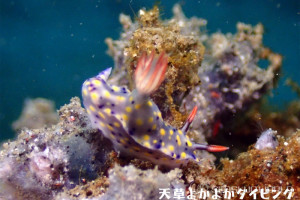

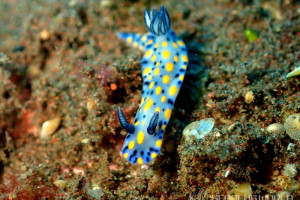

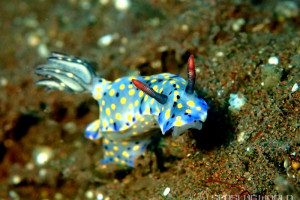
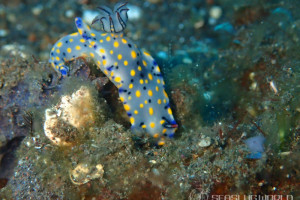




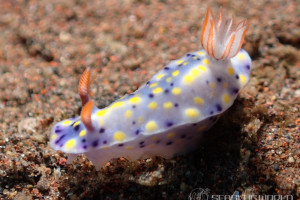

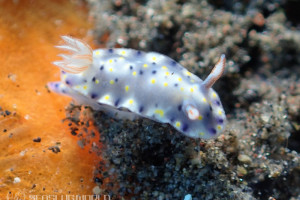
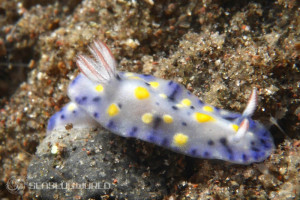
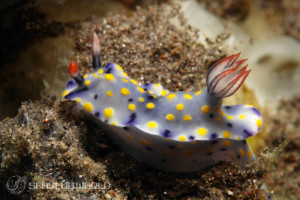

Same Genus Nudibranchs
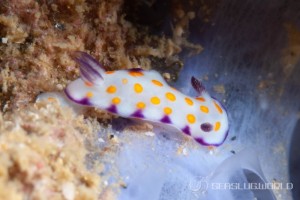
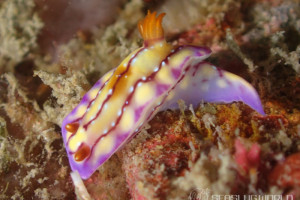
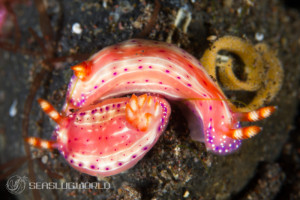

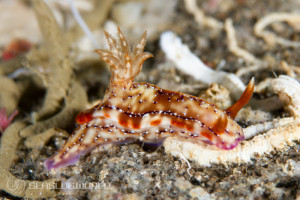
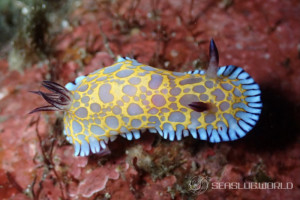
Similar Colors Nudibranchs
Academic Database
Sea slug observation data is available in international marine biodiversity databases.