Unidentia aliciae Korshunova, Mehrotra, Sp. Arnold, Lundin, Picton & Martynov, 2019
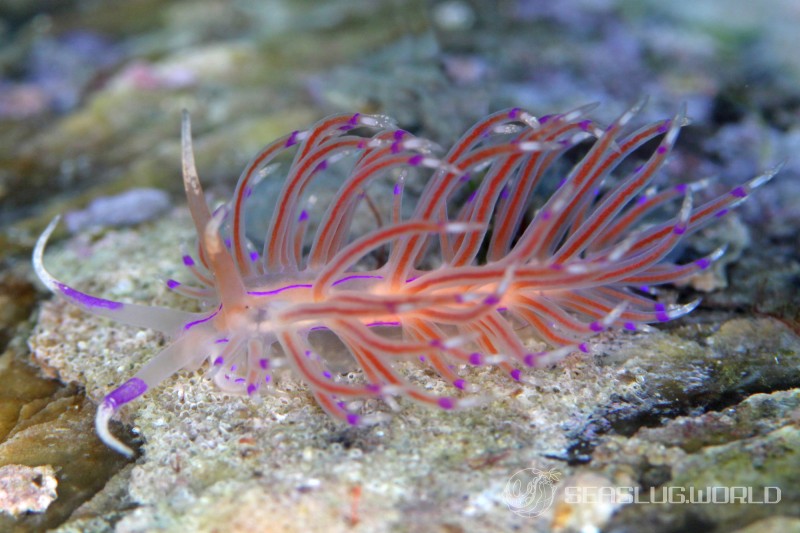
- Location
- Tengan(Kombu), Okinawa Island (East coast), Okinawa, Japan
- Date
- 2024/04/28
- Length
- 14mm
- Depth
- 3.0m
- Water temperature
- 23.0℃
Description
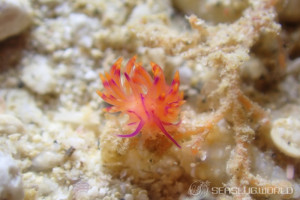
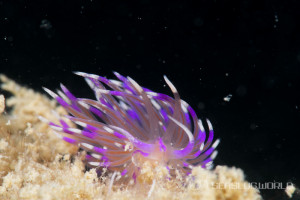
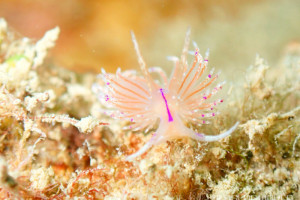
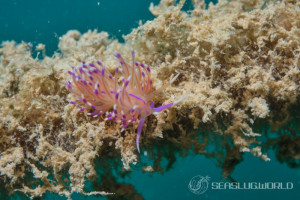
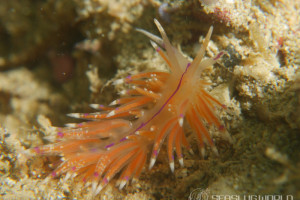
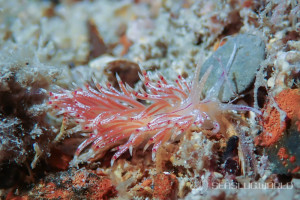
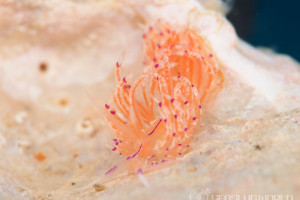
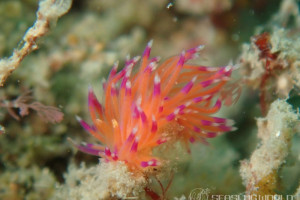
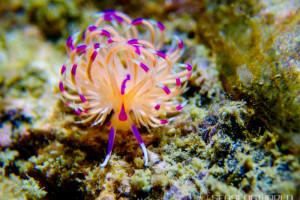
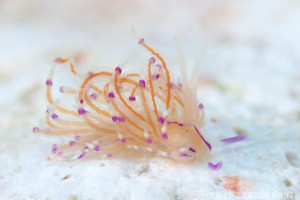
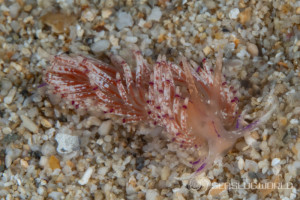
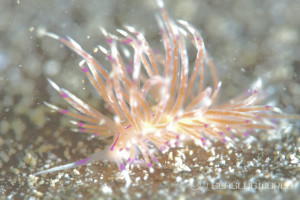
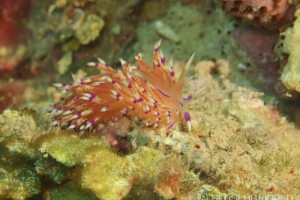
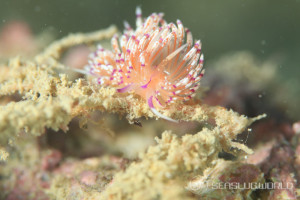
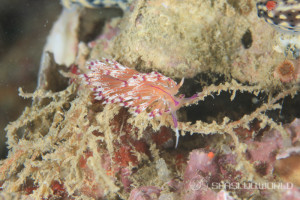
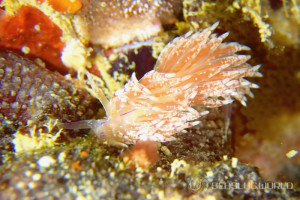
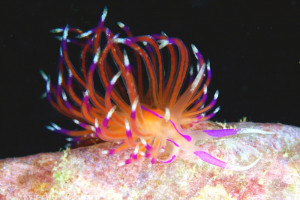
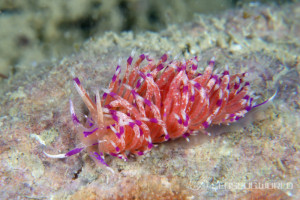
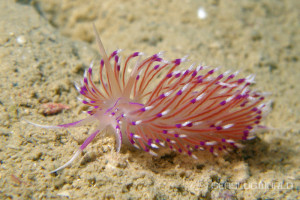
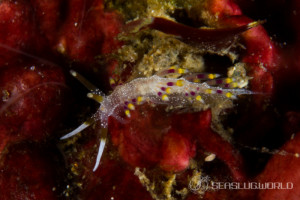
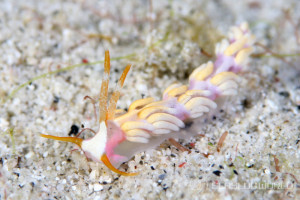
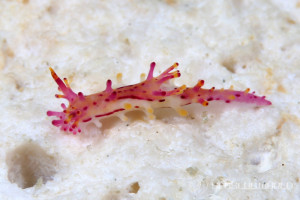
A small elongate sea slug, ~7 mm preserved (larger when alive). Background body colour is translucent creamy-yellowish, with an interrupted thin violet middorsal line. Along the dorsal edges sit 7-9 distinctly elongated elevations bearing clusters of long, finger-shaped to fusiform cerata. Cream-to-pinkish digestive gland branches show through inside the cerata. Each ceras has a conspicuous violet subapical band overlaid by a broad opaque white band, with scattered opaque white specks on the upper half. Rhinophores are smooth, similar in length to the oral tentacles, with a broad opaque white band and a violet band near the tip. Oral tentacles are heavily covered with thick violet pigment in the basal half and dense opaque white pigment in the distal half. Eyes are distinct at the base of each rhinophore.Distribution
Type locality: Chalok Bay artificial reefs, Koh Tao Island, Thailand (10°03′N 99°49′E, 7 m depth). Holotype ZMMU Op-634, 7.2 mm preserved, collected 12 January 2018 by Rahul Mehrotra. Currently known only from Thailand, but likely to occur more widely in the Indo-West Pacific.Etymology
Verbatim from the original description (Korshunova et al. 2019):This species is named in honour of Alicia Hermosillo, who together with Sandra Millen first recognized the uniqueness of the family Unidentiidae.
Remarks
Verbatim from the original description (Korshunova et al. 2019):Considering the ground and ceratal colour, patterns of the radula, number of the seminal receptacles and shape of the penial stylet U. aliciae sp. nov. clearly differs from all three so far known species of the genus, including the type species U. angelvaldesi (see Fig. 3, Discussion and Table 4 for detailed comparison). The minimal p-distance in the phylogenetic analysis was yielded between U. aliciae sp. nov. and Unidentia sp. 1 from Australia (10.76%, Table 3).Minimum pairwise COI p-distances between U. aliciae sp. nov. and other representatives of the genus Unidentia range 10.76-13.88%. Radular formula 30 × 0.1.0, the central tooth with up to 6 distinct denticles; lateral teeth absent. Two proximal seminal receptacles are present, the larger oval one bearing a supplementary chamber at the base; the distal seminal receptaculum is absent. The penial stylet is strongly curved. The animal feeds on the hydrozoan Corydendrium sp. on artificial reef structures near coral reefs at 4-18 m depth; egg masses are spiral cords of pale orange more vibrant in pigmentation than the animal, usually laid directly on the hydroid prey.
References
- ニチロミノウミウシ(新称), 中野理枝. (2018). 日本のウミウシ. 文一総合出版.
- Unidentia aliciae sp. nov., Korshunova T., Mehrotra R., Arnold S., Lundin K., Picton B. & Martynov A. (2019). The formerly enigmatic Unidentiidae in the limelight again: a new species of the genus Unidentia from Thailand (Gastropoda: Nudibranchia). Zootaxa. 4551(5): 556-570. https://doi.org/10.11646/zootaxa.4551.5.4
- オキナワチュラミノウミウシ(新称), 今川郁. (2026). 沖縄のウミウシ: DNA解析による最新の分類図鑑1089種. 誠文堂新光社.
Featured in this book
中野理枝. (2019). 日本のウミウシ. 第二版. 文一総合出版.
文一総合出版
This species, Unidentia aliciae, is included in the book.
View on Amazon PR (Amazon Associates)Seasonality
Shooting Locations
Loading shooting locations...
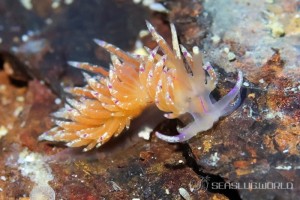
Photos of Unidentia aliciae




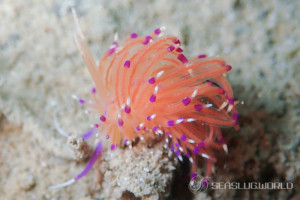

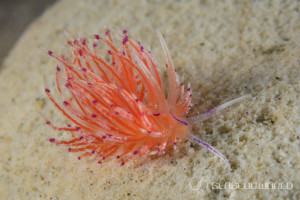

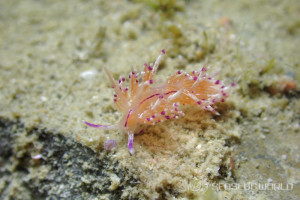
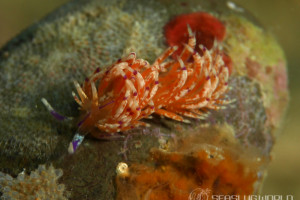











Specimen & DNA
| Observation | Database | COI | 16S | H3 |
|---|---|---|---|---|
| #53946 | BOLD Systems | SSWBP207-25 |
Same Genus Nudibranchs

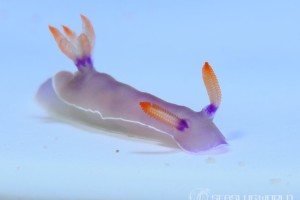
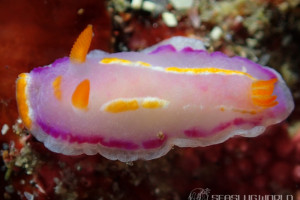
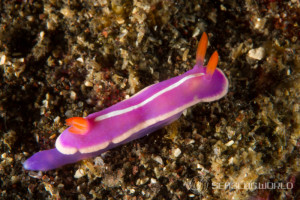
Similar Colors Nudibranchs

Academic Database
Sea slug observation data is available in international marine biodiversity databases.