Thorunna punicea (Rudman, 1995)
Thorunna punicea
No field photograph submitted for this species yet
Have you photographed this species?Description
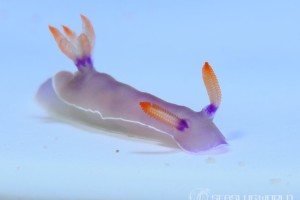
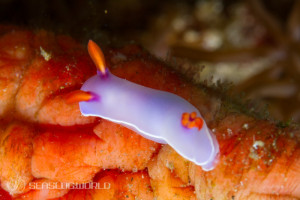
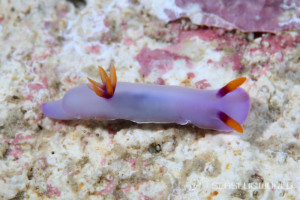
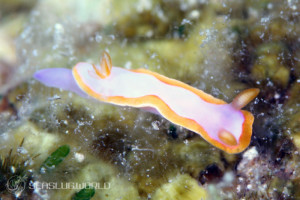
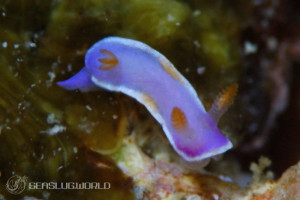
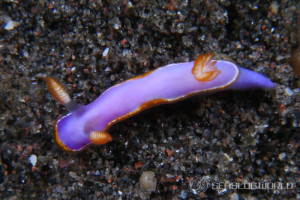
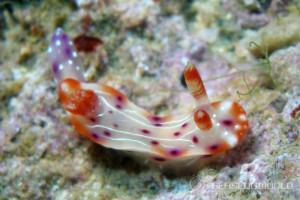
A small chromodorid, holotype 12 mm long alive. The mantle is bluish purple with a pinkish tinge anteriorly between the rhinophores. A thin opaque white line runs right along the mantle edge. The rhinophore stalk is wine-red, the colour diffusing onto the basal part of the club; the rest of the club is yellow, the uppermost few lamellae purplish-red, with a translucent clear knob at the tip. The simple gills are translucent clear with a yellowish tinge; their outer edge is orange on the basal half and red on the upper half, with red coloration along the inner edge of each gill. There are eight simple gills in a circlet open posteriorly around the anus, the two posterior gills smaller than the others. The gills vibrate rhythmically as the animal crawls, and there are no clear signs of mantle glands in either living or preserved specimens.Distribution
Type locality: Channel, Passe de Koumac, 20°40.7'S 164°14.7'E, NW New Caledonia, 66–87 m, dredged in mixed shell sand and mud (holotype 12 mm alive, 24 October 1993, AM C200618). Subsequent records from Madagascar, Papua New Guinea and Japan.Etymology
The specific epithet punicea, from the Latin for "pink", refers to the colour of the mantle.Remarks
Originally described in Hypselodoris, but the derived reproductive characters (thin elongate vaginal duct, large receptaculum seminis) led to its transfer to Thorunna.Rudman also noted that Chromodoris rosans Bergh, 1889 from Mauritius is "almost identical" in colour to this species.
References
- Hypselodoris punicea n.sp., Rudman, W. B. (1995). The Chromodorididae (Opisthobranchia: Mollusca) of the Indo-West Pacific: further species from New Caledonia and the Noumea romeri colour group. Molluscan Research. 16(1): 1-43. https://doi.org/10.1080/13235818.1995.10673663
- Thorunna punicea (Rudman, 1995) comb. nov., Gosliner T.M. & Johnson R.F. (1999). Phylogeny of Hypselodoris (Nudibranchia: Chromodorididae) with a review of the monophyletic clade of Indo-Pacific species, including descriptions of twelve new species. Zoological Journal of the Linnean Society. 125: 1-114. https://doi.org/10.1111/j.1096-3642.1999.tb00585.x
- Thorunna punicea, Johnson R.F. & Gosliner T.M. (2012). Traditional taxonomic groupings mask evolutionary history: a molecular phylogeny and new classification of the chromodorid nudibranchs. PLoS ONE 7(4): e33479.
- ツユクサイロウミウシ(新称), 中野理枝 & 小谷光. (2016). 高知県大月町樫西海域及び一切海域から記録された後鰓類. Kuroshio Biosphere. 12: 21-43.
A Kindle field guide by the site author
Kimoto N. (2026). Sea Slugs of Japan & the Indo-Pacific, 2nd Edition.
Kindle Edition
View on Amazon PR (Amazon Associates)Seasonality
Shooting Locations
Loading shooting locations...
Photos of Thorunna punicea



Same Genus Nudibranchs
Similar Colors Nudibranchs
Academic Database
Sea slug observation data is available in international marine biodiversity databases.