Unidentia nihonrossija Korshunova, Martynov, Bakken, Evertsen, Fletcher, Mudianta, H. Saito, Lundin, Schrödl & Picton, 2017
Description
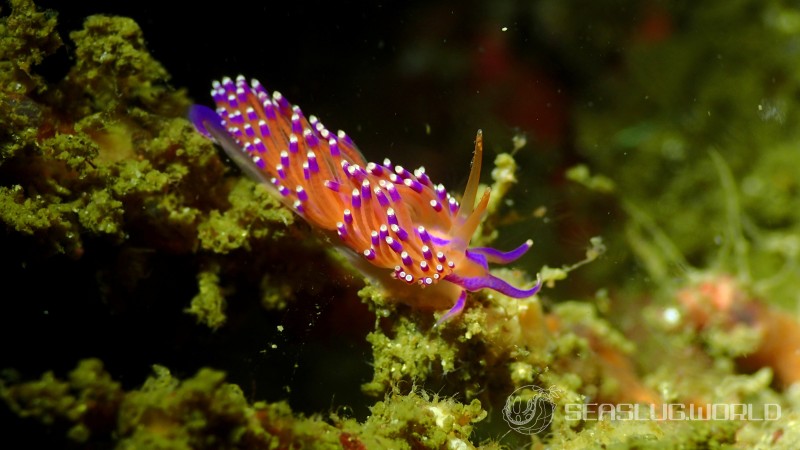
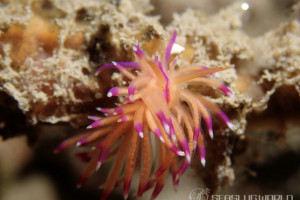
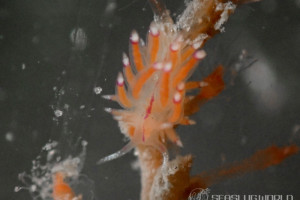
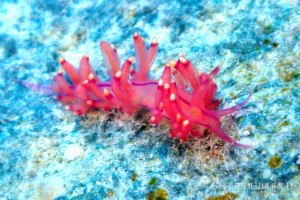
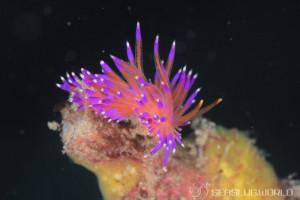
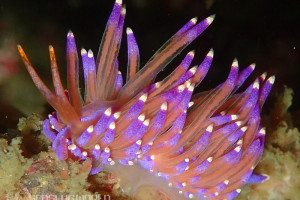
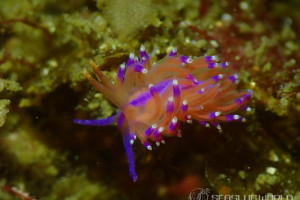
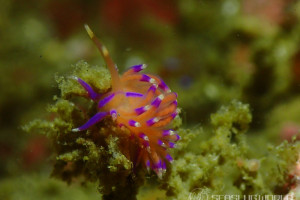
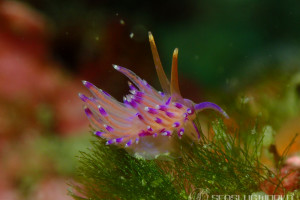
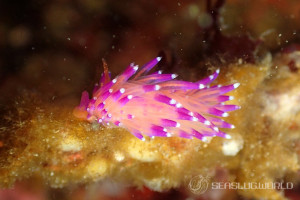
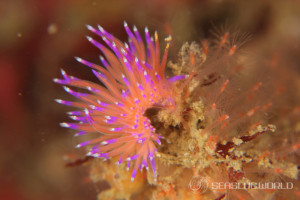
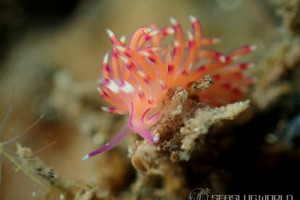
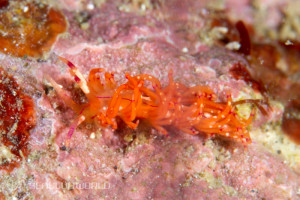
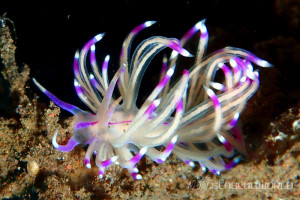
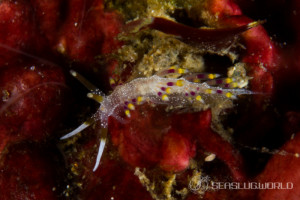
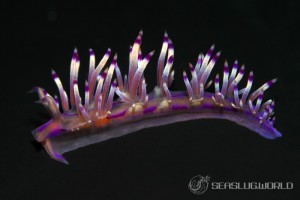
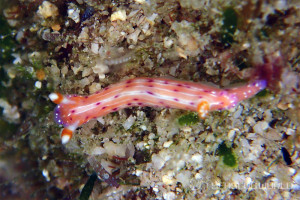
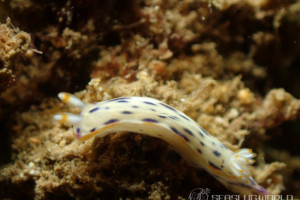
A small elongate sea slug, ~4.5 mm preserved. Background body colour is whitish; a narrow dispersed light violet band runs from the base of the oral tentacles through the middle of the dorsum. Along the dorsal edges sit 5-7 distinctly elongated elevations bearing clusters of finger-shaped to fusiform cerata. Orange to reddish-orange digestive gland branches show distinctly through the cerata wall. Each ceras has a broad opaque white subapical line, and the tip bears further white pigment. Rhinophores are smooth, light violet, and about 1.5-2× shorter than the oral tentacles. The body is narrow with slender foot and elongated anterior foot corners.Distribution
Type locality: Osezaki, Japan (Holotype ZMMU Op-517, 4.5 mm preserved, 10-15 m depth, collected 11 September 2016 by T.A. Korshunova & A.V. Martynov). Pacific side of middle Japan (Honshu).Etymology
Verbatim from the original description (Korshunova et al., 2017, p.58):After nihon (日本" (="にほん"), meaning "Japan" in Japanese) and rossija ("Россия" meaning "Russia" in Russian) in reference to the international group of Russian and Japanese scientists who organised the field work in Japan, during which this unique representative of the family Unidentiidae was collected."
Remarks
Described as a new species together with U. sandramillenae in a 2017 revision ZooKeys 717: 1-139. The radula is uniserial (formula 39 × 0.1.0); the rachidian tooth bears four to seven denticles, lateral teeth absent. The reproductive system is diaulic, with double proximal receptacula seminis, a distal receptaculum seminis, and no supplementary penial gland; the penis bears a hollow stylet. The authors noted in their Remarks that U. nihonrossija "differs substantially both morphologically and by colouration, details of the radular teeth, and presence of double proximal receptacles" from the type species U. angelvaldesi (which possesses a single receptaculum), and "differs both morphologically and according to the molecular phylogenetic analysis" from the tropical Indo-West Pacific U. sandramillenae (p.59). COI p-distance from U. sandramillenae is 14.2%.References
- Flabellina angelvaldesi, Terrence Gosliner, Ángel Valdés and David Behrens. (2015). Nudibranch and Sea Slug Identification Indo-Pacific. New World Pubns Inc.
- Unidentia nihonrossija sp. n., Korshunova T., Martynov A., Bakken T., Evertsen J., Fletcher K., Mudianta I.W., Saito H., Lundin K., Schrödl M. & Picton B. (2017). Polyphyly of the traditional family Flabellinidae affects a major group of Nudibranchia: aeolidacean taxonomic reassessment with descriptions of several new families, genera, and species (Mollusca, Gastropoda). ZooKeys. 717: 1-139. https://doi.org/10.3897/zookeys.717.21885
- ニチロミノウミウシ(新称), 中野理枝. (2018). 日本のウミウシ. 文一総合出版.
Featured in this book
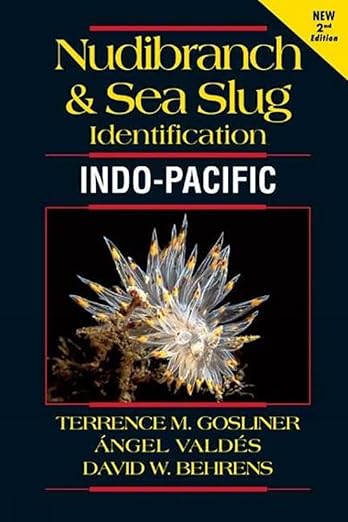
Terrence Gosliner, Ángel Valdés and David Behrens. (2018). Nudibranch and Sea Slug Identification Indo-Pacific 2nd Edition. New World Pubns Inc.
New World Publications
This species, Unidentia nihonrossija, is included in the book.
View on Amazon PR (Amazon Associates)Seasonality
Shooting Locations
Loading shooting locations...
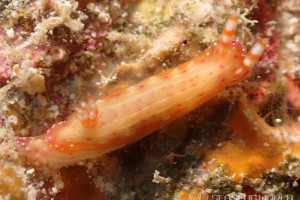
Photos of Unidentia nihonrossija





Same Genus Nudibranchs

Similar Colors Nudibranchs
Academic Database
Sea slug observation data is available in international marine biodiversity databases.