Unidentia angelvaldesi Millen & Hermosillo, 2012
Unidentia angelvaldesi
No field photograph submitted for this species yet
Have you photographed this species?Description
A small, slender aeolid; preserved specimens up to about 9.5 mm long, living animals up to 20 mm. Rhinophores and oral tentacles are equal in length and smooth. The cerata are arranged in single, raised rows that slope posteriorly: 4-6 precardiac rows and 5-8 postcardiac rows, with up to 12 cerata per row. Cerata are slender and cylindrical, up to 7 mm long. The foot is bilabiate with propodial tentacles about 1.5 mm long. The anus is acleioproctic, opening on a tall, slender papilla within the interhepatic space.Colouration is variable, with two main forms.
- Darker form: ground colour translucent with a faint reddish tint, the orange-red ovotestis showing through. Three purple longitudinal lines run along the body — one mid-dorsal and two below the cerata — meeting behind the cerata to form a broad strip down the trailing portion of the foot. Opaque white blotches occur between the ceratal rows and on the cephalic area.
- Pale form: body white to white with a purplish tint, retaining the same purple-line pattern. Oral tentacles are clear with the distal third tinged purple; rhinophores show opaque white blotches followed by a purple ring and a clear tip; cerata have opaque white cores and a thin purple ring below the cnidosacs.
Distribution
Type locality: Bahía de Banderas (Los Arcos, El Bajo del Cristo), Jalisco, Mexico. The original 2012 description treated the species as a wide-ranging Indo-West and tropical eastern Pacific taxon, with records from Isla Isabel (Nayarit, Mexico) to Isla de Coiba (Panama) in the eastern Pacific, plus Suruga Bay and Okinawa (Japan), Bali, Komodo (Indonesia) and the Philippines. A 2017 revision subsequently separated the Indo-West Pacific populations as Unidentia nihonrossija, restricting Unidentia angelvaldesi to the tropical eastern Pacific (Mexico to Panama).Etymology
The specific epithet angelvaldesi honours Dr. Ángel Valdés, a Spanish-born malacologist, for his contributions to opisthobranch biology, ecology and taxonomy.Remarks
The species has long been confused with the externally similar Flabellina rubrolineata (O'Donoghue, 1929). It is clearly distinguished by its smooth (rather than papillate) rhinophores, together with anatomical differences in anal position and radular structure. Because of this character combination, Millen & Hermosillo 2012 erected the monotypic genus Unidentia for it.It feeds on hydroids of the genus Corydendrium; in the eastern Pacific the host is the orange Corydendrium parasiticum, on which the slug is highly cryptic. The egg mass consists of 5-6 orange, slightly flattened coils laid in a wavy string along the host hydroid.
References
- Unidentia angelvaldesi sp. nov., Millen S.V. & Hermosillo A. (2012). Three New Species of Aeolid Nudibranchs (Opisthobranchia) from the Pacific Coast of Mexico, Panama, and the Indopacific, with a Redescription and Redesignation of a Fourth Species. The Veliger. 51(3): 145-164.
- Flabellina angelvaldesi, Terrence Gosliner, Ángel Valdés and David Behrens. (2015). Nudibranch and Sea Slug Identification Indo-Pacific. New World Pubns Inc.
- アンヘルミノウミウシ(新称), 中野理枝, 朝倉知子, 池田紫, 石川雅教, 今本淳, 岩瀬南美, 西田和記, 堀江諒, 山田久子 & 渡井久美. (2017). 奄美大島北部海域における後鰓類相の調査報告. Kuroshio Biosphere. 13: 1-18 + 6 pls.
- Unidentia angelvaldesi (= partial: Indo-Pacific specimens reassigned to U. nihonrossija), Korshunova T., Martynov A., Bakken T., Evertsen J., Fletcher K., Mudianta I.W., Saito H., Lundin K., Schrödl M. & Picton B. (2017). Polyphyly of the traditional family Flabellinidae affects a major group of Nudibranchia: aeolidacean taxonomic reassessment with descriptions of several new families, genera, and species (Mollusca, Gastropoda). ZooKeys. 717: 1-139. https://doi.org/10.3897/zookeys.717.21885
Featured in this book
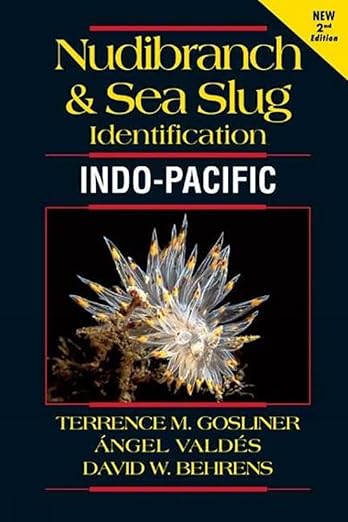
Terrence Gosliner, Ángel Valdés and David Behrens. (2018). Nudibranch and Sea Slug Identification Indo-Pacific 2nd Edition. New World Pubns Inc.
New World Publications
This species, Unidentia angelvaldesi, is included in the book.
View on Amazon PR (Amazon Associates)Seasonality
Shooting Locations
Loading shooting locations...
Same Genus Nudibranchs
Similar Colors Nudibranchs

Academic Database
Sea slug observation data is available in international marine biodiversity databases.