Rostanga arbutus (Angas, 1864)
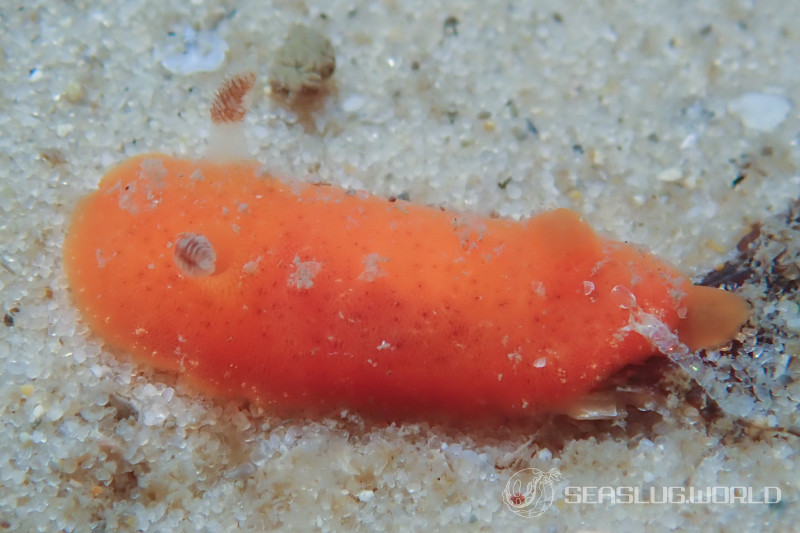
- Location
- Flypoint, Nelson Bay, New South Wales, Australia
- Date
- 2022/12/05
- Length
- 14mm
- Depth
- 8.0m
- Water temperature
- 19.0℃
Description
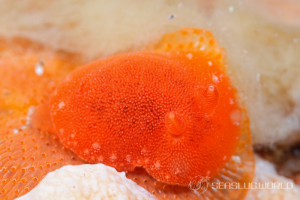
A small to medium-sized dorid reaching about 25 mm in length, with an oval to elliptical, somewhat dome-shaped body. The mantle is orange-red and is densely covered with minute spicular caryophyllidia, which appear as fine, colourless to pale yellow granulations across the entire dorsum. Scattered brown to dark-brown specks and patches occur over the orange-red ground colour, and white pigmentation may appear between the rhinophores. A submarginal row of large whitish mantle glands runs around the mantle margin, with smaller white specks usually surrounding each gland.The rhinophores are orange-red and lamellate, and the gill consists of 8-10 simply pinnate, orange branchial leaves arranged in a circle on the posterior dorsum.
Distribution
Type locality: Port Jackson (Sydney Harbour), New South Wales, Australia. The species is essentially a temperate Australian endemic, recorded mainly along the south-eastern coast (New South Wales, Victoria, Tasmania), with further records from northern New Zealand and from deeper waters off South Australia.Etymology
The specific epithet arbutus refers to the strawberry tree (Arbutus unedo), a Mediterranean shrub whose orange-red fruits resemble the colour of this slug's mantle.Remarks
Originally described in 1864 by Angas from Port Jackson material as Doris arbutus; in line with the broader generic revision of the Doridoidea, the species was subsequently transferred to Rostanga Bergh, 1879. The parentheses in the current author citation reflect this generic transfer.Like other species of Rostanga, it is a sponge-feeder, primarily on red to orange demosponges of the genus Clathria and related forms. Egg masses are often laid directly on or beside the host sponge. In contrast to many congeners, Rostanga arbutus exhibits direct development, hatching as crawling juveniles without a free-swimming veliger stage (Forrest, 1986). Garovoy, Valdés & Gosliner 2001 included it in their phylogeny of the genus, comparing its morphology with congeneric species.
References
- Doris arbutus Angas, 1864 — original description, Angas G.F. (1864). Description d'espèces nouvelles appartenant à plusieurs genres de Mollusques Nudibranches des environs de Port-Jackson (Nouvelle-Galles du Sud), accompagnée de dessins faits d'après nature. Journal de Conchyliologie, 12(1): 43-70, pl. IV.
- Rostanga arbutus (Angas), Allan J.K. (1947). Nudibranchia from the Clarence River Heads, north coast, New South Wales. Records of the Australian Museum, 21(8): 433-463, pls. xli-xliii and map. https://doi.org/10.3853/j.0067-1975.21.1947.561
- Rostanga arbutus (Angas, 1864), Garovoy J.B., Valdés Á. & Gosliner T.M. (2001). Phylogeny of the genus Rostanga (Nudibranchia), with descriptions of three new species from South Africa. Journal of Molluscan Studies. 67(2): 131-144.
- 高岡生物研究会. (2002). 日本海のウミウシ. 第2版.
A Kindle field guide by the site author
Kimoto N. (2026). Sea Slugs of Japan & the Indo-Pacific, 2nd Edition.
Kindle Edition
View on Amazon PR (Amazon Associates)Seasonality
Shooting Locations
Loading shooting locations...
Photos of Rostanga arbutus

Same Genus Nudibranchs
Similar Colors Nudibranchs
Academic Database
Sea slug observation data is available in international marine biodiversity databases.