Antiopella cristata (Delle Chiaje, 1841)
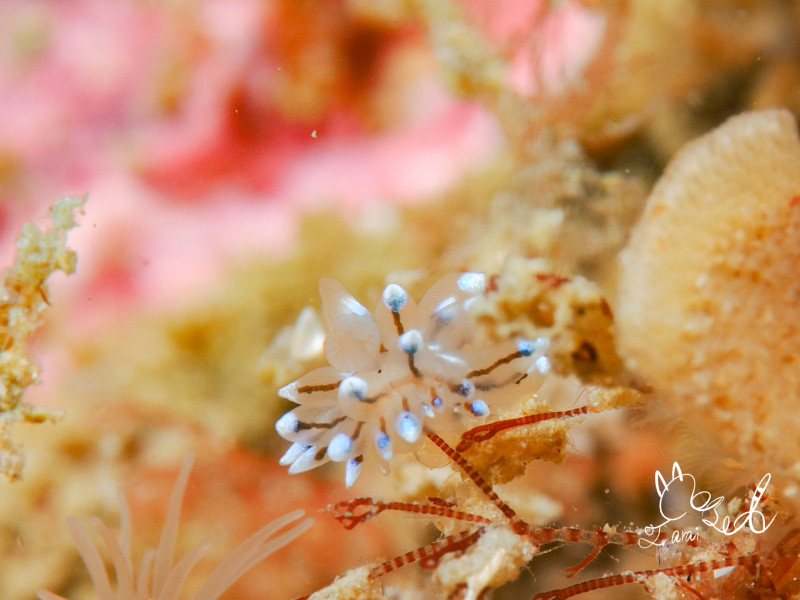
- Location
- NORRA ÄRHOLMEN, West Coast of Sweden, Sweden
- Date
- 2025/06/28
- Length
- 5mm
- Depth
- 20.0m
- Water temperature
- 14.5℃
Description
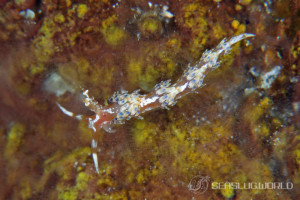
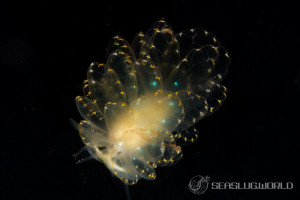
A medium to large aeolidiform nudibranch reaching about 70–80 mm in length. The body bears numerous closely-packed cerata that are smooth-surfaced and fusiform, swelling globosely in the middle. The tips of the cerata are bluish white and produce an iridescent sheen depending on the angle of view, a feature reflected in the English vernacular name "crystal sea slug". Within each ceras the digestive gland branches and extends toward the apex, dividing further within the apical region. A well-developed convoluted caruncle is present between the rhinophores. The masticatory border of the jaws is finely denticulate, a key diagnostic character of the genus. The reproductive system is androdiaulic, with an elongate, semi-serial receptaculum seminis on a long duct and a small but distinct bursa copulatrix.Distribution
Eastern Atlantic Ocean and the Mediterranean Sea.Etymology
The specific epithet cristata is Latin for "crested", referring to the dense cover of cerata along the dorsum that resembles a crest.Remarks
Originally described as Eolis cristata Delle Chiaje, 1841. Alder & Hancock 1848 erected the genus Antiopa with A. splendida Alder & Hancock, 1848 as the type species, but Antiopa Alder & Hancock, 1848 was preoccupied by Antiopa Meigen, 1800 (a dipteran), so Hoyle 1902 proposed Antiopella as a replacement name. Gosliner 1981 subsequently synonymised Antiopella with Janolus Bergh, 1884 on the basis of intermediate morphological characters, and this species was treated as Janolus cristatus for many years.A 2019 revision reinstated Antiopella as a valid genus distinct from Janolus, based on combined molecular phylogenetics and a morphological reassessment, and accordingly transferred this species to Antiopella cristata. Antiopella cristata is the type species of the resurrected genus by replacement.
The reinstated Antiopella contains species with smooth cerata, opaque white or yellow ceratal tips, a digestive gland duct that extends unbranched to the tip of each ceras, and a reproductive system with a long-ducted, semi-serial receptaculum seminis and a distinct bursa copulatrix. Janolus in the strict sense, by contrast, has tuberculate or papillate cerata and denticulate radular teeth. Antiopella is distributed in the Atlantic and eastern Pacific oceans, in contrast to the largely Indo-Pacific distribution of Janolus sensu stricto. Currently included species are Antiopella cristata (type), Antiopella barbarensis (Cooper, 1863), Antiopella longidentata (Gosliner, 1981), Antiopella capensis (Bergh, 1907) and Antiopella fusca (O'Donoghue, 1924); Pola et al. 2019 also suggest that Janolus gelidus Millen, 2016 should be placed in Antiopella.
Earlier names and combinations include Eolis cristata Delle Chiaje, 1841 (original combination), Janus spinolae Vérany, 1845 (synonym), Antiopa splendida Alder & Hancock, 1848 (synonym), Eolidia cristata (Delle Chiaje, 1841) (unaccepted combination) and Janolus cristatus (Delle Chiaje, 1841) (combination used prior to Pola et al., 2019).
References
- Antiopella cristata (genus context, Antiopa = Antiopella), Alder J. & Hancock A. (1848). Additions to the British species of Nudibranchiate Mollusca. Annals and Magazine of Natural History. (2)1(3): 189-192.
- Antiopella cristata, Pola M., Hallas J.M. & Gosliner T.M. (2019). Welcome back Janolidae and Antiopella : Improving the understanding of Janolidae and Madrellidae (Cladobranchia, Heterobranchia) with description of four new species. Journal of Zoological Systematics and Evolutionary Research. 57(2): 345-368. https://doi.org/10.1111/jzs.12257
A Kindle field guide by the site author
Kimoto N. (2026). Sea Slugs of Japan & the Indo-Pacific, 2nd Edition.
Kindle Edition
View on Amazon PR (Amazon Associates)Seasonality
Shooting Locations
Loading shooting locations...
Photos of Antiopella cristata

Same Genus Nudibranchs
Similar Colors Nudibranchs




Academic Database
Sea slug observation data is available in international marine biodiversity databases.