Austraeolis ornata (Angas, 1864)
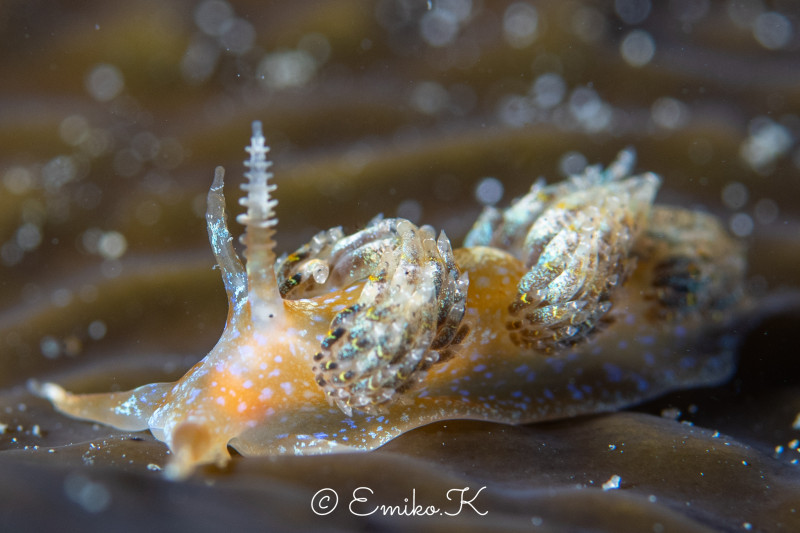
- Location
- Chowder Bay, New South Wales, Australia
- Date
- 2020/06/23
- Length
- 20mm
- Depth
- 5.0m
- Water temperature
- 17.0℃
Description
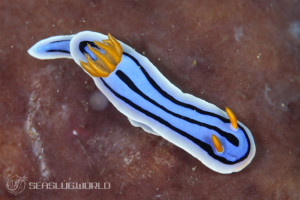
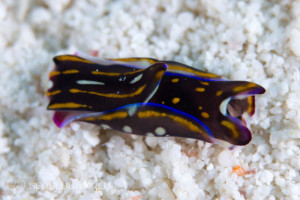
A medium-sized aeolid reaching about 28 mm in body length (including cerata) and 7 mm in width. The body is elongate, the ground colour orange in life with scattered small blue spots and larger lemon-yellow spots. The cerata are arranged in 9–10 well-separated bushy groups along each side of the body, each group fairly large and bulky. The cerata are olive-coloured with numerous black spots on one side and pale-golden spots running in a continuous series to the posterior end on the other. The foot tapers posteriorly with two broad pointed angular whitish processes anteriorly. The four tentacles (oral and rhinophoral) are all the colour of the body, with the rhinophores clavate and annulate. Angas's type was 28 mm long and 7 mm wide. As a defensive reaction the species can autotomise its cerata; the detached cerata continue to move actively in water for about an hour, and Angas observed that "the animal itself sometimes eats them up".Distribution
South-eastern Australia (Tasman Sea). Type locality: Port-Jackson, New South Wales, based on specimens collected by Angas.Etymology
The specific epithet ornata is the feminine of Latin ornatus ("decorated, adorned"), in reference to the species' showy orange ground colour ornamented with blue, black and gold-yellow spots.Remarks
Originally placed by Angas in Flabellina. Later transferred to Austraeolis; the parentheses in the author citation reflect this generic transfer. The autotomy described by Angas is typical of this group; Crosse cited similar cases discussed in the Journal de Conchyliologie 1860, vol. VIII, p.225 in a footnote.References
A Kindle field guide by the site author
Kimoto N. (2026). Sea Slugs of Japan & the Indo-Pacific, 2nd Edition.
Kindle Edition
View on Amazon PR (Amazon Associates)Seasonality
Shooting Locations
Loading shooting locations...
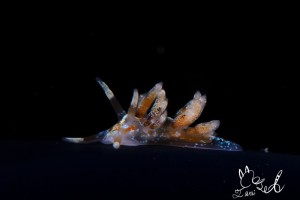
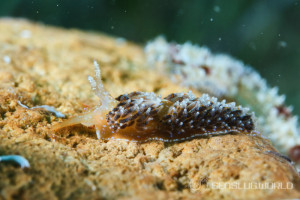
Photos of Austraeolis ornata


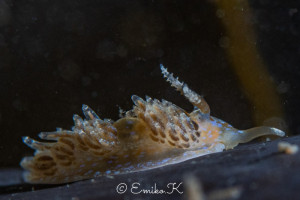

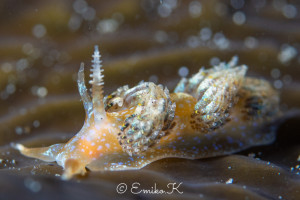
Same Genus Nudibranchs
Similar Colors Nudibranchs
Academic Database
Sea slug observation data is available in international marine biodiversity databases.